Error Codes



How to remove bottom grill from KitchenAid refrigerator?
To remove the bottom grill (toe kick) on your KitchenAid KBLC36MHS01 built-in refrigerator, pull the toe kick straight forward to release the retaining clips, then lift it away from the lower frame. Reinstall by aligning it and snapping it back into place.
Before you start
- Unplug the refrigerator or switch off power at the breaker (recommended for safety).
- Remove items near the base so you have room to pull straight out.
- Use a towel or cardboard to protect flooring and stainless panels.
Steps to remove the bottom grill (toe kick)
- Stand centered in front of the toe kick.
- Grip the grill at both ends (or at the hand-hold openings, if present).
- Pull straight forward with steady pressure to pop it off the clips.
- If one side releases first, keep the grill level and work the other side free.
If it will not come off
- Check for screws at the ends or along the bottom edge; some installations use screws in addition to clips.
- Look for a buildup of debris along the bottom edge; vacuum and try again.
- If the grill is rubbing the floor, slightly lift while pulling forward.
Common causes and quick fixes
| What you notice | Likely cause | What to do |
|---|---|---|
| Grill feels stuck on one side | Clip not releasing evenly | Pull from both ends at the same time |
| Grill will not budge | Hidden screws | Inspect ends and underside for fasteners |
| Grill comes off but will not snap back | Misalignment or bent clip area | Re-align to the lower frame and press evenly |
Why it matters
The toe kick protects the lower components and helps airflow at the base. Removing it correctly prevents broken clips and makes it easier to clean condenser-area dust that can affect cooling efficiency.
Related DIY help
For general refrigerator DIY guidance and what repairs are realistic to do yourself, use can i fix my own fridge.
Last updated: February 2026
Are bottom mount fridges better?
Bottom-mount refrigerators like the KitchenAid KBLC36MHS01 are better for many kitchens because the fresh-food section sits at eye and waist level, so everyday items are easier to reach while the freezer stays in a lower drawer. They are a strong choice for frequent cooking and meal prep.
What “better” usually means with a bottom-mount design
- More ergonomic access to fresh foods (less bending for milk, produce, leftovers)
- Wider, drawer-style freezer storage that can be easier to organize than a top freezer
- Good visibility for refrigerated items, which helps reduce forgotten food
- Often quieter in daily use when airflow is unobstructed and doors seal well
When a bottom-mount might not be the best fit
Bottom-mount is not automatically the best for every household. Consider these common tradeoffs:
- You may bend more for frozen foods if you use the freezer most often
- Freezer drawers can feel heavier when fully loaded
- Built-in models can have tighter installation clearances, so door swing and leveling matter
Quick comparison
| Feature | Bottom-mount refrigerator | Top-freezer refrigerator |
|---|---|---|
| Fresh-food access | Best (most-used items up high) | Good, but lower shelves require more bending |
| Freezer access | Drawer, lower position | Eye-level freezer access |
| Organization | Strong for fresh foods; freezer bins help | Simple layout; fewer drawers |
| Best for | Frequent cooking, fresh-food heavy households | Freezer-heavy use, budget-focused setups |
Why it matters
Most households open the refrigerator section far more than the freezer. With a bottom-mount layout, we keep the most-used zone (fresh food) in the most comfortable reach, which improves day-to-day convenience and can help you keep temperatures steadier by reducing door-open time.
Keep performance “better” over time
A bottom-mount only stays great if airflow and sealing stay strong:
- Keep vents clear and avoid overpacking shelves
- If cooling seems uneven, use our guide: how to fix your evaporator cooling fan
- If you notice warm spots or noisy airflow, inspect the evaporator fan area; parts like the refrigerator evaporator fan motor WP4389155 and refrigerator evaporator fan blade WP2169142 are common service items
Last updated: February 2026
Why is water collecting in the bottom of my KitchenAid refrigerator?
Water collecting in the bottom of your KitchenAid KBLC36MHS01 built-in refrigerator is usually caused by a clogged or frozen defrost drain, which makes defrost water overflow into the fresh food compartment instead of draining to the pan underneath.
Most common causes
- Frozen defrost drain from heavy frost or a recent door-left-open event
- Clogged drain hole or drain tube from food debris, sludge, or ice
- Drain pan shifted or cracked so water does not stay contained
- Door not sealing well, creating excess frost that overwhelms the drain
What to check and do (safe DIY steps)
- Unplug the refrigerator (or switch off power) before removing any panels.
- Look for ice at the back/bottom inside the fresh food section; that points to a frozen drain.
- Melt the ice and clear the drain:
- Use warm water (a turkey baster works well) to flush the drain hole.
- Use a flexible plastic tube or pipe cleaner to loosen debris.
- Repeat until water flows freely.
- Inspect the drain pan underneath for overflow, cracks, or misalignment.
- Check door closing and sealing; a poor seal creates extra frost and repeat drain freezes.
Parts that can be involved
If you confirm the drain pan is damaged or not heating/evaporating water correctly, these model-matched parts can be relevant:
| Symptom you see | What it often points to | Example part for KBLC36MHS01 |
|---|---|---|
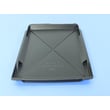
| Water under the unit, pan looks damaged | Cracked or warped drain pan | Refrigerator drain pan WP2001264 |
| Water in bottom of fridge plus recurring ice sheet | Drain freezing or restricted airflow | Refrigerator evaporator fan motor WP4389155 |
| Water seems to overflow during defrost cycles | Drain pan heater issue (if equipped) or pan problem | Refrigerator heater drain pan WP2004545 |
Why it matters
Standing water can lead to odors, ice buildup, and temperature swings that stress the evaporator fan and cooling system. Clearing the drain early helps prevent repeat leaks and food spoilage.
For a step-by-step walkthrough on leak causes and cleanup, use our guide: how to get rid of refrigerator puddles.
Last updated: February 2026
What is the most common problem with KitchenAid refrigerators?
The most common KitchenAid refrigerator problem we see is cooling trouble (warm fridge, warm freezer, or temperatures that swing). On the KitchenAid KBLC36MHS01 built-in refrigerator, the fastest checks are airflow (evaporator fan), defrost performance, and door sealing because those issues create the most noticeable temperature complaints.
Most common symptoms and what they usually point to
- Fridge warms up but freezer is closer to normal: restricted airflow or an evaporator fan issue
- Both sections warm and you hear clicking: compressor start device problem (start relay) or compressor issue
- Frost buildup on the back wall or poor airflow: defrost system problem (timer, heater, or control)
- No ice or small/odd cubes: ice maker or water supply issue
- Water under the unit or inside the fresh food section: drain or drain pan issue
Quick troubleshooting steps (safe, no tools)
- Confirm vents are not blocked by food packages.
- Set temps to typical targets: 37°F fresh food and 0°F freezer.
- Listen for the evaporator fan when the doors are closed (it should run much of the time).
- Check door closing and gasket contact all the way around.
- If ice maker performance is the complaint, verify the shutoff arm is down and the water supply is on.
Common parts tied to these problems (examples)
| Problem area | What you may notice | Example part on this model page |
|---|---|---|
| Evaporator airflow | Warm temps, weak airflow | Refrigerator evaporator fan motor WP4389155 |
| Compressor starting | Clicking, intermittent cooling | Start relay WP2262181 |
| Ice production | No ice or irregular cubes | Ice maker assembly - refrigerator ice maker by whirlpool 4317943 |
| Defrost timing | Frost buildup, warming | Defrost timer WP2183400 |
Why it matters
Cooling problems can spoil food quickly and also force the compressor to run longer than normal. Catching airflow, defrost, or door-seal issues early helps restore stable temperatures and reduces strain on major sealed-system components.
For step-by-step help on a very common cooling culprit, use our guide: how to fix your evaporator cooling fan.
Last updated: February 2026