Owner’s manual
 Error Codes



How to tell cubic feet of Kenmore refrigerator by model number?
For Kenmore Elite refrigerator model 79579043313, the most reliable way to get cubic feet is to look up the capacity in the specifications section of the 79579043313 owner's manual or on the refrigerator’s identification label inside the fresh food compartment. This avoids guessing based on model-number patterns.
Fast ways to find cubic feet (best to least)
- Check the specs in the 79579043313 owner's manual (capacity is typically listed with other key specs).
- Find the identification label on the interior liner of the refrigerator compartment; record the model and serial number and look for capacity information.
- Measure and estimate only if you cannot access specs (useful for planning, not for exact capacity).
- Compare to similar Kenmore 795 bottom-mount models; many fall in a mid-to-large capacity range, but the exact cubic feet varies by configuration.
How to estimate cubic feet by measuring (if you need a quick approximation)
Measure the usable interior space (not the exterior cabinet):
- Fresh food compartment: width x height x depth
- Freezer compartment: width x height x depth
Then convert:
| What you have | Convert to cubic feet |
|---|---|
| Cubic inches | divide by 1,728 |
| Cubic centimeters | divide by 28,316 |
Tip: Subtract space taken by thick walls, bins, and air channels; measured volume usually comes out higher than the published “usable” capacity.
Why it matters
Cubic feet affects how you choose replacement storage parts (bins, drawers, covers), plan food storage, and compare refrigerators. For ordering parts for 79579043313, the model number is the key identifier; capacity is helpful but not required.
Last updated: February 2026
How to tell if a Kenmore refrigerator compressor is bad?
If your Kenmore Elite refrigerator model 79579043313 is not cooling, runs almost constantly, trips the breaker, or makes abnormal noises, the compressor can be failing. First rule out normal long run times and airflow issues described in the 79579043313 owner's manual.
Quick checks before blaming the compressor
- Confirm the unit has had up to 24 hours to cool after being plugged in or after a power outage.
- Make sure doors fully close and seals are making contact all the way around.
- Reduce door openings and avoid loading hot food; both can extend run time.
- Clean dust from the condenser cover and vents using a vacuum attachment (do not remove the condenser area panel).
- Verify the room temperature is within typical operating limits (hot rooms make the compressor run longer).
Signs that point more strongly to a bad compressor
- Warm refrigerator and freezer even though the compressor seems to run frequently.
- Compressor repeatedly tries to start (clicking on and off) and cooling never stabilizes.
- Breaker trips or the unit shuts down shortly after the compressor attempts to run.
- Unusual loud buzzing or grinding that is not explained by normal operating sounds.
Normal sounds vs. problem sounds
The manual notes several sounds that are considered normal during operation.
| Sound you hear | Often normal? | What it usually indicates |
|---|---|---|
| Clicking | Yes | Defrost control or thermostat cycling |
| Gurgling | Yes | Refrigerant moving through the sealed system |
| Whooshing | Yes | Evaporator or condenser fan moving air |
| Pulsating/high-pitched | Yes | High-efficiency compressor running |
| Loud repeated start attempts + no cooling | No | Compressor start or compressor issue |
Parts that can mimic a “bad compressor”
A compressor can be fine but unable to start or run correctly if a related component fails. For this model, common suspects include the refrigerator compressor overload protector 6750CL0001D.
- Overload protector or start components opening under load
- Dirty condenser area causing overheating and long run times
- Fan or airflow problems (refrigerator cannot shed heat effectively)
Why it matters
Replacing a compressor is a major repair, and many “compressor symptoms” are actually caused by airflow, door sealing, or start-device problems. Doing the quick checks first helps avoid unnecessary parts and downtime.
Last updated: February 2026
What are the common problems with Kenmore Elite refrigerators?
On Kenmore Elite refrigerator model 79579043313, the most common problems we see are cooling complaints (too warm, not cooling, or food freezing), ice maker and water dispenser issues, and door sealing or closing problems. Many of these are caused by airflow blockages, temperature setting issues, or water supply problems and can be confirmed using the 79579043313 owner's manual.
Most common symptoms (and what they usually point to)
- Refrigerator or freezer not cooling: controls set to OFF, demo mode enabled, or the unit is in a defrost cycle
- Too warm in one section: blocked air vents, frequent door openings, hot room location, or warm food load
- Food freezing in fresh food section: items placed near an air vent or temperature set too cold
- Ice maker not making ice: freezer not cold enough yet (ice maker needs about 15°F or below to start), ice maker switch OFF, or water supply issue
- Doors not closing or popping open: bins/shelves out of position, food packages blocking, or the refrigerator not level
Quick checks we recommend first (fast, no parts)
- Confirm cooling is actually enabled: make sure the controls are ON and demo mode is OFF.
- Give it time after a move or install: cooling can take up to 24 hours to stabilize.
- Check airflow: keep packages from blocking vents in both compartments.
- Reduce door-open time: frequent openings quickly raise temperature and moisture.
- Verify room temperature: this model is designed to run in roughly 55°F to 110°F ambient conditions.
Water and ice problems: what to verify
If you have slow ice production, no ice, or no water dispensing, start with the basics:
| What to check | Typical target | Why it matters |
|---|---|---|
| Water pressure | 40 to 120 psi | Low pressure causes weak fill and small/slow ice |
| Water flow rate | About 0.5 gpm | Helps the valve and ice maker fill properly |
| Connection leaks | None | Leaks can reduce pressure and cause damage |
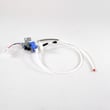
If diagnostics point to a failed fill component, a common repair is replacing the lg refrigerator water inlet valve AJU73753101.
Why it matters
Cooling, ice, and door-seal problems often overlap. For example, a door that does not seal can cause warm temperatures, frost, and poor ice production. Starting with airflow, settings, and water supply prevents unnecessary part replacement.
Related help
- Use the Kenmore 795 model bottom freezer refrigerator error codes guide if your display shows an error.
Last updated: February 2026
What does DH mean on Kenmore Elite refrigerator?
On Kenmore Elite model 79579043313, DH indicates a defrost heating problem (the refrigerator is not sensing normal warming during the defrost cycle). This commonly points to the defrost heater circuit, defrost sensor, wiring, or the electronic control not driving the heater.
What to check first (safe, no-tools basics)
- Confirm the doors are closing fully and the freezer gasket is sealing; warm air leaks can create heavy frost.
- Look for heavy frost or an ice sheet on the freezer back wall; that is a strong defrost-system clue.
- Power reset: unplug the refrigerator (or switch off the breaker) for 5 minutes, then restore power.
- Verify temperature settings in the control panel match the recommended range in the 79579043313 owner's manual.
- If the unit is warming up, move food to a cooler and limit door openings.
Likely causes and the parts that usually fix them
In this model family, DH is most often tied to the defrost sensor, heater circuit, or control.
| Symptom you notice | Most likely area | What it affects |
|---|---|---|
| Frost buildup, weak airflow, warmer temps | Defrost system | Evaporator can ice over and block airflow |
| Intermittent cooling, error returns after reset | Sensor or wiring | Control gets incorrect defrost temperature feedback |
| No defrost heat during a forced/diagnostic defrost | Control or heater circuit | Heater never energizes |
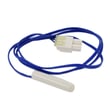
If you are troubleshooting parts, the defrost sensor is a common starting point: refrigerator defrost sensor assembly 6615JB2005N.
Why it matters
A DH condition can lead to an evaporator packed with frost, which restricts airflow and causes the refrigerator section to warm even if the compressor is running. Addressing it early helps prevent food spoilage and reduces strain on the cooling system.
When to stop and get service
- You see damaged wiring, burnt connectors, or signs of overheating.
- The refrigerator is not cooling and the error returns quickly.
- You are not comfortable removing panels or using a multimeter.
Last updated: February 2026
What is the average lifespan of a Kenmore Elite refrigerator?
A Kenmore Elite refrigerator like model 79579043313 typically lasts 10 to 15 years with normal household use. Consistent maintenance (clean airflow, good door sealing, and a healthy ice and water system) is what most often determines whether it lands closer to 10 or closer to 15.
What affects lifespan the most
- Condenser airflow and cleanliness (dust buildup makes the compressor work harder)
- Door gasket condition (warm air leaks increase run time and frost)
- Ice maker and water system health (leaks and clogs create avoidable strain)
- Defrost performance (heavy frost reduces cooling efficiency)
- Power quality (frequent outages and surges can stress electronics)
Quick maintenance plan (keeps you in the 10 to 15 year range)
- Vacuum and brush the condenser area every 6 to 12 months.
- Keep freezer drawers and vents clear so air can circulate.
- Replace water filters on schedule and purge air after changes (see 79579043313 owner's manual).
- If doors do not close easily, correct alignment and check for food packages blocking closure.
- Address water leaks quickly; a small drip can turn into corrosion, ice buildup, or fan issues.
Common “end-of-life” symptoms vs. fixable issues
| Symptom | Often fixable? | What it commonly points to |
|---|---|---|
| Warm fridge, freezer OK | Yes | Airflow/evaporator fan, frost restriction |
| Frost buildup on back wall | Yes | Defrost sensor/heater issue |
| No ice or slow ice | Yes | Ice maker, water inlet valve, frozen fill tube |
| Loud clicking, won’t start | Sometimes | Compressor start device/overload |
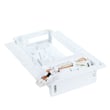
If ice production is the main problem, the lg refrigerator ice maker assembly model AEQ72909603 is a common replacement part used on this platform.
Why it matters
A refrigerator that is running longer cycles due to dirty coils, air leaks, or defrost problems can still “work,” but it wears out major components faster and raises energy use. Preventive care is the simplest way to extend service life.
Last updated: February 2026
Where do I find the model number on a Kenmore Elite refrigerator?
On Kenmore Elite model 79579043313, the model and serial number are printed on an identification label inside the fresh food (refrigerator) compartment, on the interior liner. Use that label information when ordering parts, checking warranty coverage, or scheduling service; see the 79579043313 owner's manual.
Where to look first (fastest checks)
- Open the refrigerator door and look along the inside walls (the interior liner).
- Check near the crisper drawer area; many bottom-mount designs place the label low on a side wall.
- Look for a white or silver sticker that lists Model and Serial.
- Write the numbers down exactly as shown (including dots or dashes, if present).
Other common label locations on bottom-mount refrigerators
If you do not spot the label right away inside the fresh food compartment, these are the next most common places to check:
- Behind the lower crisper drawers (remove the drawers for a clearer view).
- Along the door frame area (hinge side) where the gasket meets the cabinet.
- Under the front edge of the refrigerator (some models store a tech sheet there; do not remove labels).
What the label typically includes
| Label item | What it’s used for | Example of what to record |
|---|---|---|
| Model number | Matching parts and diagrams | 79579043313 |
| Serial number | Service history and warranty | Letters and numbers |
| Manufacturing info | Reference for technicians | Codes/dates |
Why it matters
We use the model number to match the correct Kenmore parts and configurations (ice maker, water inlet valve, door bins, gaskets). Even small model variations can change which replacement part fits.
Last updated: February 2026
Why is my Kenmore Elite refrigerator leaking water out of the bottom?
Water leaking from the bottom of your Kenmore Elite refrigerator model 79579043313 is usually caused by a defrost drain problem (ice or debris blocking the drain so meltwater overflows), or a water-supply leak to the dispenser or ice maker. Use the 79579043313 owner's manual to locate access points and follow the model’s troubleshooting guidance.
Quick checks we recommend first
- Look for a sheet of ice or standing water on the freezer floor (common with a clogged defrost drain).
- Check the water filter area and any visible tubing for drips after dispensing water.
- Pull the refrigerator forward and inspect the floor under the back for water trails.
- Confirm the water supply line is connected to cold water only and is not kinked.
- If you hear banging in the pipes (water hammer), correct it; it can contribute to leaks.
Most common causes and what to do
| What you see | Most likely cause | What to do next |
|---|---|---|
| Water under crisper drawers or pooling inside | Defrost drain clogged or frozen | Clear the drain path; flush with warm water; confirm the drain tube is open |
| Water on floor near front, especially after using dispenser | Dispenser tubing connection leaking | Inspect tubing connections; reseat fittings; replace damaged tubing |
| Water on floor near back, steady drip | Water inlet valve or supply connection leaking | Check fittings and valve body; replace the valve if it seeps |
| Leak seems to start after ice maker cycles | Ice maker fill or valve issue | Inspect fill tube and valve; check for cracks or misalignment |
Parts that commonly fix bottom leaks on this model
If your inspection points to a failed component, these parts are commonly involved:
- Refrigerator drain tube 5251JA3003D if the drain tube is split, loose, or restricted.
- Lg refrigerator water inlet valve AJU73753101 if the valve seeps, drips, or does not fully close.
Why it matters
Bottom leaks can lead to hidden water damage and can also cause icing in the freezer, which restricts airflow and hurts cooling performance. Fixing the drain or water-supply leak quickly helps protect floors and keeps temperatures stable.
Last updated: February 2026
Why is my refrigerator not getting cold at the bottom?
If your Kenmore Elite refrigerator model 79579043313 is warm at the bottom, the most common causes are blocked air vents, frequent door openings, or the unit not having enough time to stabilize after installation. Start by restoring proper airflow and confirming the temperature settings in the 79579043313 owner's manual.
Quick checks that fix most “warm bottom” complaints
- Clear air vents in the fresh food section; avoid packing items tightly against vent openings.
- Reduce door-open time; long openings let warm, humid air settle low in the compartment.
- Wait for temperature recovery after loading groceries; adding a lot of food can temporarily warm the lower shelves.
- Confirm room temperature; this refrigerator is designed to run best in typical indoor conditions (roughly 55°F to 110°F).
- Verify the doors seal and close fully; a door that is slightly ajar often shows up as warmer temps near the bottom.
What to look for (symptom-to-cause guide)
| What you notice | Likely cause | What we recommend first |
|---|---|---|
| Top shelves feel cooler than bottom | Airflow blocked or restricted | Reposition food to open vents and air paths |
| Temps rise after parties or frequent use | Doors opened often/too long | Shorten openings; let temps recover |
| Warm after install or power outage | Normal stabilization time | Allow up to 24 hours to fully stabilize |
| Warm after stocking with groceries | Heat load from food | Cool food before loading; avoid overfilling |
Why it matters
Bottom-area warming is usually an air circulation issue, not a sealed-system failure. When vents are blocked or doors are opened often, cold air cannot move through the compartment evenly, so the lower area can drift warmer and food safety can be affected.
If cooling is still uneven after the quick checks
- Make sure nothing is blocking the return-air path (often behind lower bins or drawers).
- Listen for normal fan operation; a failed evaporator fan can cause uneven cooling.
- If you also have ice maker or water issues, check for water supply problems that can create icing and airflow restrictions; our how to prevent water dispenser and ice maker problems guide helps you prevent common causes.
Last updated: February 2026