Owner’s manual
 Error Codes





How to lower wheels on Maytag refrigerator?
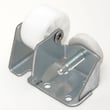
On a Maytag MFI2569VEM4 bottom-mount refrigerator, you typically lower the front by turning the front leveling legs counterclockwise (this transfers weight back onto the wheels/rollers so the unit can roll). For exact access points and the correct tool size, follow the steps in the MFI2569VEM4 owner's manual.
How to lower the front (and get the wheels to roll)
- Unplug the refrigerator or switch off power at the breaker.
- Remove the base grille (toe grille) at the bottom front.
- Locate the two front leveling legs, one at each front corner.
- Use a wrench or nut driver to turn each leveling leg:
- Counterclockwise: lowers the front (more weight on wheels)
- Clockwise: raises the front (less weight on wheels)
- Adjust both sides evenly until the refrigerator rolls smoothly.
Quick checklist
- Turn both leveling legs the same amount to prevent cabinet twist.
- Keep the refrigerator stable; do not leave it resting only on wheels.
- Reinstall the base grille after adjustment.
Set the correct tilt for door closing
Most bottom-mount and French door refrigerators are set with a slight backward tilt so the doors self-close.
| Goal | What to do | What you should notice |
|---|---|---|
| Make it easier to roll out | Lower the front leveling legs slightly | Wheels carry more weight |
| Improve door closing | Raise the front slightly | Doors close more reliably |
| Stop rocking | Fine-tune both legs evenly | Cabinet feels solid |
Why it matters
Correct leveling helps the doors seal, reduces warm air leaks, and can prevent frost buildup and temperature swings. If the refrigerator is too low in front, doors may not close consistently; too high and it may be hard to move.
Last updated: February 2026
Is a top mount or bottom mount fridge better?
A bottom-mount refrigerator (like your Maytag MFI2569VEM4) is usually better for everyday convenience because fresh-food items sit at eye level, while a top-mount is often a better pick if you want the simplest layout and typically lower purchase cost.
Quick comparison
| Feature | Top-mount (freezer on top) | Bottom-mount (freezer on bottom) |
|---|---|---|
| Everyday access | More bending for fresh food | Less bending for fresh food |
| Freezer access | Easier access | More bending for freezer |
| Organization | Usually simpler | Often more drawers and baskets |
| Efficiency (typical) | Often slightly better | Can be slightly higher use |
| Repair complexity | Often simpler | Can be more complex (drawers, rails) |
What we recommend for most homes
- Choose bottom-mount if you use the refrigerator section most and want easier access to produce, drinks, and leftovers.
- Choose top-mount if you want a straightforward design and you use the freezer more often.
- If you have kids, a bottom-mount keeps everyday snacks and drinks within easier reach.
- If you bulk-freeze food, a top-mount can feel more convenient day to day.
Why it matters
The “better” choice comes down to how you load and unload groceries. Most people open the fresh-food doors far more than the freezer, so bottom-mount designs reduce bending and make daily use feel easier.
Model-specific tip for MFI2569VEM4 owners
If your bottom freezer drawer is hard to open or doesn’t glide smoothly, check the drawer alignment and rails in the MFI2569VEM4 owner's manual. Drawer glide issues are also commonly tied to worn rails or misalignment after overloading.
Last updated: February 2026
What is the average lifespan of a Maytag refrigerator?
Most Maytag refrigerators average 10 to 15 years of service life. For a Maytag bottom-mount like MFI2569VEM4, consistent maintenance (clean airflow, good door sealing, and stable temperatures) is what most often pushes lifespan toward the high end; see the MFI2569VEM4 owner's manual for model-specific care guidance.
Typical lifespan ranges (what to expect)
- Average: 10 to 15 years
- Often achievable with good upkeep: 15 to 20 years
- Common early-life shorteners: poor condenser airflow, torn gaskets, frequent warm door openings, and ice buildup from airflow restrictions
| Component or condition | What it affects | What you can do |
|---|---|---|
| Compressor and sealed system | Core cooling performance | Keep condenser area clean and well ventilated |
| Door gaskets and alignment | Temperature stability, frost, run time | Inspect for gaps; correct sealing issues |
| Evaporator airflow (fan, vents) | Even cooling in fresh food section | Keep vents clear; address unusual fan noise |
| Ice maker and water system | Ice production, leaks, clogs | Replace worn parts and keep water path clean |
Maintenance that extends life
- Vacuum dust from the condenser area and keep clearance for airflow.
- Keep refrigerator set near 37°F and freezer near 0°F (typical targets).
- Make sure doors close fully; avoid overloading door bins.
- Clear blocked air vents inside the fresh food and freezer compartments.
- Fix small issues early (rattling fan, warm spots, frost buildup) before they strain the cooling system.
Parts that commonly impact longevity on MFI2569VEM4
If cooling performance drops or the unit runs constantly, these model-matched parts are often involved:
- Refrigerator condenser fan motor W11613295 (moves air across the condenser)
- Refrigerator gasket panel (gray) W10830055 (helps the door seal properly)
- Refrigerator run capacitor WPW10662129 (supports compressor starting)
Why it matters
A refrigerator that runs longer than normal to hold temperature uses more energy and puts extra wear on the compressor and fans. Keeping seals tight and airflow clean is the simplest way to protect the most expensive components.
Last updated: February 2026
What is the bottom part of a refrigerator called?
On a Maytag MFI2569VEM4 bottom-mount refrigerator, the “bottom part” most people mean is the compressor compartment area (the machinery space underneath or behind the cabinet). The key component down there is the compressor, which pumps refrigerant through the sealed cooling system.
What you’ll typically find at the bottom
Depending on the exact layout, the lower rear or bottom area commonly includes:
- Compressor (the main pump for the sealed system)
- Condenser coil (releases heat from the refrigerant)
- Condenser fan (moves air across the condenser area)
- Drain pan (catches defrost water so it can evaporate)
- Start components (such as a run capacitor or relay)
For diagrams and the exact component locations for your model, use the owner's manual.
Quick terminology guide (what people call “the bottom”)
| What you see or mean | Common name | What it does |
|---|---|---|
| Black “tank” or canister | Compressor | Pressurizes and circulates refrigerant |
| Warm tubing/coil area | Condenser | Dumps heat so the fridge can cool |
| Fan near compressor | Condenser fan | Prevents overheating and improves efficiency |
| Lower drawer area | Freezer compartment | Stores frozen food (not part of the cooling machinery) |
Why it matters
Knowing the correct name helps you troubleshoot symptoms faster. For example, loud humming, clicking, or overheating often points to the compressor area or its start components, while poor cooling can involve airflow at the condenser.
Parts that relate to the “bottom” area on this model
If you’re diagnosing a cooling or start-up issue, these model-matched parts are commonly involved:
- Refrigerator compressor W10160407
- Refrigerator run capacitor WPW10662129
- Refrigerator condenser fan motor W11613295
- Refrigerator condenser WPW10346415
Last updated: February 2026