Installation guide
 Owner’s manual
 Error Codes




Why is my wall oven not turning on?
If your Kenmore wall oven model 79041003603 is completely dead (no display, no beeps, no interior light), the most common causes are a tripped breaker or a wiring/power-supply problem at the junction box. After confirming correct power, a failed electronic control can also prevent startup.
Quick checks we recommend first
- Reset the double-pole oven breaker fully (OFF, then ON).
- Confirm the oven is on a dedicated 120/240V or 120/208V, 60 Hz circuit (as required for this model).
- Check for a loose or burned connection where the house wiring connects to the oven leads in the junction box.
- Make sure the neutral (white) is not fused; only the hot legs should be protected.
- If the display works but the oven will not heat, verify the oven is not in lockout mode.
Power and control causes (most common)
| What you see | Most likely cause | What to do next |
|---|---|---|
| No display and no oven light | Breaker tripped, blown fuse, or bad junction-box connection | Verify supply voltage and tighten/repair connections |
| Breaker trips immediately | Shorted wiring or incorrect connection | Inspect wiring, correct connections per the installation guide |
| Display works but oven will not start | Control settings or lockout enabled | Disable lockout and re-set Bake per the owner's manual |
| Power is correct but oven stays dead | Failed electronic control | Diagnose control circuit; replace board if confirmed bad |
Parts that are often involved
If power is present and wiring is solid, these parts are common suspects on this model:
- Wall oven relay control board 316443915 (routes power to heating circuits)
- Wall oven display control board 316460300 (user interface and display)
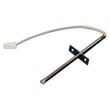
- Wall oven wire harness 318370308 (loose/burned connectors can kill power)
Why it matters
A wall oven that will not turn on is usually a power-delivery issue (breaker, junction box, harness) or a control issue (relay/display board). Verifying power first prevents replacing expensive parts unnecessarily.
Last updated: January 2026
What power is required for electric wall oven?
For Kenmore Pro electric wall oven model 79041003603, a dedicated single-phase 120/240V or 120/208V, 60 Hz AC electrical supply is required using a 3-wire or 4-wire connection. The correct circuit breaker or fuse size depends on the oven’s wattage rating shown on the serial plate.
Electrical requirements we use for this model
Use these requirements from the installation instructions:
- Dedicated circuit: separate branch circuit, fused on both sides of the line (L1 and L2)
- Supply: 120/240V or 120/208V, single-phase, 60 Hz AC
- Wiring: 3-wire or 4-wire connection (per local code)
- Protection: time-delay fuse or circuit breaker recommended
- Neutral: do not fuse the neutral (white) conductor
For the full wiring and grounding details, use the 79041003603 installation guide.
How to choose the correct breaker or fuse size
We match the breaker/fuse to the oven’s wattage on the serial plate. Use this table as the quick reference:
| Oven wattage rating | 240V recommended circuit | 208V recommended circuit |
|---|---|---|
| Less than 4800W | 20A | Less than 4100W: 20A |
| 4800W to 7200W | 30A | 4100W to 6200W: 30A |
| 7200W to 9600W | 40A | 6200W to 8300W: 40A |
| 9600W and up | 50A | 8300W and up: 50A |
Why it matters
Correct voltage and circuit sizing prevents nuisance breaker trips, slow preheat, and overheated wiring connections. It also ensures the oven’s internal controls, convection blower, and heating elements operate as designed.
Safety notes before any wiring work
- Shut off power at the breaker before making line connections
- Do not use an extension cord with a wall oven
- Follow local electrical codes; grounding is required
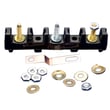
- If you see heat damage at the connection point, inspect the terminal block 5304409888 and wiring before restoring power
Last updated: January 2026
Are all 30 inch wall ovens the same size?
No. “30-inch” wall ovens are grouped by a nominal width, but the actual cabinet cutout width, height, and depth vary by brand and model. For Kenmore model 79041003603, the installation guide shows a 30 in (76.2 cm) class oven with a minimum cutout width of 30 1/8 in (76.5 cm).
What “30-inch” really means
Manufacturers use “30-inch” as a category, not a guarantee of identical dimensions. Even small differences (like 1/8 inch) can prevent the oven trim from sitting flush or cause fit and airflow problems.
Common reasons sizes differ:
- Single vs. double wall oven cutouts
- Trim and flange design differences
- Required clearance for door swing and ventilation
- Cabinet face-frame vs. frameless construction
- Electrical junction box placement requirements
Key fit checks before you buy or swap
Use the cutout requirements for your exact oven and compare them to your cabinet opening.
Minimums and notes called out for this installation:
- Cutout base must support 300 lb (136 kg)
- Allow at least 21 in (53.3 cm) clearance in front for the open door
- Cutout depth is critical; if trim does not butt to the cabinet, verify depth
- Do not remove side/back spacers (they center the oven and help prevent heat buildup)
Quick comparison: nominal vs. real-world dimensions
| What you see | What you must match | Why it matters |
|---|---|---|
| “30-inch wall oven” | Cabinet cutout width/height/depth | Prevents binding, gaps, and heat issues |
| “Fits 30-inch opening” | Minimum cutout width (example: 30 1/8 in min for this install) | Avoids forcing the oven into the cabinet |
| “Single” vs “double” | Cutout height requirements | Height differences are often the deal-breaker |
Why it matters
Wall ovens install into tight cabinet cutouts; being off by even a small amount can lead to poor alignment, excess heat buildup around cabinetry, or an oven that simply will not slide in correctly.
For the exact cutout diagram and dimension callouts for Kenmore 79041003603, use the installation guide.
Last updated: January 2026