Installation guide
 Owner’s manual
 Error Codes



What is the life expectancy of a GE gas range?
A GE gas range like model JGS905SEK1SS typically lasts 13 to 15 years. With consistent cleaning, correct burner setup, and timely replacement of wear parts (like igniters and door gaskets), many ranges reach the upper end of that range.
- Heat stress from frequent high-heat baking and broiling
- Spillovers and grease that clog burner ports or damage finishes
- Door seal condition (heat leaks make the oven work harder)
- Ignition reliability (weak igniters cause delayed ignition and longer preheat)
- Electrical events such as power outages or surges that can require control resets
- Clean cooktop and burner parts regularly; keep burner ports clear.
- Keep the oven door closing tightly; replace a worn gasket if you feel heat escaping.
- If the oven takes longer to light or preheat, inspect the igniter and burner flame pattern.
- Replace the oven light if it is out so you can avoid opening the door to check food.
- Follow the cleaning and safety guidance in the owner's manual.
| Symptom | Likely wear area | Example part for this model |
|---|---|---|
| Oven not heating consistently | Ignition or burner system | GE range oven burner igniter WB13T10045 |
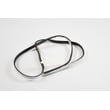
| Heat leaking, uneven baking | Door sealing | Range oven door gasket WB04T10050 |
| Oven light out | Lamp or holder | Oven lamp 40A15 |
A range that is clean, sealed, and igniting properly runs fewer extended heat cycles. That reduces stress on the gas valve, controls, and oven cavity, which is the simplest way to get the full expected lifespan from your GE JGS905SEK1SS.
Last updated: February 2026
Where is the igniter on my GE JGS905SEK1SS stove top?
On your GE JGS905SEK1SS gas range, the stovetop spark igniter (electrode) sits right next to each surface burner, mounted at the edge of the burner base under the burner head and cap. You’ll see it after you lift off the grate, burner cap, and burner head.
The igniter is a small ceramic-and-metal “pin” (electrode) that sticks up slightly beside the burner base. It is positioned so the spark can jump to the burner head area when you turn the knob to LITE.
- Remove the burner grate.
- Lift off the burner cap.
- Lift off the burner head.
- Look at the burner base; the igniter electrode is right beside it.
- Reinstall parts in order: burner head, burner cap, then grate.
| Layer | Part | What it does |
|---|---|---|
| 1 | Burner grate | Supports cookware |
| 2 | Burner cap | Shapes flame pattern |
| 3 | Burner head | Distributes gas to ports |
| 4 | Burner base | Supports burner parts; igniter mounts beside it |
| 5 | Spark igniter (electrode) | Creates spark to light gas |
The igniter electrode is exposed when the burner parts are removed, so careful handling matters.
- Turn all cooktop controls OFF before removing burner parts.
- Do not snag the electrode with a cleaning cloth.
- Do not push in or turn burner knobs while cleaning.
- Wash burner parts with a non-abrasive cleaner; dry completely before reassembly.
- Make sure the burner head pins align with the slots/holes in the burner base.
For the exact burner assembly diagram and cleaning cautions for this model, use the JGS905SEK1SS owner’s manual.
If the burner head or cap is mis-seated, the spark may click but the burner may not light, or the flame can be uneven. Keeping the igniter area clean and the burner parts properly aligned helps ensure reliable ignition.
Last updated: February 2026
What model number is the GE JGS905SEK1SS?
The model number is JGS905SEK1SS. On your GE gas range, we use that exact model number to match the correct parts list, diagrams, and specifications for your appliance; it is also the model number you will reference in the owner's manual.
We typically see the model and serial tag in one of these spots:
- Behind the oven door, on the lower left corner of the range frame
- On the frame around the oven opening (visible with the door open)
- Occasionally on a side frame rail near the storage drawer opening
Use this table to confirm you are reading the right line on the label.
| Label item | What it tells you | Example format |
|---|---|---|
| Model number | Which exact range you have (used to match parts) | JGS905SEK1SS |
| Serial number | Your unit’s unique ID (used for manufacturing date tracking) | Letters and numbers |
Using the exact model number JGS905SEK1SS prevents ordering the wrong GE range parts (like an oven control, burner cap, or igniter) that may look similar but fit differently.
Last updated: February 2026
What are the parts of a gas oven?
A gas oven in a GE JGS905SEK1SS range is built around a gas bake burner and a gas broil burner, plus ignition and safety controls that regulate gas flow and temperature. It also includes the oven cavity, door glass, door gasket, racks, and an oven light system (bulb, lens, and holder). For diagrams and component locations, use the owner's manual and installation guide.
- Bake burner: provides the primary heat for baking and roasting (bottom of oven cavity).
- Broil burner: provides high, direct heat for broiling (top rear of oven cavity).
- Ignition system (glow bar igniter): heats up to allow gas to flow and ignite; the oven will not light during a power outage.
- Temperature sensing and control: monitors oven temperature and signals the control to cycle heat (example part: sensor WB21X22134).
- Oven door system: door glass panels and hinges help retain heat and allow viewing.
- Door gasket: seals the door opening to keep heat in (example part: range oven door gasket WB04T10050).
- Oven light system: bulb, lens cover, and lamp holder illuminate the cavity (examples: oven lamp 40A15, lens cover WB25T10002, oven lamp holder WB08T10002).
| Area | Common parts you will see | Why it matters |
|---|---|---|
| Heat source | Bake burner, broil burner | Cooking performance and preheat time |
| Safety/ignition | Igniter (glow bar), gas valve/regulator | Gas only flows when ignition conditions are met |
| Temperature control | Sensor, oven control | Accurate temperatures and stable baking |
| Door and sealing | Door glass, gasket | Heat retention, even cooking, safe exterior temps |
| Lighting | Bulb, lens, holder | Visibility and safe checking without opening door |
Knowing the major oven parts helps you troubleshoot symptoms faster. For example, weak heat or no ignition often points to the igniter or gas flow controls, while heat loss and uneven baking often point to the door gasket or door glass fit.
Last updated: February 2026