Owner’s manual
 Error Codes




How long to let a refrigerator sit after laying it down?
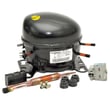
For Whirlpool model GB9FHDXWS08, we recommend setting the refrigerator upright and letting it sit at least 24 hours before plugging it in. This gives compressor oil time to drain back where it belongs, helping prevent hard starts, poor cooling, or compressor damage. See the GB9FHDXWS08 owner's manual for handling and startup guidance.
Recommended wait time (based on how it was transported)
- On its side (most common risk): wait 24 hours
- On its back: wait 24 hours (often higher risk than on its side)
- Only briefly tilted (not fully laid down): wait 4 to 12 hours
- Laid down for a long trip or stored on its side for days: wait 24 to 48 hours
Quick decision table
| How it was laid down | Minimum upright time before power | Best practice |
|---|---|---|
| Tilted only | 4 to 12 hours | 12 hours |
| On side | 24 hours | 24 to 48 hours |
| On back | 24 hours | 24 to 48 hours |
Before you plug it in (simple checklist)
- Keep the refrigerator upright and level.
- Make sure the doors close and seal properly.
- Confirm the power cord is not pinched or damaged.
- If the unit has an ice maker, verify the water line is not kinked and the shutoff valve is open.
- After startup, allow 24 hours for temperatures to stabilize.
Why it matters
When a refrigerator is laid down, compressor oil can migrate into the sealed system tubing. Letting the unit sit upright helps the oil return to the compressor so it can lubricate properly when the compressor starts.
Last updated: January 2026
How do you remove the bottom freezer drawer on a Whirlpool refrigerator?
To remove the bottom freezer drawer on your Whirlpool GB9FHDXWS08 bottom-mount refrigerator, we typically remove the drawer front first (by releasing the fasteners on each side), then lift the drawer bin off the slide rails. Use the steps in the GB9FHDXWS08 owner's manual for the exact clip and screw locations.
Before you start (safety and prep)
- Unplug the refrigerator or switch off power at the breaker.
- Remove food and the ice bin (if equipped) to reduce weight.
- Protect the floor with a towel or cardboard.
- Use a #2 Phillips screwdriver and a small flat-blade screwdriver.
- Keep screws in a cup so nothing falls into the freezer compartment.
Typical removal steps for a bottom-mount drawer
- Pull the drawer fully open so you can access both slide rails.
- Remove the upper basket/bin (most lift up and out).
- Locate the drawer-front fasteners on the left and right sides (often screws or locking tabs where the drawer front attaches to the rail brackets).
- Release the drawer front:
- If screws: remove them on both sides.
- If locking tabs: gently pry the tabs outward and lift the drawer front up.
- Lift the drawer bin off the rails: with the front removed or loosened, lift the drawer bin straight up to disengage it from the rail hooks.
- If you need the rails out: remove the rail mounting screws after the drawer is off.
What you will see (quick guide)
| What you’re removing | What holds it in | What to do |
|---|---|---|
| Upper basket | Sits in side supports | Lift up and pull out |
| Drawer front | Screws or locking tabs at rail brackets | Remove screws or release tabs |
| Drawer bin | Hooks/slots on slide rails | Lift up to unhook |
Why it matters
Removing the freezer drawer the right way prevents bent slide rails, cracked drawer fronts, and air leaks that can cause frost buildup and temperature swings.
Last updated: January 2026
What is the most common problem with a Whirlpool refrigerator?
The most common Whirlpool refrigerator problem is a cooling complaint: the fresh food section gets warm, temperatures swing, or the unit runs constantly. On the Whirlpool GB9FHDXWS08, the most frequent root causes are airflow problems (fan or damper), dirty condenser coils, or a temperature-sensing/control issue; confirm the basics in the GB9FHDXWS08 owner's manual.
Most common symptoms and what they usually point to
- Refrigerator warm, freezer OK: restricted airflow into the fresh food section, often a stuck or failed damper
- Freezer warm and refrigerator warm: poor heat removal (dirty coils) or a fan/control problem
- Runs all the time: dirty coils, door not sealing, or temperature sensor/control issues
- Ice maker not making ice: water supply or inlet valve issue, or a failed ice maker
- Frost buildup, then warming: defrost system problem (heater, thermostat, or control)
Quick checks we recommend before replacing parts
- Set temperatures to normal (typical targets: 37°F fresh food, 0°F freezer) and allow 24 hours to stabilize.
- Clean condenser coils and confirm the condenser area has good airflow.
- Check door gaskets for gaps, rips, or areas not sealing.
- Listen for the evaporator fan in the freezer; it should run when the compressor is running (door switch may need to be pressed).
- If you have an ice maker, confirm the shutoff arm is down and the water supply valve is fully open.
Parts that commonly solve these problems on GB9FHDXWS08
| Symptom | Common suspect | Example part for this model |
|---|---|---|
| Fresh food warm, freezer OK | Damper not opening/closing | Refrigerator damper control assembly WPW10196393 |
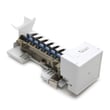
| Ice maker not working | Ice maker failure | Refrigerator ice maker assembly W10884390 |
| No water to ice maker | Inlet valve not opening | Refrigerator water inlet valve WPW10498976 |
| Temperature swings | Sensor reading wrong | Refrigerator thermistor 12002355 |
| Random cooling issues | Control not managing loads | Refrigerator electronic control board WPW10503278 |
Why it matters
Cooling and ice maker complaints often share the same underlying causes: restricted airflow, poor heat rejection, or incorrect temperature feedback. Fixing the root cause protects food, reduces run time, and prevents repeat failures.
Related help
If your unit is showing a fault or you suspect a control-related issue, use our Whirlpool refrigerator error codes reference to narrow the diagnosis.
Last updated: January 2026
Why is my Whirlpool bottom freezer frosting up?
Frost buildup in the freezer of your Whirlpool GB9FHDXWS08 usually happens when warm, humid air leaks into the freezer or when the defrost system is not clearing moisture off the evaporator. The fastest wins are fixing door sealing issues and clearing airflow so the freezer can defrost and circulate air normally.
Most common causes (and what to check first)
- Door not sealing: torn gasket, debris on the gasket, or the door not closing fully.
- Frequent door openings or leaving the freezer ajar.
- Blocked vents or overpacked freezer: cold air cannot circulate, so moisture freezes on surfaces.
- Moisture introduced into the freezer: uncovered liquids, wet packages, or warm food.
- Defrost problem: frost keeps accumulating on the evaporator area instead of melting during defrost.
Quick troubleshooting steps for GB9FHDXWS08
- Inspect the gasket and closing: wipe the gasket and cabinet sealing surface; confirm the door closes without resistance.
- Check leveling: a slight backward tilt helps doors self-close on many bottom-mount designs.
- Improve airflow: keep packages from touching the rear wall and don’t block air returns.
- Look for “snow” vs. a solid ice sheet:
- Light, even frost often points to door sealing or humidity.
- Heavy frost/ice on the back panel often points to a defrost or airflow issue.
- Review model-specific guidance in the GB9FHDXWS08 owner’s manual.
Parts that commonly relate to frosting symptoms
If you find heavy frost behind the freezer’s rear panel or weak airflow, these model-matched parts are often involved:
| Symptom you notice | What it often points to | Example model-matched part |
|---|---|---|
| Freezer cold but fridge warm | Airflow/damper issue | Refrigerator damper control assembly WPW10196393 |
| Noisy or weak airflow | Evaporator fan issue | Refrigerator evaporator fan blade WP2169142 or refrigerator evaporator fan motor W11024089 |
| Frost returns quickly after manual defrost | Defrost sensing/control issue | Refrigerator defrost bi-metal WP627985 or refrigerator electronic control board WPW10503278 |
Why it matters
Frost buildup is not just cosmetic. It restricts airflow across the evaporator, which can make temperatures swing, reduce ice production, and force longer run times that increase energy use.
Last updated: January 2026