Installation guide
 Owner’s manual
 Error Codes


How to remove bottom grille on GE refrigerator?
On the GE CFSP5RKBCSS bottom-mount refrigerator, the bottom grille (base grille/toe grille) typically comes off by releasing its retaining clips or removing a couple of screws, then pulling the grille straight out and down. We use this access point for cleaning and for servicing the condenser area.
- Unplug the refrigerator (or switch off power at the breaker).
- Look along the top edge and corners of the grille for screws.
- If screws are present, remove them with a Phillips screwdriver.
- Grip the grille at both ends and pull straight outward to release the clips.
- Tilt the grille slightly and lift it away from the bottom tabs (if your version uses tabs).
- Confirm all visible screws are removed (some models use 2 screws near the ends).
- Pull evenly from both sides; twisting can bind the clips.
- Use a flashlight to spot hidden clip points along the top edge.
- If the grille feels stuck, press inward slightly, then pull outward to pop the clips.
- Avoid prying hard with a metal tool; it can crack the grille or mar the finish.
To reinstall, align the bottom tabs (if used), push the grille into position, then reinstall the screws (if used) and snug them down.
| Grille style | What you will see | How it releases |
|---|---|---|
| Screw-retained | Phillips screws at ends/top | Remove screws, then pull off |
| Clip-retained | No screws visible | Pull straight outward to pop clips |
| Tab + clip | Tabs at bottom, clips at top | Lift off tabs, then pull/push to release clips |
Removing the bottom grille lets us clean dust from the condenser area, which helps the compressor run cooler, improves airflow, and can reduce warm-temperature complaints.
For model-specific illustrations and fastener locations, follow the access and panel removal guidance in the installation guide.
Last updated: February 2026
What is the advantage of a bottom mount fridge?
A bottom-mount refrigerator like the GE CFSP5RKBCSS puts the fresh-food section at eye and waist level, so you reach for everyday items with less bending. The freezer stays below, which is convenient if you access frozen foods less often (typical for many households).
- Less bending for fresh food: produce, drinks, and leftovers are easier to see and grab.
- Better organization up top: shelves and crispers are in your natural line of sight.
- Freezer drawer capacity: many bottom-mount designs use a pull-out basket system that holds bulky items well.
- Improved “grab-and-go” access: you spend less time with the refrigerator door open.
- Good fit for families: kids can often reach common fridge items without digging through a top freezer.
| Feature | Bottom-mount refrigerator | Top-freezer refrigerator |
|---|---|---|
| Fresh-food access | Higher, easier reach | Lower, more bending |
| Freezer access | Lower drawer | Upper door |
| Best for | Frequent fresh-food use | Frequent freezer use |
| Typical storage style | Wide shelves, pull-out freezer baskets | Simpler, more basic layout |
Most people open the refrigerator compartment far more than the freezer. With a bottom-mount layout, we keep the most-used space (fresh food) in the most ergonomic position, which reduces strain and makes it easier to spot items before they expire.
Layout details (shelf positions, freezer basket style, and door features) can vary by configuration. We recommend checking the GE CFSP5RKBCSS owner's manual for the exact storage and compartment features.
Last updated: February 2026
What is the most common problem with GE refrigerators ice maker?
The most common GE refrigerator ice maker problem is no ice production caused by restricted water flow (a clogged filter, a kinked/blocked supply line, or a weak water inlet valve). On the GE CFSP5RKBCSS, start by confirming freezer temperature and water supply, then check the filter and valve.
- Make sure the freezer is cold enough; 0°F to 5°F is the typical target range for steady ice production.
- Confirm the ice maker is turned on and the bin is seated correctly.
- Check for an ice jam in the mold or chute; clear any stuck cubes.
- Verify the household shutoff valve is fully open and the supply line is not kinked.
- Replace the water filter if it is overdue; a restricted filter commonly causes slow fill or no fill.
| Symptom | Most likely cause | What to do next |
|---|---|---|
| No ice at all | Water flow restriction | Replace the filter; check supply line and pressure |
| Small or hollow cubes | Low water fill | Check filter, then test the inlet valve |
| Ice clumps or jams | Freezer temp too warm or moisture intrusion | Set temp colder; clear jam; check door seal |
| Water leaking near fridge | Loose connection or valve seep | Inspect fittings; consider valve replacement |
If water is not reaching the ice maker, these model-compatible parts are the most common fixes:
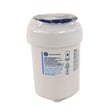
- GE refrigerator water filter MWFP (clogged filters are the top restriction point)
- Refrigerator water valve WR57X33326 (a weak valve can prevent proper fill)
- Refrigerator water filter head and tubing WR17X11894 (cracks or restrictions at the head can reduce flow)
Ice makers are simple: they need cold air and steady water flow. When either one is marginal, you will see the earliest symptoms in cube size, production rate, and jamming. Fixing the restriction early also helps prevent dispenser and valve problems.
- Use the owner's manual for the exact control settings and ice maker operating details for GE CFSP5RKBCSS.
- For step-by-step filter guidance, follow how to replace the water filter in a GE refrigerator.
Last updated: February 2026