Installation guide
 Owner’s manual
 Error Codes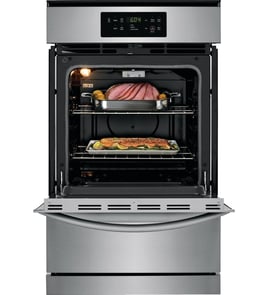


Does anyone make a 30 gas wall oven?
Yes. Multiple brands make 30-inch gas wall ovens; your Kenmore model 79030529801 is itself a 30-inch class built-in gas wall oven, and there are also current 30-inch gas wall oven options from specialty and mainstream manufacturers.
To avoid fit and hookup problems, we recommend matching these items before you buy:
- Cutout dimensions (cabinet opening height, width, and depth)
- Gas supply location and shutoff valve access
- Electrical outlet location (gas ovens still need power for controls and ignition)
- Door swing clearance; many installs need about 19-3/8 inches of clearance for full door opening
- Vent location; on this style of oven, warm air vents through the upper control panel trim
For the most accurate cutout and clearance requirements for your installation, use the 79030529801 installation guide.
Most 30-inch built-in wall ovens are designed around a standard cabinet cutout, but the exact numbers vary by model and trim style.
| Item to match | Why it matters | What to verify |
|---|---|---|
| Cabinet cutout | Prevents gaps or binding | Cutout width/height/depth in the install guide |
| Gas hookup | Safe, code-compliant connection | Gas line size, shutoff valve, leak test method |
| Electrical | Ignition and controls must power up | Outlet type and location |
| Clearance | Door must open fully | Minimum door clearance and nearby obstructions |
Gas wall ovens must be installed and serviced by a qualified installer or service agency. Key safety points include:
- If you smell gas: do not light appliances or touch switches; contact your gas supplier
- Check gas connections for leaks using a manometer or liquid leak detector (never a flame)
- Follow local codes and applicable national fuel gas and electrical codes
These requirements and clearances are detailed in the 79030529801 installation guide.
A “30-inch” label alone does not guarantee a drop-in replacement. Matching the cutout, venting, door clearance, and gas and electrical hookups prevents costly cabinet modifications and helps ensure safe operation.
Last updated: February 2026
Are wall ovens electric or gas?
Wall ovens can be electric or gas. The Kenmore 79030529801 is a gas wall oven that still requires a properly grounded electrical connection for controls, the oven light, and the igniter system (see the 79030529801 installation guide for the required electrical and gas hookup details).
- Electric wall oven: heats with electric bake and broil elements
- Gas wall oven: heats with a gas burner and uses an igniter to light the burner
- Convection versions: can be electric or gas; they add a fan to circulate hot air
Check these items on your appliance:
- Model tag and rating label (confirms fuel type)
- Gas supply line connected to the oven cabinet (gas models)
- Dedicated grounded outlet or junction box (both types can have electrical requirements)
- Burner ignition behavior (gas models typically ignite within about a minute when heating)
Your Kenmore 79030529801 uses gas for heat, but it must be electrically grounded and connected to power. Installation should follow local codes and commonly references the National Fuel Gas Code and National Electrical Code.
| Feature | Electric wall oven | Gas wall oven (like 79030529801) |
|---|---|---|
| Primary heat source | Electric elements | Gas burner |
| Needs electricity | Yes | Yes (controls, igniter, light) |
| Common heat issue | Failed element | Weak igniter or gas supply issue |
Fuel type affects troubleshooting and parts selection. For example, a gas wall oven that will not heat often points to the igniter or burner system; an electric wall oven that will not heat often points to a bake or broil element.
Last updated: February 2026
How do I know if my wall oven is 27 or 30?
For your Kenmore wall oven model 79030529801, the most reliable way to tell 27-inch vs 30-inch is to measure the cabinet cutout opening (not the oven door). Measure the inside width from the left cabinet wall to the right cabinet wall; that number will be closest to 27 or 30 inches.
Use a tape measure and take measurements in at least two spots (front and back) because cabinets can be slightly out of square.
- Measure width: inside left cabinet edge to inside right cabinet edge
- Measure height: cabinet floor/support to the underside of the top rail
- Measure depth: front cabinet face to the back wall (or obstruction)
- Measure at the front and back for width and depth
- Write down the smallest measurement you get (that is the limiting size)
Most wall ovens are built to fit a cutout that is slightly larger than the nominal oven width.
| Nominal wall oven size | Typical cutout width you’ll measure | What to order |
|---|---|---|
| 27-inch | About 27 inches (often a bit over) | 27-inch wall oven parts/trim |
| 30-inch | About 30 inches (often a bit over) | 30-inch wall oven parts/trim |
The cutout width determines whether the oven will physically fit and whether the trim sits flush. It also prevents problems during installation, such as binding against the cabinet or gaps around the frame.
Your installation instructions also explain key fit and safety requirements (including proper grounding and gas installation practices). Use the installation guide for the exact cutout and mounting guidance for model 79030529801.
Last updated: February 2026