Owner’s manual
 Error Codes


What is the upper part of a fridge called?
On the Kenmore 79579972902 top-mount refrigerator, the upper section is typically called the freezer compartment (or simply the freezer). It’s the insulated area designed to hold frozen foods and maintain temperatures at or below 0°F.
Common names you’ll hear
- Freezer compartment
- Freezer section
- Top freezer
- Freezer cabinet (less common)
- Freezer liner (refers to the interior walls, not the whole section)
What the upper (freezer) section does
The freezer compartment is responsible for:
- Keeping food frozen for long-term storage
- Providing cold air that helps cool the fresh food section (through an air damper system)
- Supporting ice production if your refrigerator has an ice maker
- Managing frost control through the defrost system
Related parts you might see referenced
If you’re troubleshooting cooling or airflow issues that seem to start in the upper section, these model-specific parts are commonly involved:
| Symptom | Upper-section area often involved | Example part for 79579972902 |
|---|---|---|
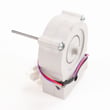
| Freezer cold, fridge warm | Airflow/damper between sections | Refrigerator air damper motor 4681JB1027N |
| Noisy airflow or vibration | Evaporator fan area | Refrigerator evaporator fan blade 5901JJ1003A |
Why it matters
Knowing the correct name helps you match the right diagrams and instructions when ordering Kenmore refrigerator parts or following troubleshooting steps in the 79579972902 owner's manual.
Last updated: January 2026
What size is Kenmore refrigerator model 79579972902?
Kenmore refrigerator model 79579972902 is a top-mount (top freezer) refrigerator; the exact exterior dimensions and total capacity vary by the specific configuration and are listed in the product specifications section of the 79579972902 owner's manual.
How to find the exact size for your 79579972902
Use these quick checks to confirm the correct measurements and capacity for your kitchen opening:
- Look up overall dimensions (W x D x H) in the specifications section of the 79579972902 owner's manual
- Measure your refrigerator at the widest points (handles, hinges, and doors can add width)
- Measure depth with doors closed and note whether you need depth with handles
- Confirm you have clearance for door swing and airflow behind and above the cabinet
- If the unit is installed in a tight space, verify the minimum installation clearances
Typical size range for Kenmore top-mount refrigerators (helpful planning)
If you are planning cabinetry or delivery before checking the manual, most Kenmore top-mount refrigerators are commonly in these ranges:
| Measurement | Typical range |
|---|---|
| Width | 28 to 33 inches |
| Height | 65 to 70 inches |
| Depth (without handles) | 30 to 34 inches |
| Capacity | 18 to 23 cu. ft. |
Why it matters
Getting the exact size right prevents delivery issues, door clearance problems, and poor cooling from blocked airflow. It also helps when ordering fit-related parts such as a door gasket or hinge components.
Related parts that affect fit and door swing
If your question is tied to door alignment or clearance, these model-matched parts are commonly involved:
- Refrigerator door hinge bushing 4984JJ3003A (reduces play at the hinge pivot)
- Refrigerator door stop 4620JJ2009A (limits door travel and helps prevent over-swing)
- Refrigerator door hinge AEH72915201 (supports the door and affects alignment)
Last updated: January 2026
What are the common problems with Kenmore Elite refrigerators?
Kenmore Elite refrigerators, including Kenmore model 79579972902, most often have cooling problems, frost or ice buildup, water leaks, and unusual noises. These symptoms usually trace back to airflow issues, a defrost or drain problem, or a failing electrical or sealed-system component; we use the same core checks on this model.
Most common symptoms and what they usually mean
- Not cooling or warm temperatures: dirty condenser coils, blocked vents, weak evaporator airflow, or a control issue
- Frost buildup in the freezer: door not sealing, frequent door openings, or a defrost system problem
- Water under the refrigerator or inside the fresh food section: clogged/iced drain path or a drain tube issue
- Buzzing, clicking, or humming: condenser fan noise, compressor start components, or compressor strain
- No ice or water issues (if equipped): low water pressure, kinked line, or a water inlet valve problem
Quick checks we recommend first (safe, high-impact)
- Confirm settings: freezer near 0°F and refrigerator near 37°F (typical targets).
- Make sure air vents are not blocked by food packages.
- Clean condenser coils and verify the condenser fan runs when the compressor runs.
- Inspect door gaskets for gaps, tears, or areas that do not grip paper.
- Look for ice or debris in the drain area; a slow drain often leads to puddles.
Parts that commonly relate to these problems on model 79579972902
| Symptom | Part that often relates | Example part on this model |
|---|---|---|
| Water leaks/puddles | Drain path components | Refrigerator drain tube 5251JA3003D |
| No water/ice fill | Water inlet valve | Refrigerator water valve AJU55759303 |
| Clicking, hard starts | Start components | Compressor start relay (varies by symptom) |
| Warm temps, poor airflow | Air damper or fan system | Air damper motor, fan blade |
Why it matters
Cooling, frost, and leak complaints are usually connected: restricted airflow or a blocked drain can cause temperature swings, ice buildup, and water on the floor. Catching the root cause early helps prevent food spoilage and reduces strain on the compressor.
Helpful references
- Use the 79579972902 owner's manual for control settings, airflow guidance, and model-specific care steps.
- For water and ice symptoms, follow the steps in how to diagnose a faulty refrigerator water inlet valve.
Last updated: January 2026