Owner’s manual
 Error Codes




Which is better, top mount or bottom mount refrigerator?
A bottom-mount refrigerator like the GE CYE22TSHJSS is usually better for everyday convenience because fresh-food items sit at eye level and you bend less. A top-mount is often the better pick if you want a simpler layout and typically lower purchase cost.
Quick comparison
- Bottom-mount (bottom freezer): fresh food at eye level; freezer down low
- Top-mount (top freezer): freezer at eye level; fresh food down low
- Both styles can be reliable and efficient; the “better” choice depends on how you use your refrigerator
| Feature | Top-mount | Bottom-mount (like CYE22TSHJSS) |
|---|---|---|
| Everyday access | More bending for fresh food | Less bending for fresh food |
| Freezer access | Easier (freezer up top) | More bending (freezer drawer) |
| Organization | Simple shelves and bins | Often more drawers and zones |
| Space needs | Often slightly less depth/complexity | Can be deeper; check clearances |
How to decide for your kitchen
Use these practical checks before you choose:
- What you grab most: if it is produce, drinks, and leftovers, bottom-mount usually feels better day to day.
- Who uses the freezer most: if you are in the freezer constantly, a top-mount can be more comfortable.
- Doorway and install space: measure openings and plan for airflow clearances; the manual calls out minimum clearances for proper circulation (sides, top, and back). See the owner's manual.
- Moving and positioning: bottom-freezer units can be heavier; follow leveling and moving guidance to avoid floor damage.
- Features you want: water filtration, ice maker, and dispenser features can add convenience but also add parts to maintain.
Why it matters
The “best” refrigerator is the one that matches your daily habits and your kitchen constraints. Choosing the right mount style reduces bending, improves organization, and helps avoid installation headaches like tight doorways and insufficient ventilation.
Last updated: February 2026
How to remove bottom grille on GE refrigerator?
On the GE CYE22TSHJSS bottom-mount refrigerator, the bottom grille (base grille) typically comes off by releasing its retaining clips or removing a couple of screws (model variations exist). Once released, pull the grille straight out from the bottom front of the cabinet; then reinstall by aligning and snapping or screwing it back in. For your exact fastener locations, use the CYE22TSHJSS owner's manual.
Quick removal steps
- Unplug the refrigerator or switch it off at the control to avoid accidental fan or dispenser operation.
- Open both fresh food doors for better access to the lower front edge.
- Look along the top edge of the grille for screws; if present, remove them with a Phillips screwdriver.
- If there are no screws, grip the grille near the ends and pull straight out to release the clips.
- If it feels stuck, check for hidden tabs near the corners and press them in while pulling.
- Set the grille aside; avoid bending it so it snaps back in cleanly.
Reinstalling the grille
- Line up the grille’s tabs with the slots in the cabinet frame.
- Push evenly across the grille until it seats fully.
- Reinstall any screws you removed and snug them down (do not overtighten).
What you can do while the grille is off
Removing the bottom grille is often the first step for cleaning and airflow checks.
| Task | What to look for | Why it helps |
|---|---|---|
| Vacuum front intake area | Dust, pet hair, lint | Improves airflow and cooling efficiency |
| Check for water traces | Drips or puddles near the front | Helps spot drain or dispenser leaks early |
| Listen for fan noise changes | Rattling or buzzing | Can point to airflow restrictions |
Why it matters
A properly seated base grille helps protect components at the bottom front of the refrigerator and supports correct airflow. If the grille is loose or blocked, you can see warmer temps, longer run times, or more dust buildup.
Last updated: February 2026
What is the most common problem with GE refrigerators ice maker?
The most common ice maker problem on a GE refrigerator like model CYE22TSHJSS is no ice or low ice production caused by a water supply issue (filter restriction, valve not filling, or a kinked line) or the ice maker not being turned on after the water line is connected. Confirm the basics in the CYE22TSHJSS owner's manual.
Quick checks we recommend first
- Make sure the refrigerator is connected to water and the shutoff valve is fully open.
- Verify the ice maker is turned ON at the control panel (it will not make ice just because it is plugged in).
- Check freezer temperature; for reliable ice production, keep it cold enough for the ice maker to cycle normally.
- Replace the water filter if water flow is slow or ice production drops, even if the indicator has not called for it yet.
- Clear any ice clumps or a jam in the ice bin that can block the ejector or stop dispensing.
Most common causes and what they look like
| Symptom | Most likely cause | What to do next |
|---|---|---|
| No ice at all | Ice maker OFF or no water supply | Turn ice maker ON; confirm water line and valve are on |
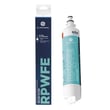
| Small cubes or slow ice | Restricted filter or low water flow | Replace GE refrigerator water filter RPWFE; purge dispenser air |
| Ice tastes or smells odd after startup | Normal after first start | Discard the first 24 hours of ice production |
| Ice production suddenly drops | Filter restriction or freezer warming | Replace filter; check door seal and airflow |
Parts that commonly solve ice maker complaints
If the basics check out and the ice maker still will not produce, these model-compatible parts are common fixes:
- GE refrigerator water filter RPWFE (restriction is a top cause of low ice)
- Refrigerator ice maker assembly WR30X28731 (mechanical or internal ice maker failure)
- Valve tri wa WR57X10102 (water inlet valve not filling the mold)
Why it matters
Ice makers are sensitive to water flow and temperature. A partially restricted filter or a water valve that is not filling consistently can look like an “ice maker failure” even when the ice maker itself is fine.
Last updated: February 2026