Owner’s manual
 Error Codes






Why does the arm of the ice maker keep going up?
On the Whirlpool W8RXEGMWB03, the ice maker’s wire shutoff arm is designed to lift to the OFF position when the ice bin is full or when the arm is being bumped or jammed. If it keeps popping up, the most common causes are a stuck ejector, an ice jam, or the arm not moving freely.
- Make sure the wire shutoff arm is fully lowered to the ON (arm down) position.
- Check for an ice cube jammed in the ejector area; remove ice with a plastic utensil.
- Empty the ice bin and reinstall it fully so it is not pushing the arm upward.
- Confirm the freezer is cold enough; after a hookup or temperature change, allow 24 hours for ice production.
- If the ice maker was just installed, allow up to 72 hours for full ice production to begin.
| Shutoff arm position | What it means | What to do |
|---|---|---|
| Arm up | Ice maker OFF | Lower the arm to resume ice making |
| Arm down | Ice maker ON | Normal operation |
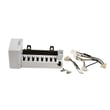
If the arm moves up because the mechanism is binding (for example, repeated jamming at the mold or ejector), the ice maker assembly can be the root cause.
- Inspect the ice maker mold for distorted ice or repeated jams.
- If the arm feels loose, bent, or the module cycles erratically, replacement is a common repair.
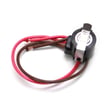
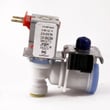
Helpful parts for this model:
When the shutoff arm stays up, the ice maker remains OFF and you will get little to no ice. Repeated jamming can also lead to inconsistent cube size and intermittent ice production.
For the exact ON/OFF arm position and ice maker troubleshooting steps for the W8RXEGMWB03, follow the W8RXEGMWB03 owner's manual.
Last updated: January 2026
What is the lifetime of a Whirlpool refrigerator?
Most Whirlpool refrigerators, including the Whirlpool W8RXEGMWB03 top-mount refrigerator, typically last about 13 years with normal household use and basic maintenance. Keeping airflow clear, temperatures correct, and seals tight helps you reach that expected lifespan.
A refrigerator’s life is mostly determined by compressor run time, heat removal, and how well the doors seal.
- Average expected life: about 13 years
- Heavy use (frequent door openings, warm garage installs) can shorten life
- Good maintenance (cleaning coils, fixing leaks early) can extend life
- Power issues (surges, repeated outages) can stress the compressor and controls
Use your W8RXEGMWB03 owner's manual for model-specific care steps and cleaning guidance.
- Keep the refrigerator at 37°F and the freezer at 0°F (typical targets)
- Clean dust from the condenser area regularly (more often with pets)
- Make sure door gaskets seal all the way around; fix gaps quickly
- Keep vents inside the compartments unblocked for proper airflow
- If you have an ice maker, address slow fill or no ice early to prevent leaks
| Symptom | Often repairable? | Common next step |
|---|---|---|
| Warm fridge, freezer OK | Yes | Check airflow and evaporator fan operation |
| Frost buildup on back wall | Yes | Check defrost system components |
| Loud buzzing/clicking at start | Sometimes | Check start components and compressor health |
| Water under fridge | Yes | Check drain path and water supply connections |
If cooling is weak and you hear fan issues, the refrigerator evaporator fan motor WP2315539 is a common service item on many Whirlpool top-mount designs.
Knowing the typical 13-year lifespan helps you decide whether to repair or replace. If your W8RXEGMWB03 is under 10 years old, many cooling, defrost, and ice maker problems are usually worth repairing; past that point, repeated sealed-system or compressor issues can shift the value equation.
Last updated: January 2026
What is the most common problem with a Whirlpool refrigerator?
The most common Whirlpool refrigerator issue is a cooling complaint caused by restricted airflow or a frost/defrost problem. On model W8RXEGMWB03, start by making sure interior vents are not blocked and that air can circulate between the freezer and fresh-food sections (see the W8RXEGMWB03 owner's manual).
- Make sure packages are not blocking the freezer or refrigerator air vents.
- Confirm both doors close easily and seal fully.
- Listen for the evaporator fan; it should run and may speed up when doors open.
- Look for heavy frost on the freezer back wall (often points to a defrost issue).
- Verify temperature settings were not accidentally changed.
| Symptom | Most likely cause | What to do next |
|---|---|---|
| Fridge warm, freezer cold | Airflow blocked or iced-over evaporator area | Clear vents; check for frost buildup |
| Both sections warm | Compressor/fan not running, dirty condenser area, or control issue | Listen for compressor and fans; check airflow |
| Frost buildup in freezer | Defrost system problem | Inspect defrost components |
| Noisy operation | Normal high-efficiency compressor/fan sounds | Compare to normal sound descriptions in manual |
If you find heavy frost or an iced-over evaporator area, these model-matched parts are common fixes:
- Refrigerator defrost bi-metal WPW10225581 (opens/closes to protect the defrost heater)
- Refrigerator heater WP2263749 (melts frost during defrost)
- Refrigerator evaporator fan motor WP2315539 (moves cold air through both compartments)
This refrigerator is designed to run efficiently; the compressor and fans may run longer and sound different than older units. When vents are blocked or frost builds up, cold air cannot move properly, so temperatures rise and food quality suffers.
Last updated: January 2026