Installation guide
 Owner’s manual
 Error Codes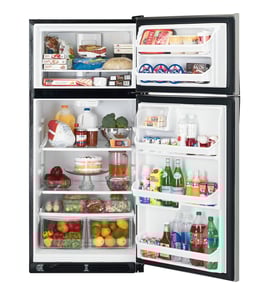


Are top mount or bottom mount fridges better?
For most households, a top-mount refrigerator like the Frigidaire FRT17G5CSB5 is the better all-around choice because it typically uses less energy and has simpler, proven airflow and defrost design; a bottom-mount is often better if you want fresh-food items at eye level and bend less.
Quick comparison: top mount vs bottom mount
- Top mount (freezer on top): usually lower operating cost and fewer complex components
- Bottom mount (freezer on bottom): easier access to the refrigerator section, often better for back or knee comfort
- Either style: performance depends heavily on door sealing, airflow clearances, and temperature control settings
| Feature | Top mount (like FRT17G5CSB5) | Bottom mount |
|---|---|---|
| Fresh-food access | Lower, more bending | Higher, less bending |
| Energy use (typical) | Lower | Higher |
| Repair complexity (typical) | Simpler | More complex |
| Best for | Value, efficiency, reliability | Convenience, frequent fridge access |
What matters most for real-world performance
Even the “better” style will struggle if airflow and sealing are off. For the FRT17G5CSB5, we recommend:
- Keep installation clearances for airflow (sides/top and back) per the owner's manual
- Level the cabinet so doors close freely and seal consistently
- Avoid overpacking; blocked vents reduce cooling and can cause temperature swings
- Check door bins and rails for secure fit so the door closes fully (a loose bin can interfere)
- If you notice warm temps in the fresh-food section, inspect the damper area and airflow path
Why it matters
Top-mount designs tend to be more energy-efficient because the freezer (coldest compartment) is above the fresh-food section, and the cooling system can circulate cold air downward more naturally. Bottom-mount units trade some efficiency for day-to-day convenience.
Last updated: February 2026
What are the disadvantages of a top mount fridge?
A top-mount refrigerator like the Frigidaire FRT17G5CSB5 puts the freezer on top and the fresh-food section below, so the main tradeoffs are less convenient access to everyday items, fewer built-in organization features than some newer designs, and fewer dispenser options on many models. See the owner's manual for your exact feature set.
Common disadvantages (what you will notice day to day)
- You bend more to reach fresh-food shelves and crispers (the most-used area is lower).
- Organization can be simpler; door bins and shelves are often adjustable, but layouts are typically less specialized.
- Many top-mount models do not include an external water or ice dispenser.
- Freezer space can feel narrower for wide boxes because the compartment is on top.
- Temperature differences between compartments can be more noticeable if airflow is restricted.
What you can do to reduce the downsides
- Keep frequently used items at eye level in the refrigerator section.
- Avoid blocking vents; good air circulation helps both compartments cool evenly.
- Level the cabinet so doors close consistently; the installation guidance calls for the refrigerator to be level side-to-side and tilted about 1/4 inch (6 mm) front-to-back.
- Use door storage for quick-grab items; the manual describes adjustable door bins and a dairy compartment for short-term storage.
Quick comparison: top-mount vs bottom-freezer
| Feature | Top-mount (like FRT17G5CSB5) | Bottom-freezer |
|---|---|---|
| Fresh-food access | Lower, more bending | Higher, easier access |
| Freezer access | Eye level | Lower drawer/basket |
| Organization | Often simpler | Often more specialized |
| Dispensers | Less common | More common on many models |
Why it matters
Most households open the fresh-food door far more than the freezer. With a top-mount design, that means more bending and more time with the door open, which can affect convenience and temperature stability if the refrigerator is heavily used.
Last updated: February 2026
What is the top part of a refrigerator called?
On a Frigidaire top-mount refrigerator like model FRT17G5CSB5, the top compartment is the freezer compartment (often just called the freezer). It is designed to keep foods frozen and typically includes door shelves plus interior shelving for more stable temperatures (see the owner's manual).
What you will typically find in the top freezer section
- Freezer door shelves for smaller, frequently used items
- Interior shelf space for items that need steadier temperatures
- A freezer light cover and bulb on some configurations
- Cold-air circulation paths that help freeze food quickly
Best storage practices for the top freezer
The freezer door is convenient, but it is also the area with the most temperature variation when you open the door.
- Store ice cream and juice in the freezer interior, not on the door
- Leave space between packages so cold air can circulate
- Avoid overpacking; blocked airflow can reduce cooling performance
- Keep the door closed as much as possible to prevent warming and frost
Quick reference: freezer door vs freezer interior
| Location | Best for | Avoid storing |
|---|---|---|
| Freezer door shelves | Small items you grab quickly | Ice cream, juice, items that soften easily |
| Freezer interior | Long-term frozen storage, temperature-sensitive foods | Overstuffing that blocks airflow |
Why it matters
Knowing the top section is the freezer helps with troubleshooting and food storage. Many “freezer not cold enough” complaints come from blocked airflow or storing temperature-sensitive foods on the door instead of the interior.
Last updated: February 2026
What does CF mean on a Frigidaire refrigerator?
On a Frigidaire FRT17G5CSB5 refrigerator, CF is a control-related fault that points to a communication or response problem between the user interface and the main control (often wiring, a connection, or a failed control board). Use the owner's manual to confirm the display behavior and safe reset steps for your exact configuration.
What to do first (quick checks)
- Unplug the refrigerator for 5 minutes, then plug it back in to reset the controls.
- Confirm the outlet has power and the plug is fully seated.
- Make sure the temperature control is not set to "0" (that turns off the compressor but not power to the unit).
- Wait 20 minutes after restoring power; the refrigerator may be in a normal defrost cycle.
- If the code returns, inspect for loose connections at the control housing (only if you can do so safely).
What CF usually affects
CF commonly shows up with symptoms like warm temperatures, intermittent cooling, or fans/compressor not running consistently. If the refrigerator is not cooling, we treat CF as a control system issue first.
Common causes vs. what you can observe
| Likely cause | What you may notice | Typical next step |
|---|---|---|
| Loose or damaged wiring/connector | Code comes and goes, unit works after reset | Reseat connections, check harness routing |
| Failed main control or interface | Code returns quickly after reset | Diagnose controls, replace the failed component |
| Power interruption/voltage dip | Code appears after outage | Reset and monitor for recurrence |
Why it matters
A control communication fault can prevent the compressor and fans from running when they should, which can lead to unsafe food temperatures. Addressing CF quickly helps protect cooling performance and reduces strain on components like the condenser fan motor.
Helpful related info
- If your display is showing multiple codes or you want code definitions in one place, use our Frigidaire refrigerator error codes reference.
Last updated: February 2026