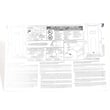
Installation guide
 Owner’s manual
 Error Codes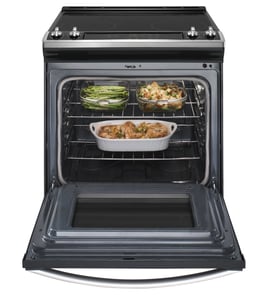



How big is the Kenmore 7909421240C?
The Kenmore 7909421240C is a standard 30-inch freestanding electric range size class. For exact cutout, clearance, and leveling requirements for your kitchen, we use the measurements and diagrams in the 7909421240C installation guide.
Typical size you should plan for
Most 30-inch freestanding electric ranges measure in these approximate ranges:
- Width: about 30 in.
- Depth (to door handle): about 25 to 28 in.
- Height (to cooktop/backguard): about 36 in. (adjustable with leveling legs)
- Oven capacity: commonly 3.0 to 5.0 cu. ft. depending on configuration
What to measure at home (so it fits the first time)
Use a tape measure and check these points before ordering trim kits or planning cabinetry:
- Opening width at the front and back (walls are not always square)
- Depth from the back wall to the front edge of the countertop
- Clearance behind the range for the power cord/strain relief
- Height from floor to countertop, then confirm leveling leg adjustment range
- Door swing clearance so the oven door can open fully
Quick planning table
| Measurement | What it affects | What to use |
|---|---|---|
| Width | Whether the range sits flush between cabinets | Installation guide diagram |
| Depth | Whether the door/handle sticks out past counters | Your countertop depth + guide |
| Height | Leveling, alignment with countertop | Leveling legs + guide |
Why it matters
Correct sizing prevents heat damage to nearby surfaces and avoids having to reach over hot surface elements. The installation instructions also cover safe placement and grounding, which are essential for an electric range installation. For operating details (features, cleaning, and general use), we follow the 7909421240C owner’s manual.
Last updated: February 2026
How many watts does a Kenmore oven use?
For the Kenmore 7909421240C electric range, the oven’s exact wattage depends on which heating circuit is running (bake, broil, convection fan, or preheat). Most electric ovens of this type draw about 3,000 to 5,000 watts while actively heating; check the rating label and the 7909421240C owner's manual for the specific electrical ratings.
Quick wattage ranges you can expect
These are typical values for many Kenmore electric ranges and help you estimate energy use:
- Bake element: often 2,500 to 3,500 watts
- Broil element: often 3,000 to 4,500 watts
- Convection fan motor: typically under 200 watts
- Preheat: can run bake and broil together briefly, so wattage is higher
- Cooktop elements: vary widely by element size and setting
Where to find the exact wattage for model 7909421240C
We recommend using two model-specific sources:
- The rating plate (model and serial tag) on the range frame (commonly visible when you open the storage or warmer drawer)
- The electrical specifications section in the 7909421240C installation guide
What you’re looking for on the label
- kW or W at 240V (sometimes also listed at 208V)
- Amps (A)
- Circuit requirement (commonly a dedicated 40A or 50A range circuit)
Estimating cost to run the oven
Use this simple approach to estimate operating cost.
| If the oven is drawing | Energy used in 1 hour | Cost at $0.16/kWh |
|---|---|---|
| 3,000 W (3.0 kW) | 3.0 kWh | $0.48 |
| 4,800 W (4.8 kW) | 4.8 kWh | $0.77 |
| 5,000 W (5.0 kW) | 5.0 kWh | $0.80 |
Why it matters
Knowing wattage helps us choose the right electrical supply (breaker size and wiring) and gives a realistic estimate of energy use, especially during preheat when the oven can draw near its maximum.
Last updated: February 2026
Why is my Kenmore electric oven not working?
If your Kenmore electric range model 7909421240C is not working, the most common causes are a power supply problem, a control that needs to be cleared after a fault, or a failed heating or sensing component. Start with the simple power and control checks, then move to bake/broil and sensor diagnostics.
Quick checks first (fastest fixes)
- Confirm the range is fully plugged in and the cord is seated correctly.
- Check the home breaker; a range can lose one leg of power and act “dead” or heat poorly.
- If the control is beeping and showing an F code, press STOP/CLEAR to stop the beeping and clear the display.
- After any power outage, turn the range off; when power returns, reset the clock and oven function.
- Review model-specific control and operating steps in the 7909421240C owner's manual.
If the cooktop works but the oven will not heat
These checks focus on the oven heating circuit.
- Bake element: Look for visible damage (blistering, cracks) and test for continuity. Consider replacing the frigidaire range bake element 316413800 if it is open.
- Broil element: Some models use broil to help preheat; test for continuity and replace if open.
- Oven temperature sensor: A failed sensor can prevent proper heating or cause erratic temps; test resistance per the manual and replace the frigidaire range oven temperature sensor 316490000 if out of spec.
What the symptoms usually mean
| Symptom | Most likely cause | What to do next |
|---|---|---|
| Entire range does not operate | Power supply, wiring, outage | Breaker, outlet, cord, then wiring per guide |
| Control beeps with F code | Electronic control detected a fault | Press STOP/CLEAR; then follow error-code steps |
| Oven will not heat but cooktop works | Failed bake/broil element, sensor, or control | Continuity tests; sensor check; inspect wiring |
Why it matters
An electric range needs full, stable power and accurate temperature feedback to heat safely and evenly. Fixing the root cause prevents repeated shutdowns, poor baking results, and overheating conditions.
Helpful references
- Use the installation guide to confirm power connection and installation basics.
- If you see an error code, use the Kenmore 790 range 4-digit error codes guide to match the code to the most likely failed part.
Last updated: February 2026