Owner’s manual
 Error Codes


How to lower wheels on Kenmore refrigerator?
On Kenmore refrigerator model 79579983511, you lower the front by turning the front leveling legs to the right (clockwise). The adjustment screw does not come out; it simply changes the height so the cabinet sits level and the doors close properly. See the owner's manual for the exact leveling points and tool access.
How to lower the front (leveling legs)
- Pull the refrigerator forward enough to reach the front leveling legs.
- Use an 11/16-inch wrench or a flat-blade screwdriver (depending on the leg style).
- Turn the leveling leg to the right to lower that side.
- Turn the leveling leg to the left to raise that side.
- Make small adjustments, then recheck door closing.
Quick checklist
- Unplug the refrigerator before putting hands near moving parts.
- Adjust both front leveling legs in small, equal turns when you want a front-to-back tilt change.
- Recheck that both fresh food doors close easily.
- If the cabinet rocks, lower the high side or raise the low side until stable.
- If doors do not self-close, tilt the refrigerator slightly more to the rear (raise the front slightly).
Door not even after leveling? Use the door alignment nut
This model uses an adjustable nut at the bottom hinge to fine-tune door height after the cabinet is level.
| What you see | What to adjust | Typical result |
|---|---|---|
| One fresh food door sits higher | Bottom hinge adjustable nut | Doors align at the top and center gap evens out |
| Doors align but do not close easily | Front leveling legs (tilt slightly rearward) | Better self-closing and sealing |
| Cabinet feels unsteady | Front leveling legs | Reduces rocking and vibration |
Why it matters
Proper leveling helps the door gaskets seal, prevents warm air leaks, reduces frost and moisture issues, and improves ice maker and water dispenser performance by keeping the refrigerator stable.
Last updated: February 2026
Where is the model number located on a Kenmore refrigerator?
On Kenmore refrigerator model 79579983511, the model and serial number are printed on an identification label inside the fresh food (refrigerator) compartment, typically on the interior liner. Use the label information when ordering parts or checking service details in the 79579983511 owner's manual.
Where to look first (fastest checks)
- Open the refrigerator door and scan the interior side walls (liner)
- Check near the top side wall or upper area of the fresh food compartment
- Look behind or beside the crisper drawers if the label is lower on the liner
- Use a flashlight; labels can be easy to miss against white plastic
Other common label locations on Kenmore refrigerators
If you do not see it right away in the fresh food compartment, these are other common places Kenmore places ID labels:
- Inside the freezer compartment side wall
- On the door frame (hinge side) when the door is open
- Behind the toe grille (kick plate) at the bottom front
What information you should write down
| Label item | What it’s used for | Example use |
|---|---|---|
| Model number | Identifies the exact refrigerator design | Matching parts to 79579983511 |
| Serial number | Identifies production run details | Service history, technician diagnostics |
| Date of purchase (your records) | Helps with documentation | Warranty paperwork, receipts |
Why it matters
Kenmore model numbers can look similar, but parts like a water filter, ice maker, or door gasket can vary by model. Using the exact model number from the ID label helps ensure you get the correct replacement part the first time.
Last updated: February 2026
Is a top mount or bottom mount fridge better?
A bottom-mount refrigerator like Kenmore model 79579983511 is better when you want everyday items at eye level and more organized freezer access (pull-out drawers). A top-mount is better when you want the simplest layout and typically lower energy use.
Quick comparison
| Feature | Bottom-mount (like 79579983511) | Top-mount |
|---|---|---|
| Fresh food access | Easier (less bending) | More bending |
| Freezer access | Drawer-style, organized | Shelf-style, simpler |
| Organization | Usually more bins and dividers | Usually fewer features |
| Energy use | Often slightly higher | Often slightly lower |
| Price/complexity | Typically higher/more features | Typically lower/simpler |
Choose a bottom-mount if you want
- Fresh food at eye level (less bending for daily use)
- Better freezer organization with pull-out baskets
- Easier access for wide items in freezer drawers
- A layout that supports frequent door openings with less “search time”
Choose a top-mount if you want
- A simpler design with fewer moving parts and features
- A freezer you access more often than the refrigerator section
- A layout that is often more budget-friendly
Why it matters for real-world use
Your fridge style affects comfort and efficiency. With a bottom-mount, we typically see people keep the refrigerator doors open for less time because shelves and bins are easier to reach and organize. Your owner's manual also explains shelf adjustment and door closing and alignment tips that help any style run efficiently.
Setup notes that matter either way (from the manual)
- Install where ambient temperature stays 55°F to 110°F.
- Allow clearance: at least 24 inches in front for door swing and at least 2 inches behind for airflow.
- If doors do not close easily, level the unit so it tilts slightly to the rear; adjust both leveling legs evenly.
Last updated: February 2026
What size is Kenmore refrigerator model 79579983511?
Kenmore refrigerator model 79579983511 is a full-size bottom-mount style refrigerator; most units in this series are about 33 inches wide, 31 to 34 inches deep (depth varies with handles), and about 68 inches tall. For the exact cabinet and clearance dimensions, use the owner's manual.
Typical dimensions and what to measure
When you are planning a fit, we recommend measuring both the refrigerator and the opening.
- Width: measure the cabinet at the widest point (usually the hinge side)
- Depth: measure without handles and with handles
- Height: measure to the top hinge cover (not just the cabinet)
- Door swing space: allow room for French doors to open fully
- Ventilation clearance: leave space above and behind for airflow
Quick planning table (common fit checks)
| What you are checking | What to use | Why it matters |
|---|---|---|
| Will it fit between cabinets? | Width (cabinet and hinge side) | Prevents rubbing and door alignment issues |
| Will it stick out past counters? | Depth with handles | Helps match a standard 24-inch counter line |
| Will it clear overhead cabinets? | Height to top hinge | Avoids installation surprises |
| Can drawers open fully? | Door swing and interior clearance | Ensures freezer drawer and crispers operate normally |
Why it matters
Correct sizing prevents installation problems like doors that cannot open fully, poor airflow that can affect cooling performance, and water line kinks that can impact the ice maker and water dispenser.
Related help for this model
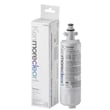
If you are also planning filter access space or troubleshooting low water flow, see how to replace the water filter in a Kenmore refrigerator. The replacement filter commonly used for this model is the genuine Kenmore refrigerator water filter 9690 AGF80300801.
Last updated: February 2026
What are the most common problems with Kenmore refrigerators?
The most common Kenmore refrigerator problems are cooling issues, ice maker or water dispenser failures, leaks, and frost buildup. On Kenmore model 79579983511, these symptoms often trace back to airflow restrictions, a failing ice maker or water valve, or a defrost sensing problem; use the owner's manual for model-specific checks.
Most common symptoms and what they usually point to
- Not cooling or warm temperatures: dirty condenser area, airflow blocked by food, evaporator fan or sealed-system issue
- Ice maker not making ice: water supply off, frozen fill tube, failed ice maker
- No water from dispenser: clogged filter, low house water pressure, failed inlet valve
- Water leaking or puddles: clogged/iced drain, door not sealing, cracked water line
- Frost buildup in freezer: door left ajar, bad door gasket, defrost sensor/heater issue
Parts that commonly solve these problems (when symptoms match)
If your symptoms match, these model-compatible parts are common fixes:
- Water taste/flow issues: genuine Kenmore refrigerator water filter 9690 AGF80300801
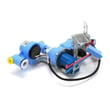
- No water to ice maker/dispenser: lg refrigerator water inlet valve AJU72992603
- Frost/defrost problems: refrigerator defrost sensor assembly 6615JB2005R
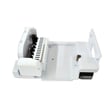
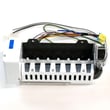
- Ice production issues: lg refrigerator ice maker AEQ73130004
- Poor heat removal (warm fridge): refrigerator condenser coil ACG73645004
Quick checks we recommend before replacing parts
- Confirm temperature settings (typical targets: 37°F fresh food, 0°F freezer).
- Make sure vents inside the refrigerator and freezer are not blocked.
- Verify doors close fully; inspect gaskets for gaps or tears.
- If water is slow, replace the filter and fully seat it; then flush several cups of water.
- If ice is slow, confirm the shutoff arm or sensor is in the ON position and the bin is seated.
Symptom-to-part cheat sheet
| Symptom | Most likely area | Example part on this model page |
|---|---|---|
| Slow/no water at dispenser | Filter or inlet valve | AGF80300801 or AJU72992603 |
| No ice production | Ice maker or water supply | AEQ73130004 |
| Frost buildup, warming over time | Defrost system | 6615JB2005R |
| Fridge warm, freezer struggling | Condenser/airflow | ACG73645004 |
Why it matters
Catching the root cause early helps prevent food spoilage and reduces strain on the compressor. Simple airflow and door-seal issues can mimic major failures, so quick checks can save time and parts.
Last updated: February 2026