Owner’s manual
 Error Codes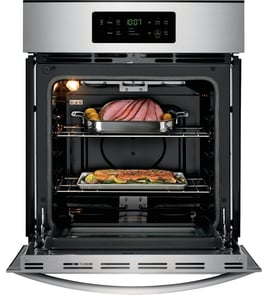



How to find wall oven model number?
For Kenmore wall oven model 91141189991, the model and serial number label is typically on the front frame behind the oven door. Open the door and look along the frame (often near the top on double ovens) for a rating plate sticker.
Check these spots in order:
- Front frame behind the oven door (most common location)
- Along the door rim or inner edge of the door opening
- On an inside side panel (visible when the door is open)
- On the upper oven frame area (for double wall ovens)
For the exact location callout for this series, use the 91141189991 owner's manual.
- Use a flashlight and look for a silver or white rating label
- Wipe grease or cleaner residue off the frame so the numbers are readable
- Write down both model number and serial number; both are useful for parts lookup
- Take a photo so you can zoom in and avoid transposing digits
| Item on label | What it’s used for | Example format |
|---|---|---|
| Model number | Matching parts and diagrams | 911.41189xxx |
| Serial number | Date/production tracking | Letters and numbers |
| Electrical rating | Verifying power requirements | Volts/amps |
We use the model number to match the correct Kenmore wall oven parts, wiring layout, and service information. Even small model-number differences can change parts like the temperature sensor, door hinge, or cooling fan.
Last updated: January 2026
Are all 30 inch wall ovens the same size?
No. “30-inch” wall ovens are grouped by nominal width, but the exact outside dimensions and the required cabinet cutout can vary by brand and model. For Kenmore model 91141189991 (a 30-inch double electric built-in wall oven), use the cutout and clearance specs in the 91141189991 owner's manual before ordering cabinetry or a replacement oven.
Most 30-inch wall ovens are designed to fit a 30-inch class opening, but manufacturers allow small differences in:
- Overall width (often just under 30 inches)
- Cutout width tolerance (varies by model)
- Overall height (single vs. double ovens differ a lot)
- Depth behind the front frame (important for flush installs)
- Trim overlap (how much the oven face covers the cabinet opening)
Measure the cabinet opening and compare it to the oven’s required cutout dimensions.
- Cutout width: inside-to-inside of the cabinet opening
- Cutout height: inside-to-inside top to bottom
- Cutout depth: from cabinet front to back wall (allowing for wiring)
- Front clearance: door swing and handle clearance
- Electrical location: junction box placement and slack for the conduit
| Spec type | What it describes | Why it matters |
|---|---|---|
| Nominal size (30-inch) | Category label | Helps narrow options, not a guarantee |
| Actual oven dimensions | Physical oven size | Determines whether the unit physically fits |
| Cutout dimensions | Cabinet opening required | Prevents gaps, binding doors, or install issues |
Even small differences can cause big problems: an oven that is slightly too wide will not slide in, and an opening that is too large can leave visible gaps around the trim. Using the model-specific specs avoids rework and protects the cabinet finish.
Last updated: January 2026
What is the best brand for electric wall ovens?
There is no single “best” brand for every kitchen; the best electric wall oven brand is the one that fits your cooking needs, cabinet cutout, and service support. For Kenmore model 91141189991, we recommend comparing features like self-clean, convection, and control layout using the 91141189991 owner's manual.
- Fit first: confirm 30-inch class size, cabinet cutout requirements, and electrical supply match your home.
- Cooking performance: look for even baking, reliable broil performance, and stable temperature control.
- Features you will actually use: self-clean, convection, delay start, Sabbath mode, or smart features.
- Service and parts availability: choose a brand with strong local service and readily available replacement parts.
- Long-term ownership cost: consider typical repair frequency and part pricing, not just purchase price.
| What you care about most | What to prioritize | What to verify before buying |
|---|---|---|
| Even baking results | Convection options, strong temperature control | Rack positions, convection modes, calibration steps |
| Easy cleaning | Self-clean cycle design | Door lock behavior, cleaning instructions |
| Reliability | Proven platform, parts availability | Common wear parts and service access |
| Quiet operation | Cooling fan design | Fan run time after baking and during self-clean |
This Kenmore electric built-in oven is a 30-inch self-cleaning double wall oven style. When comparing brands, match the features you already use (bake, broil, self-clean) and confirm you can maintain key components over time.
Common parts that influence performance and ownership experience include:
- Temperature sensing and heat regulation (example: g.e. wall oven temperature sensor WB23X5340)
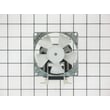
- Cooling airflow after cooking (example: wall oven cooling fan assembly WB26K5061)
- Door sealing and heat retention (gasket condition, hinge alignment)
A wall oven is a built-in appliance; choosing based on fit, features, and serviceability prevents expensive cabinet modifications and reduces downtime if you ever need parts like a temperature sensor, door gasket, or cooling fan.
Last updated: January 2026
Are electric wall ovens 110 or 220?
Most electric wall ovens like Kenmore model 91141189991 are wired for 240 volts (often called 220/230/240V), not a standard 120-volt (110) household outlet. They are typically hardwired to a dedicated double-pole breaker rather than plugged into a regular receptacle.
Most built-in electric ovens use a dedicated 240V circuit because the bake and broil elements draw much more power than a 120V circuit can safely provide.
- Dedicated 240V circuit (double-pole breaker)
- Typically hardwired in the junction box behind the oven
- Uses heavier-gauge wiring than a standard outlet circuit
- Often shares the same circuit type as an electric range
- Exact breaker size and wire gauge depend on the oven’s rating plate
Use the installation and electrical specs in the 91141189991 owner's manual. Also check the rating plate (usually on the front frame behind the oven door) for voltage and amperage.
- Look for a double breaker handle in your electrical panel (common sign of 240V)
- Verify the oven is connected to a junction box, not a standard outlet
- Confirm the rating plate lists 240V (or 208/240V)
| Appliance connection | Typical voltage | Typical setup |
|---|---|---|
| Standard kitchen outlet | 120V | Plug-in receptacle |
| Electric wall oven | 240V (sometimes 208/240V) | Hardwired to junction box |
| Gas wall oven | 120V | Plug-in (controls/ignition) |
Using the correct voltage protects the control board, heating elements, and wiring from overheating or damage. It also helps the oven heat properly and maintain stable baking temperatures.
Last updated: January 2026