 Owner’s manual



What is the capacity of rtw4340sq0?
The exact wash basket capacity for the Roper RTW4340SQ0 washer is not stated in the model-specific information we have for this model. For practical loading, we recommend following the load-level guidance in the RTW4340SQ0 washer user manual to avoid overfilling and poor cleaning.
How to estimate the right load size (without a published capacity)
Even when a cubic-foot number is not listed, you can load RTW4340SQ0 correctly by using these rules:
- Load items loosely; do not pack them down.
- Keep the load even around the agitator to reduce vibration.
- Fill only to the top of the basket (not above it).
- Choose the correct water level/load size setting for the fabric and load.
- Mix large and small items so clothes move freely through wash water.
Why published “capacity” numbers can be confusing
Capacity can be listed as tub volume, usable wash volume, or a marketing “equivalent” size. That is why two sources can quote different cubic-foot values for the same model family.
Quick guidance table for everyday loads
| Load type | What it looks like in the basket | Best practice |
|---|---|---|
| Small | Items cover the bottom and rise a few inches | Use a lower water level |
| Medium | Basket about half full, loose | Balance items around agitator |
| Large | Basket near the top, still loose | Avoid packing; use highest water level |
When capacity matters for troubleshooting
If you are seeing poor cleaning, lint, or tangling, the “capacity” issue is often really a loading or water-level issue.
- If clothes come out with lint, review how to avoid lint when washing clothes video.
- If loads are consistently too wet, reduce load size and re-balance the basket.
- If the washer is noisy or walking, check leveling and avoid overloading.
Why it matters: Correct loading protects the drive system, improves agitation, and helps the washer drain and spin properly.
Last updated: January 2026
How to reset a washing machine that won't spin?
On the Roper washer model RTW4340SQ0, there is no special electronic “reset” procedure because this washer uses a mechanical timer. What you can do safely is a power cycle (unplug briefly) and then restart the cycle; if it still will not spin, the issue is usually lid-safety or draining related.
What to do first on RTW4340SQ0
- Push the timer knob in to stop the washer.
- Set the timer to a spin portion of the cycle.
- Make sure the lid is fully closed (this model will not spin with the lid open).
- Unplug the washer for 1 minute, then plug it back in (this is a power cycle, not a programmed reset).
- Pull the timer knob out to restart.
For model-specific operating and troubleshooting notes, use the RTW4340SQ0 washer user manual.
If it still will not spin: checks that match this design
Because RTW4340SQ0 will not spin with the lid open and must drain to spin properly, focus on these basics:
- Lid switch function: if the washer acts like the lid is open, it will not spin.
- Drain path: a kinked drain hose or a clog can prevent draining, which can stop spinning.
- Oversudsing: too much detergent can slow draining and leave the cycle “stuck.”
- Load balance: redistribute bulky items and try spin again.
Parts to consider if symptoms point to a failure
If your checks suggest a component problem, these are model-compatible parts often involved in “no spin” complaints:
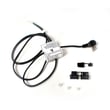
- Washer lid switch assembly WP8318084 (prevents spin if the lid signal is not made)
- Washer drain pump WP3363394 (won’t drain well, spin may not complete)
- Coupling 285753A (motor-to-transmission coupling; basket may not spin if broken)
Symptom-to-next-step guide
| What you observe | What it suggests on RTW4340SQ0 | What we do next |
|---|---|---|
| No spin, no drain | Drain restriction or pump issue | Check hose routing, clogs, pump operation |
| Drains but will not spin | Lid switch or drive issue | Confirm lid switch clicks and engages |
| Motor runs, basket does not spin | Coupling/drive issue | Inspect coupling and drive components |
Why it matters
A washer that cannot spin leaves clothes soaking wet and can overheat the drive motor if repeatedly restarted. A simple power cycle is safe to try, but repeated no-spin usually means a lid-safety, drain, or drive component needs attention.
Last updated: January 2026
How long does a Roper washing machine last?
Roper does not publish a specific expected service-life number for the Roper RTW4340SQ0 washer, so we cannot give a model-specific lifespan. In typical household use, many top-load washers run about 10 to 15 years, but actual life depends most on load habits, water conditions, and how quickly you address small problems.
What we can say for RTW4340SQ0 (model-specific)
The best model-specific guidance is the care and troubleshooting information in the RTW4340SQ0 washer user manual. Following those steps helps reduce wear that shortens the life of this washer.
Key care steps called out for this model include:
- Load loosely and only up to the top of the basket; avoid overloading.
- Keep the washer level and loads balanced to reduce vibration and component stress.
- Clean the washer interior by running a complete hot cycle with 1 cup chlorine bleach plus 2 cups detergent (repeat if needed).
- Replace water inlet hoses after 5 years; inspect for bulges, kinks, cuts, wear, or leaks.
- Turn off the water supply if the washer will sit unused for an extended period.
Common “life-shortening” patterns
- Chronic overloading or consistently unbalanced loads
- Hard-water scale, detergent buildup, and poor cleaning performance over time
- Continuing to run the washer with leaks, grinding noises, or slow draining
- Installation issues (unlevel floor, loose fill hoses, poor drain setup)
Repair vs replace: how we suggest deciding
When RTW4340SQ0 has a single clear failure, repair is often worthwhile. When multiple major symptoms show up close together, replacement can make more sense.
| Symptom on RTW4340SQ0 | Possible causes (examples) | Typical next step |
|---|---|---|
| Won’t agitate or spin | Lid not closed, lid switch circuit, motor coupling, drive components | Do basic checks first, then diagnose |
| Won’t drain or drains slowly | Drain hose restriction, pump issue, clogs | Inspect hose and pump path |
| Loud banging or walking | Unbalanced load, leveling, suspension wear | Re-level and correct loading |
If your RTW4340SQ0 will not agitate or spin, one part to test in the safety interlock circuit is the washer lid switch assembly WP8318084; it is not the only possible cause, but it is a common no-spin/no-agitate checkpoint on lid-switch top-load designs.
Why it matters
Knowing the typical lifespan range helps you plan maintenance and decide whether a repair is a smart investment based on the washer’s age, condition, and the cost of the fix.
Last updated: January 2026
How good are Roper washing machines?
Roper washers, including model RTW4340SQ0, are built around straightforward top-load washing with an agitator and standard cycle controls. How “good” it is for you depends less on brand claims and more on whether the washer’s cleaning style, noise tolerance, and maintenance needs match your household.
What we can confirm for RTW4340SQ0
From the model’s documentation, RTW4340SQ0 is operated with traditional top-load steps such as selecting water level, wash temperature, and cycle time; it also relies on proper loading and balance for best results. For model-specific operating and care details, use the RTW4340SQ0 washer user instructions manual.
Key takeaways that affect satisfaction:
- Load evenly and avoid overloading to reduce out-of-balance spinning
- Match water level to load size so clothes can move freely
- Measure detergent to avoid excessive suds and poor rinsing
- Keep the lid closed; the washer will not agitate or spin with the lid open
- Inspect inlet hoses periodically and replace if worn (the manual recommends replacement after 5 years)
How to evaluate “good” for your needs
Instead of relying on general ratings, we recommend judging performance using a few practical checks over several loads.
| What you care about | What to check on RTW4340SQ0 | What “good” looks like |
|---|---|---|
| Cleaning | Proper agitation and water level | Clothes circulate and come out clean without residue |
| Spin results | Load balance and cycle choice | Load is not overly wet at end of cycle |
| Noise/vibration | Leveling and balanced loads | No excessive banging or walking |
| Reliability | Preventive care | No leaks, consistent fill, drain, and spin |
If performance drops, common wear items to consider
If the washer fills and drains but agitation becomes weak (clothes barely move), worn agitator components are a common cause on many agitator-style top-loaders. One example is the agitator dog 80040, which helps the agitator “grab” and move clothing during wash.
Why it matters
A washer can seem “good” or “bad” based on setup and use. Correct loading, water level selection, and basic maintenance often make the biggest difference in cleaning results, vibration, and day-to-day usability.
Last updated: January 2026





