Installation guide
 Owner’s manual
 Error Codes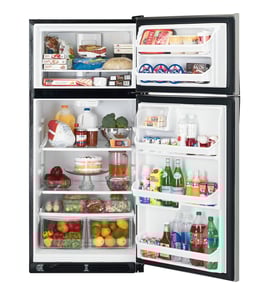



What is a possible drawback for top and bottom freezer refrigerators?
A common drawback of top-freezer and bottom-freezer refrigerators is convenience: one compartment is always less ergonomic to access. With a bottom freezer, you bend down more; with a top freezer, you reach up more. For setup and use details on FGTR1845QF3, follow the FGTR1845QF3 owner's manual.
- Top freezer: fresh-food items are lower, so you bend more often for everyday use.
- Bottom freezer: frozen items can get stacked and harder to find, especially in deep bins.
- Either style: the less-used compartment tends to become “out of sight, out of mind,” which can lead to forgotten food.
- Either style: door alignment and sealing matter; a poor seal can cause temperature swings and frost.
| Style | Most common drawback | Best for |
|---|---|---|
| Top freezer | More bending for fresh-food access | Budget-focused kitchens, simple layouts |
| Bottom freezer | More bending for freezer access; items can get buried | People who use the refrigerator section most |
Ergonomics affects daily comfort, but it also affects food quality. When doors are opened longer while you search for items, temperatures rise and moisture can enter, which increases frost risk and can make the refrigerator work harder.
- Set refrigerator and freezer controls to the recommended starting point, then fine-tune after 24 hours.
- Keep frequently used items at eye level in the fresh-food section.
- Use bins to group freezer items so nothing gets buried.
- Confirm the cabinet is level and the doors seal fully on all sides.
- Allow an initial cool-down period (doors closed) before loading groceries.
Last updated: February 2026
Is Frigidaire Gallery high end?
Frigidaire Gallery is not a luxury, high-end line; it is a strong mid-range tier. Compared with basic Frigidaire models, Gallery typically adds more convenience features, upgraded finishes, and better overall performance while staying priced below true premium lines.
We generally see Frigidaire positioned in tiers like this:
| Tier | Typical positioning | What you usually get |
|---|---|---|
| Entry-level Frigidaire | Value focused | Basic cooling, simpler controls |
| Frigidaire Gallery | Mid-range upgrade | More features, more finish options, more convenience |
| Premium lines (varies by brand) | High-end/luxury | Pro-style features, higher-end materials, higher price |
When customers ask if a refrigerator is high end, they usually mean a combination of:
- Premium materials and fit/finish (handles, hinges, interior trim)
- Advanced temperature management (tighter control, better airflow)
- Quieter operation and better energy efficiency
- More capacity and storage flexibility (bins, shelves, drawers)
- Higher price point and more “pro” style features
Gallery often checks some of these boxes, but it is designed to be an upgrade without moving into luxury pricing.
Your Frigidaire FGTR1845QF3 is a top-mount refrigerator model. For model-specific features, controls, and options (such as ice service and water supply setup), we recommend using the FGTR1845QF3 owner's manual.
Knowing the product tier helps set expectations for noise level, feature set, and repair decisions. For example, mid-range models often use proven components and offer good parts availability, which can make repairs like door sealing or temperature sensing more practical over time.
Last updated: February 2026
What is the average life of a Frigidaire refrigerator?
Most Frigidaire refrigerators, including the FGTR1845QF3 top-mount style, typically last 10 to 15 years. With steady care (good airflow, clean seals, correct temperatures), it’s common to reach the upper end of that range before major sealed-system or control issues appear.
Refrigerators often keep running for years, but performance problems usually show up before a total failure.
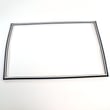
- Door gaskets can loosen or tear, causing warm temps and longer run times.
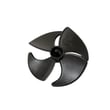
- Fans (evaporator or condenser) can get noisy or stop, reducing cooling.
- Defrost system parts can fail, leading to frost buildup and poor airflow.
- Sensors/thermistors can drift, causing temperature swings.
- Electronic controls can fail after power surges or age.
We recommend these habits for a Frigidaire top-mount refrigerator:
- Keep condenser area clear of dust and pet hair (improves compressor cooling).
- Confirm doors close fully and the gasket seals all the way around.
- Avoid overpacking; leave space for air circulation.
- Set stable temps (about 37°F fresh food, 0°F freezer).
- After moving or first start-up, follow the cool-down guidance in the FGTR1845QF3 owner's manual.
| What you do | What it helps prevent | Why it matters |
|---|---|---|
| Clean condenser area | Overheating, long run times | Reduces compressor stress |
| Keep gaskets sealing | Warm temps, moisture, frost | Protects food and efficiency |
| Maintain airflow inside | Hot spots, freezing in fridge | Improves temperature control |
A refrigerator that’s running longer to hold temperature wears out the compressor and controls faster. Simple upkeep (especially airflow and door sealing) is the most reliable way to get a full 10 to 15 years from a Frigidaire unit.
Last updated: February 2026
What is the most common problem with Frigidaire refrigerators?
The most common problem we see with Frigidaire refrigerators like model FGTR1845QF3 is a cooling complaint: the fresh food section gets warm, temperatures swing, or frost builds up and restricts airflow. These symptoms usually trace back to airflow, dirty condenser coils, or a defrost system issue; check the basics first in the FGTR1845QF3 owner's manual.
- Refrigerator section warm but freezer still cold
- Frost or ice buildup on the freezer back wall
- Loud fan noise, weak airflow, or no airflow from vents
- Food freezing in the refrigerator section (temperature control or sensor issue)
- Water leaks or puddles (often from a clogged defrost drain)
- Confirm power and control settings: Make sure the unit is plugged in and the control is not set to “0” or “OFF” (the manual notes these as common causes of a no-run condition).
- Give it time after a power event: Some models run a brief self-test; allow about 15 minutes if the compressor or fan is not running.
- Clean airflow paths: Keep vents inside the refrigerator and freezer unblocked; avoid overpacking.
- Clean condenser coils: Dust buildup reduces heat removal and causes warm temperatures.
- Look for frost patterns: Heavy frost on the evaporator area points to a defrost problem.
| Likely cause | What you notice | What to check next |
|---|---|---|
| Airflow problem (blocked vents, fan issue) | Warm refrigerator, uneven temps | Listen for fan, check vent blockage |
| Defrost system problem | Frost buildup, reduced cooling over days | Inspect for ice on freezer back wall |
| Temperature sensing/control issue | Temps swing, food freezing | Verify settings; consider sensor diagnostics |
| Door seal leak | Moisture, frost, longer run times | Inspect gasket for gaps and tears |
- If you find air leaks or visible gasket damage, a door seal can be the root cause; for this model, options include the refrigerator door gasket (white) 242193206 (color must match your door).
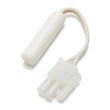
- If temperatures are erratic, a sensor can be involved; this model uses a refrigerator temperature sensor 240597220 in some temperature-control circuits.
Cooling problems are usually progressive; restricted airflow and frost buildup force longer run times, raise food-safety risk, and can lead to more expensive component wear.
Last updated: February 2026