Owner’s manual
 Error Codes



How to adjust leveling feet on refrigerator?
On Kenmore bottom-mount refrigerator model 59666032601, you adjust the front tilt by turning the roller adjustment screws (not removing them). Turn the screws right to raise the front and left to lower it; then set the brake foot so the cabinet stays put. See the 59666032601 owner's manual for the exact access points and steps.
- Pull off the base grille by grasping it firmly and pulling it toward you.
- Use a screwdriver or 3/8-inch hex driver on the roller adjustment screw(s).
- Raise the refrigerator: turn the adjustment screw to the right.
- Lower the refrigerator: turn the adjustment screw to the left.
- Have someone push gently against the top of the refrigerator to reduce weight on the rollers; this makes turning easier.
- Turn both sides the same amount to keep the cabinet level side-to-side.
- Turn the brake foot clockwise until it is firmly against the floor (prevents rolling when the freezer drawer opens).
A properly leveled bottom-mount refrigerator is usually tilted slightly to the rear so the doors close easily.
| What you notice | What to adjust | What to do |
|---|---|---|
| Door swings open or does not seal well | Front is too low | Raise the front (turn screws right) |
| Door closes too hard or cabinet rocks | Front is too high or uneven | Lower the high side (turn screw left) |
| Freezer drawer pulls the unit forward | Brake foot not set | Tighten brake foot clockwise |
Correct leveling helps the door gasket seal, reduces warm air leaks (frost and temperature swings), and keeps the freezer drawer from tugging the refrigerator forward.
Last updated: February 2026
How to tell if a Kenmore refrigerator compressor is bad?
If your Kenmore 59666032601 bottom-mount refrigerator is warm and the compressor repeatedly clicks, runs briefly then stops, or runs but cooling never recovers after normal troubleshooting, the compressor or its start components are failing. Confirm basics first because power, controls, airflow, and door sealing can mimic compressor failure.
- Verify the refrigerator control is turned on and set correctly (not off or too warm).
- After a new install or a power interruption, allow up to 24 hours to cool completely.
- Check the house breaker or fuse if the unit is dead.
- Listen for normal operating sounds (pulsating, hissing, popping, water dripping) that are not failures.
- Make sure doors close fully and are not being left open frequently.
For model-specific operating and troubleshooting guidance, use the 59666032601 owner's manual.
These symptoms are strong indicators when the fans are running and settings are correct:
- Repeated clicking every few minutes (overload protector cycling).
- Compressor is very hot to the touch and shuts off quickly.
- Refrigerator and freezer both warm, with little or no improvement over several hours.
- Loud buzzing or hard-start sound followed by a click.
- Frost pattern is abnormal (for example, only a small patch of frost on the evaporator).
| Symptom | Often not the compressor | What to check first |
|---|---|---|
| Warm temps but unit runs a lot | Airflow/defrost issue | Evaporator fan operation, heavy frost, blocked vents |
| Clicking but won’t start | Start device or control issue | Start components, wiring, control outputs |
| Temps drift after door openings | Door seal/usage | Gasket fit, door alignment, loading |
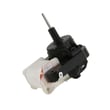
If you suspect an airflow problem, the evaporator fan is a common culprit; see the evaporator motor WPW10128551.
A compressor diagnosis affects cost and repair approach. Many “bad compressor” complaints are actually control, fan, defrost, or door-seal problems that are faster to fix and restore normal temperatures.
Last updated: February 2026
How to tell what model Kenmore refrigerator?
Your Kenmore refrigerator’s model number is printed on the model and serial number label on the appliance; for Kenmore model 59666032601, that label is the key identifier we use to match the correct parts, diagrams, and troubleshooting information. Use the owner's manual to confirm the label location and how to record it.
On most Kenmore bottom-mount refrigerators, you can find the model and serial number label in one of these common spots:
- Inside the fresh food compartment on a side wall
- On the ceiling of the fresh food compartment
- Behind or beside the crisper drawers (remove the drawer to see the label area)
- Along the cabinet frame near the door opening
- Occasionally behind the toe grille or kick plate area
Record the information exactly as shown on the label so we can match parts like control boards, switches, and gaskets to your exact build.
- Model number (example: 59666032601)
- Serial number (helps identify production run details)
- Purchase date (useful for warranty and service history)
Kenmore model families can look similar, but parts can differ by revision. Using the exact model number prevents ordering the wrong refrigerator electronic control board, light switch, or freezer door gasket.
| Item | What it tells us | Used for |
|---|---|---|
| Model number | The exact refrigerator design | Correct parts list and diagrams |
| Serial number | The unit’s unique identifier | Version details and service records |
Try these steps to make the characters clearer:
- Wipe the label gently with a damp cloth and dry it
- Use a flashlight held at an angle to reduce glare
- Take a close-up photo and zoom in
- Copy letters and numbers carefully (avoid swapping 0 and O, 1 and I)
Last updated: February 2026
What is the bottom part of a refrigerator called?
On a Kenmore bottom-mount refrigerator model 59666032601, the “bottom part” most people mean is the base area behind the base grille, where key components like the compressor and condenser fan system are located. For your model’s access points and leveling rollers, use the owner's manual.
Depending on what you see or what problem you are troubleshooting, the “bottom part” can mean different things:
- Base grille (toe grille): the vented cover at the very bottom front
- Compressor compartment: the machinery area near the floor (often at the rear)
- Condenser area: where heat is released (coil and fan parts are typically nearby)
- Drain pan (drip tray): catches defrost water so it can evaporate
- Leveling rollers/feet: used to steady the cabinet and help doors close properly
| If you need to… | The “bottom part” is usually called… | Common symptom |
|---|---|---|
| Clean dust and improve cooling | Base grille / condenser area | Warm fridge, long run times |
| Stop water collecting underneath | Drain pan (drip tray) / drain system | Puddles, musty odor |
| Fix a loud hum or clicking | Compressor compartment | Noise, poor cooling |
| Make doors close easier | Front adjustable rollers/leveling | Door won’t self-close |
If you’re diagnosing a cooling or water issue, these model-matched parts are commonly involved:
- Tray, drip e W11337775 (drain pan area)
- Refrigerator fan blade W10156818 (airflow and heat removal)
- Refrigerator condenser coil 67006133 (heat exchange)
Using the right name helps you find the correct diagram, instructions, and replacement part for model 59666032601. For example, “base grille” relates to cleaning and leveling access, while “compressor compartment” points to cooling-system components.
Last updated: February 2026