Installation guide
 Owner’s manual


Does my Kenmore top load washer have a filter?
Yes. Your Kenmore top load washer model 11028002012 uses a drain-pump system that can trap debris, but it typically does not have a simple, user-accessible “lint filter” like a dryer. We recommend checking the drain path and pump area when you have draining or spinning problems; see the 11028002012 owner's manual.
What “filter” means on this washer
On many Kenmore top-load HE washers, “filter” can refer to one of these:
- Drain pump trap area: coins, hair pins, lint, and small items can restrict flow.
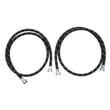
- Inlet valve screens: tiny screens where the fill hoses connect can clog and slow filling.
- Washplate and tub area: residue can build up and cause odor, even without a removable filter.
Quick checks you can do safely
Before any inspection, unplug the washer and turn off both water faucets.
- If the washer will not drain or leaves clothes wet, suspect a restriction in the drain path.
- Check the drain hose for kinks, crushing, or an installation issue.
- Confirm the drain hose is not pushed too far into the standpipe (a deep insertion can contribute to siphoning or poor draining).
- If filling is slow or temperatures seem wrong, check the inlet hose connections and the inlet valve screens.
- Run routine cleaning to reduce odor-causing residue buildup.
Common symptoms and the most likely “filter-related” area
| Symptom | Most likely area to check | Typical fix |
|---|---|---|
| Not draining, still wet after spin | Drain path / pump | Clear blockage; inspect pump |
| Slow fill or no fill | Inlet valve screens | Clean screens; straighten hoses |
| Odor or residue | Tub/washplate area | Monthly cleaning procedure |
Why it matters
A partially blocked drain path can keep the washer from pumping out water within the expected time, leaving loads wet and causing poor spin performance. Keeping hoses, screens, and the drain system clear also helps the washer clean better and reduces odor.
Last updated: February 2026
How many cubic feet is a Kenmore Model 11028002012 washer?
The exact tub capacity (cubic feet) for Kenmore washer model 11028002012 is listed on the model’s specifications in the 11028002012 owner's manual. For most Kenmore 110-series top-load washers of this design, capacity is typically in the 3.2 to 3.5 cu. ft. range.
Where to find the exact capacity
We recommend checking these places in order:
- The specifications section of the 11028002012 owner's manual
- The model/serial tag on the washer (often under the lid or on the cabinet rim)
- Any tech sheet stored inside the cabinet (commonly behind the control panel or along an interior wall)
Typical capacity range (what it means for loads)
If you are estimating load size for detergent, bedding, or cycle selection, this quick guide helps.
| Capacity (cu. ft.) | Typical load size | Common examples |
|---|---|---|
| 3.2 | Medium | 2-3 bath towels plus mixed items |
| 3.5 | Medium-large | A small comforter or larger mixed load |
Why it matters
Capacity affects how full you should load the basket, how well items circulate during wash, and how likely you are to see out-of-balance conditions during spin. Overloading can also increase wear on drive components like the washer drive belt WPW10006384 and suspension.
Quick tips for best results
- Load loosely; keep items below the top rim of the basket
- Mix large and small items to reduce imbalance
- Use the right water temperature and cycle for fabric type
- If the washer bangs or walks, check leveling per the installation guide
Last updated: February 2026
How to hard reset a Kenmore Elite washer?
For the Kenmore washer model 11028002012, a “hard reset” is a safe power reset: unplug the washer (or switch off the breaker) for 1 minute, then restore power and start a cycle. If the control is still unresponsive, use the control-panel cancel/pause steps in the 11028002012 owner's manual.
Hard reset steps (power reset)
- Press START/PAUSE/UNLOCK LID once to stop the cycle.
- Wait until all washer movement stops; the lid can stay locked for several minutes after a high-speed spin.
- Unplug the washer for 60 seconds (or turn the circuit breaker off).
- Plug back in (or turn breaker on).
- Select a normal cycle and press START/PAUSE/UNLOCK LID to test operation.
If it still will not start
These checks come straight from common “won’t run/fill” troubleshooting for this style of Kenmore top-load washer:
- Confirm the outlet has power; reset a tripped breaker or replace a blown fuse.
- Make sure the lid is fully closed; the washer will not run with the lid open.
- Reduce oversudsing; use HE detergent and avoid using too much.
- Redistribute the load if it is tightly packed or unbalanced; the washer may pause to sense and correct balance.
- If the washer is stuck locked, wait for the basket to stop completely, then press START/PAUSE/UNLOCK LID again.
Parts that commonly relate to “won’t run” symptoms
A reset helps when the control is confused; if the problem repeats, a failed safety or drive component is more likely.
| Symptom after reset | Common cause | Example part for this model |
|---|---|---|
| Won’t start, lid won’t lock | Lid lock not engaging | Washer lid lock assembly W10404050 |
| Hums, won’t drain or spin | Drain pump not pumping out | Washer drain pump assembly WPW10276397 |
| Agitates/spins inconsistently | Shift/actuation issue | Washer actuator WPW10006355 |
Why it matters
Resetting clears a temporary control “hang” and lets the washer re-run its normal sensing and lid-lock logic. It also prevents forcing the lid open while the basket is still moving, which can damage the lid lock and create a safety issue.
Last updated: February 2026
How to identify a Kenmore washer model?
Your Kenmore washer model number is the ID we use to match parts and manuals to your exact washer. On Kenmore model 11028002012, you will typically find the model/serial tag under the lid (top-load) or on the back of the cabinet near the power cord or control area; confirm it against the 11028002012 owner's manual.
Where to look on the washer
Check these common locations in this order:
- Under the lid, around the tub opening or on the underside of the lid
- On the back panel of the washer cabinet
- Along the rear edge of the control console
- Inside the cabinet opening (if the top is raised for service)
- On a metal plate or white sticker with a barcode
What the model number looks like (and what to write down)
For Kenmore washers, the model number is often a long number and may start with 110. Record the full model number exactly as printed, plus the serial number.
| What to capture | Example format | Why it matters |
|---|---|---|
| Model number | 11028002012 | Ensures diagrams and parts match your washer |
| Serial number | Letters and numbers | Helps confirm production series and revisions |
| Type | Top-load vs. front-load | Affects where the tag is located and which parts fit |
Quick tips to avoid ordering the wrong part
- Use the full model number, not just the first 3 digits
- Match every digit; one digit off can change the drive system or controls
- If the tag is worn, take a clear photo and zoom in on the barcode area
- Use the model number to cross-check repair steps in the installation guide
Why it matters
Kenmore washers can share similar styling across multiple model families, but internal parts like the lid lock, drain pump, drive belt, and actuator can differ. Using the exact model number keeps your parts selection and troubleshooting accurate.
Last updated: February 2026
What is the average lifespan of a Kenmore washer?
A Kenmore washer typically lasts 10 to 15 years under normal household use. For Kenmore model 11028002012, consistent maintenance (especially using HE detergent correctly and preventing hose leaks) is what most often determines whether you land closer to 10 years or closer to 15.
Typical lifespan and what affects it
Most washers reach their full service life when they are not overloaded, are kept clean, and have wear items replaced before they cause secondary damage.
Common factors that shorten lifespan:
- Frequent overloading or washing heavy items back-to-back
- Excess detergent (causes residue, odors, and longer cycle times)
- Ignoring small leaks or vibration
- Running with a worn drive system (belt, cam, gear case)
- Poor installation setup (not level, drain issues)
Maintenance that extends life (high impact)
We recommend following the care guidance in the 11028002012 owner's manual. Key habits that make a measurable difference:
- Use HE detergent only and measure carefully
- Leave the lid open between loads to help dry the tub
- Run periodic cleaning cycles per the manual
- Keep loads balanced to reduce suspension and drive wear
- Inspect for leaks and unusual noises early
Wear items to plan for
Some parts are designed to wear over time; replacing them promptly helps protect more expensive components.
| Wear item | What you may notice | Example model-matched part |
|---|---|---|
| Drive belt | Slipping, weak spin, burning rubber smell | Washer drive belt WPW10006384 |
| Lid lock | Won’t start, lid won’t lock/unlock properly | Washer lid lock assembly W10404050 |
| Drain pump | Won’t drain, humming, water left in tub | Washer drain pump assembly WPW10276397 |
Why it matters
A washer that is maintained and repaired early usually avoids “cascade failures” (for example, a worn belt causing extra strain on the drive system). That is the difference between a simple repair and a shortened overall lifespan.
Last updated: February 2026