Owner’s manual
 Error Codes



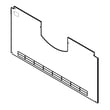


How to remove bottom grill from KitchenAid refrigerator?
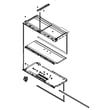
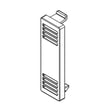
On the KitchenAid KRMF606ESS00 refrigerator, the bottom grill (base grille/toe kick) pulls straight off. Open the freezer drawer for access, then use both hands to grasp the grille firmly and pull it toward you; it snaps back on when aligned and pressed into place (see the KRMF606ESS00 owner's manual).
- Open the freezer drawer so you can reach behind the grille and access the brake feet area.
- Stand centered in front of the grille.
- Grasp the grille firmly with both hands near the ends.
- Pull the grille straight toward you to release the retaining clips.
- Set the grille aside where it will not get stepped on or bent.
- Align the ends of the grille with the leveling assemblies on each side.
- Press the grille inward until it snaps into place.
- Confirm the grille sits flush and does not rattle.
| Task | What you do | What to watch for |
|---|---|---|
| Remove base grille | Pull straight toward you with both hands | Avoid twisting; clips can bind |
| Reinstall base grille | Align ends, then snap into place | Make sure it is fully seated |
We remove the base grille to access the adjustable brake feet and to clean the condenser area behind the grille. A properly installed grille also helps protect components at the bottom front of the refrigerator.
Last updated: January 2026
What are the advantages of bottom mount refrigerators?
Bottom-mount refrigerators like KitchenAid model KRMF606ESS00 keep fresh-food shelves at eye and waist level, so we reach everyday items with less bending. The freezer stays below, and this model’s door-closing design helps reduce accidental “door left open” situations when the doors are properly aligned.
- Easier access to fresh food: the refrigerator section is where we spend the most time.
- Less bending and squatting: produce, dairy, and leftovers sit higher.
- Better organization for fresh items: wide shelves and bins are easier to see and sort.
- Freezer storage stays separate: frozen items are contained in the lower drawer area.
- Door-closing help: the doors are designed to swing fully closed with a gentle push when hinges are set correctly.
This model uses bottom hinges with door closers. When everything is adjusted correctly, the doors can softly close from a partially open position, which helps prevent warm air from entering and reduces temperature swings.
- Confirm the doors were removed and reinstalled at a 90° angle (important for hinge reset).
- Make sure the refrigerator is level and stable on the floor.
- Check that bins and shelves are fully seated and not blocking the door.
- Inspect the door gasket for folds, gaps, or sticky residue.
| Feature | Bottom-mount benefit | What it helps with |
|---|---|---|
| Fresh-food section on top | Less bending | Daily convenience |
| Freezer drawer on bottom | Contained frozen storage | Organization |
| Door closer hinges (this model) | Doors swing closed with gentle push | Energy efficiency and food protection |
A bottom-mount layout typically matches how we use a refrigerator: frequent access to fresh food, less strain on knees and back, and fewer “door ajar” temperature problems when the doors and hinges are set up correctly.
For model-specific door removal, hinge reset, and leveling steps, use the KRMF606ESS00 owner’s manual.
Last updated: January 2026
Which is better top mount or bottom mount fridge?
For most households, a bottom-mount refrigerator like the KitchenAid KRMF606ESS00 is better for everyday convenience because fresh foods sit at eye level and the freezer is in a pull-out drawer. A top-mount is often the better pick when you want the simplest layout and typically lower purchase cost.
- Bottom-mount: easier access to refrigerator shelves and crisper drawers; freezer is a lower drawer.
- Top-mount: freezer is at eye level; refrigerator section is lower, so you bend more for fresh food.
- Organization: bottom-mount designs usually offer more drawer-style storage and “zones” for fresh foods.
- Space planning: French door bottom-mount models need door-swing clearance; check the clearances in the KRMF606ESS00 owner’s manual.
| Feature | Top-mount | Bottom-mount (like KRMF606ESS00) |
|---|---|---|
| Fresh food access | Lower, more bending | Higher, easier reach |
| Freezer access | Higher, easier reach | Lower drawer |
| Typical layout | Simple, fewer compartments | More compartments and drawers |
| Best for | Budget and simplicity | Convenience and organization |
Your KitchenAid KRMF606ESS00 needs breathing room and door clearance to work and feel “right” in the kitchen.
- Allow about 1/2 inch space on each side and at the top
- Allow about 1 inch behind the refrigerator
- If you have an ice maker, leave extra room for the water line
- If installed next to a wall, allow about 3 3/4 inches so the door can swing open
Choosing the right mount style affects how often you bend, how easily you can see and rotate groceries, and whether the doors and drawers open fully in your kitchen. For many people, bottom-mount wins on daily comfort, while top-mount wins on simplicity.
Last updated: January 2026
What is the most common problem with a KitchenAid refrigerator?
For KitchenAid refrigerators like model KRMF606ESS00, the most common problems we see are ice maker and water dispensing issues, temperature swings from airflow problems, and noisy operation from fans. These symptoms usually trace back to filters, the evaporator fan, or dispenser water supply components.
- Ice maker problems: slow ice production, no ice, clumping, or small cubes.
- Water dispenser problems: weak flow, no water, or intermittent dispensing.
- Cooling complaints: fresh food too warm, freezer too warm, or uneven temperatures.
- Noise: buzzing, clicking, or a loud fan sound that comes and goes.
- Odors: persistent smells even after cleaning.
Start with the simple items that cause the highest number of “no ice/no water” and “not cooling right” complaints.
- Confirm the temperature settings are at normal targets (most refrigerators run best around 37°F fresh food and 0°F freezer).
- Replace the water filter if it is overdue; a restricted filter can reduce water flow to the dispenser and ice maker.
- Replace the air filter if odors linger or airflow seems stale.
- Listen for the evaporator fan; if it is loud or not running, cooling can become uneven.
- Check for frost buildup on the back freezer panel; heavy frost often points to a defrost or airflow issue.
| Symptom | Most likely area | Example part for this model |
|---|---|---|
| No ice or slow ice | Ice maker, water supply | Refrigerator ice maker W11577195 |
| Weak/no water at dispenser | Water supply, valve, filter | Refrigerator water inlet valve assembly WPW10341329 |
| Warm temps or loud fan noise | Airflow in freezer | Refrigerator evaporator fan and temperature sensor assembly W11087438 |
| Bad odors | Air filtration | Refrigerator air filter W10311524 |
These “common problems” often share the same root causes: restricted airflow, restricted water flow, or a failing fan or valve. Fixing the underlying cause protects food temperatures, improves ice production, and can prevent repeat service calls.
Use the troubleshooting steps and maintenance intervals in the KRMF606ESS00 owner's manual to match your exact symptom (ice, water, cooling, or noise) to the correct diagnostic steps.
Last updated: January 2026