 Owner’s manual



What is the lifespan of a GE washing machine?
A GE washing machine typically lasts 10 to 14 years. For your GE GTW840CSN0WS washer, lifespan depends most on load size, detergent use (HE), and routine cleaning; consistent maintenance can push service life toward the high end. See the care guidance in the GTW840CSN0WS owner’s manual.
- Overloading (stresses the drive system and suspension)
- Too much detergent (causes oversudsing and residue buildup)
- Infrequent cleaning (odor, buildup, and poor performance over time)
- Unbalanced loads (extra vibration during spin)
- Old fill hoses (risk of leaks and water damage)
The GTW840CSN0WS manual calls out routine care items like replacing water supply hoses every 5 years and running a monthly cleaning cycle.
- Run a monthly cleaning cycle (the manual recommends using the Bulky Items cycle with bleach)
- Use HE detergent and avoid “extra” dosing unless the load truly needs it
- Load items loosely and distribute around the basket for better balance
- Turn off water faucets when away for extended periods
- Replace inlet hoses on schedule (every 5 years is a solid rule)
| Household use pattern | Typical lifespan range | What usually shortens it |
|---|---|---|
| Light (few loads/week) | 12 to 14 years | Long idle periods without cleaning |
| Average (most households) | 10 to 12 years | Overloading, oversudsing |
| Heavy (daily or large loads) | 8 to 10 years | Vibration, wear on drive and suspension |
Knowing the expected lifespan helps you decide when maintenance is worth it versus when a repair may be more cost-effective, especially if multiple wear items (like suspension or draining components) start acting up at the same time.
Last updated: January 2026
What is the most common problem with GE washers?
For the GE GTW840CSN0WS washer, the most common customer-reported issues are “won’t drain/spin” and “won’t start,” which are often tied to lid-lock sensing, draining restrictions, or out-of-balance loads. We recommend starting with the basic checks and the troubleshooting tips in the GTW840CSN0WS owner’s manual.
- Washer won’t drain or leaves clothes wet: drain path restriction, drain pump issue, or a control-related drain/spin interruption.
- Washer won’t start: lid not fully closed, lid-lock not engaging, or control lock enabled.
- Spin light blinking or heavy vibration: out-of-balance load or suspension issues.
- Water not entering (“H2O SUPPLY” message): supply valves off, low water pressure, or inlet restriction.
- Stops mid-cycle / cancels: lid opened too long, paused too long, or a condition the washer is protecting against.
- Close the lid fully; this model typically will not start with the lid open (except certain cycles).
- If the display shows “Lid”, open and close the lid, then restart.
- If the load is wet at the end, redistribute and run Drain & Spin.
- Confirm both water supply valves are fully open; address “H2O SUPPLY” if shown.
- Reduce oversudsing by using HE detergent and the correct amount.
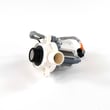
If the washer won’t drain or you hear the pump running but water does not leave the tub, the drain pump is a common suspect on many top-load designs. For this model, a compatible replacement is the GE washer drain pump assembly WH23X28418.
If the washer won’t start and lid-related messages persist, the lid lock circuit is often the next area to inspect. A compatible replacement is the washer lid lock WH08X37938.
| Symptom on GTW840CSN0WS | Common area to check | Example compatible part |
|---|---|---|
| Won’t drain / clothes still wet | Drain pump, drain hose, clogs | WH23X28418 |
| Won’t start / lid messages | Lid lock, lid alignment, harness | WH08X37938 |
| Excessive vibration in spin | Load balance, suspension | WH03X35581 |
Drain, spin, and lid-lock problems can stop a cycle early or prevent high-speed spin, which leaves clothes wetter and can increase dryer time. Catching a simple clog, load-balance issue, or failing lid lock early can prevent repeat cycle interruptions.
Last updated: January 2026
How do I run a diagnostic test on my GE washer?
On the GE GTW840CSN0WS washer, the owner’s documentation we have for this exact model family focuses on normal operation, cycle selection, and troubleshooting tips; it does not provide a step-by-step “service mode” or diagnostic test entry sequence. For model-safe checks, we recommend using the display messages and troubleshooting guidance in the GTW840CSN0WS owner’s manual.
These checks are built into normal operation and help confirm what the washer is “seeing”:
- Start a cycle and watch for status scroll messages such as
FILL,SEnSIng,PAUSE,LId, orH2O SUPPLY. - If the washer won’t start, confirm the lid is closed; the display can scroll
Lidwhen it’s open. - If water is not entering, address
H2O SUPPLYby verifying both supply valves are fully open. - If the load ends too wet, redistribute the load and run Drain & Spin.
- If controls won’t respond, check whether Control Lock is enabled (it can lock out button/knob changes).
Use this to narrow the problem before you go deeper.
| What you see | What it usually means | What to try next |
|---|---|---|
H2O SUPPLY |
Water not detected entering | Open house valves; check hoses for kinks |
LId |
Lid not opened recently or lid is open | Open and close lid; restart cycle |
| Spin light blinking / heavy vibration | Out-of-balance condition | Redistribute load; run Drain & Spin |
| Washer drains by itself after sitting | Automatic drain feature | Close lid; avoid leaving paused too long |
GE top-load washers often have a service diagnostics mode, but the exact button/knob sequence can vary by control design and revision. For the most accurate direction, match your symptom to the correct GE top-load error code family first, then follow the recommended checks.
- Use our GE gtw top load washer error codes reference to identify the code family and likely causes.
Entering the wrong diagnostic sequence can waste time and can also mask the real issue (for example, a lid lock problem vs. a water supply problem). Starting with the GTW840CSN0WS display messages and error-code family gets you to the right repair path faster.
Last updated: January 2026


