Installation guide
 Owner’s manual
 Error Codes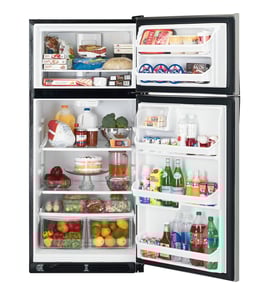


What are the disadvantages of a top mount fridge?
Top-mount refrigerators like the Frigidaire FFTR1814LWA are reliable and space-efficient, but the main disadvantages are less convenient fresh-food access (you bend more), fewer premium organization features, and fewer built-in dispenser options compared with many bottom-freezer designs. See the FFTR1814LWA owner's manual for layout and feature details.
Common disadvantages (what most owners notice)
- Fresh-food items sit lower, so you bend more for everyday use.
- Freezer is at eye level, which is convenient for frozen foods but shifts convenience away from the refrigerator section.
- Less flexible organization in many top-mount designs (fewer adjustable bins, fewer specialty drawers).
- Fewer “premium” features are common (external water/ice dispensers are less typical on top-mount models).
- Narrower door storage can feel limiting if you store tall bottles or lots of condiments.
Quick comparison: top-mount vs bottom-freezer
| Feature | Top-mount (FFTR1814LWA style) | Bottom-freezer style |
|---|---|---|
| Fresh-food access | Lower, more bending | Higher, easier daily access |
| Freezer access | Higher, easier reach | Lower, more bending |
| Organization | Often simpler | Often more configurable |
| Dispenser options | Less common | More common |
Why it matters
Most households open the refrigerator section far more than the freezer. If you want the most-used shelves at waist and eye level, a bottom-freezer layout usually feels easier day to day. If you prefer frozen foods at eye level and a simpler design, a top-mount is a strong fit.
Tips to reduce the downsides on a top-mount
- Keep everyday items on the upper refrigerator shelves.
- Use drawers for produce only, so you are not repeatedly bending for drinks and snacks.
- Avoid overpacking; airflow and visibility improve when shelves are not crowded.
- If door bins feel cramped or damaged, replace worn storage parts such as the crisper drawer - refrigerator storage component by Frigidaire 240337103 when needed.
Last updated: January 2026
Is top mounted refrigerator better than bottom mounted?
A top-mount refrigerator like the Frigidaire FFTR1814LWA is “better” when you want lower upfront cost, strong energy efficiency, and simple reliability; a bottom-mount is “better” when you want fresh-food items at eye level and easier access to the refrigerator section.
Quick comparison (what changes day to day)
| Feature | Top-mount (freezer on top) | Bottom-mount (freezer on bottom) |
|---|---|---|
| Most-used section access | Refrigerator section is lower | Refrigerator section is higher |
| Freezer access | Easier (higher) | Easier for pull-out drawers |
| Typical price | Usually lower | Usually higher |
| Complexity | Usually simpler | Often more features and parts |
When a top-mount is the better choice
- You want a straightforward refrigerator with fewer convenience features to maintain.
- You use the freezer often (frozen foods, ice trays) and prefer it at chest height.
- You want a layout that is easy to service and keep running for years.
- You have a tighter kitchen budget or need a dependable “main fridge” or garage fridge.
For model-specific use and care details (temperature settings, shelf and bin placement, cleaning), follow the FFTR1814LWA owner's manual.
When a bottom-mount is the better choice
- You cook with fresh foods daily and want the refrigerator shelves at eye level.
- You prefer a pull-out freezer drawer for organization.
- You want more premium storage features (varies by model).
Why it matters
“Better” comes down to ergonomics and habits. If you open the refrigerator door 20 times a day, a bottom-mount can feel more convenient; if you rely on the freezer often, a top-mount can feel faster and simpler.
Practical tip for either style
- Keep refrigerator temps around 37°F and freezer around 0°F for food safety and performance.
- Don’t block air vents with large containers.
- If doors don’t seal well, cooling performance drops; inspect the gasket for gaps or tears.
Last updated: January 2026
What is the most common problem with a Frigidaire refrigerator?
Cooling problems are the most common issue we see on Frigidaire refrigerators like model FFTR1814LWA. Most often, the refrigerator warms up because airflow or heat removal is restricted (dirty condenser area, weak fan, or a door that is not sealing), which makes the compressor run longer and temperatures drift.
Most common symptoms (what you notice)
- Fresh food section is warm but freezer seems closer to normal
- Freezer is warm and ice cream is soft
- Loud humming or rattling from the freezer or back of the unit
- Frost buildup on the freezer back wall
- Moisture, sweating, or gaps around the door seal
Quick checks that fix many “not cooling” complaints
- Confirm settings: Set the refrigerator to about 37°F and the freezer to about 0°F.
- Check door sealing: Look for torn, warped, or dirty gasket areas; clean and re-seat the seal.
- Improve airflow: Do not block vents inside the freezer or refrigerator; leave space around stored items.
- Clean the condenser area: Vacuum dust from the lower rear area (and any accessible coils) and ensure the unit has breathing room.
- Listen for the evaporator fan: If the freezer fan is not running or is noisy, cooling performance drops fast.
Parts that commonly cause cooling trouble on FFTR1814LWA
| Problem area | What it affects | Example part for this model |
|---|---|---|
| Door seal leak | Warm air infiltration, frost, long run times | Frigidaire refrigerator door gasket (black) 241872512 |
| Evaporator fan issue | Cold air circulation from freezer | Refrigerator evaporator fan blade 5308000010 |
| Defrost system fault | Frost blocks airflow over evaporator | Refrigerator defrost bi-metal thermostat 5303918202 |
Why it matters
When airflow is restricted or warm air leaks in, the refrigerator can look like it is “running fine” but still cannot hold safe food temperatures. Fixing the root cause early helps prevent heavy frost buildup, spoiled food, and excessive compressor run time.
Model-specific help
For FFTR1814LWA, use the FFTR1814LWA owner's manual for the recommended temperature settings, airflow guidance, and cleaning intervals, and the FFTR1814LWA installation guide for clearance and leveling tips that help doors seal correctly.
Last updated: January 2026
Is Frigidaire Professional high end?
Yes. Frigidaire Professional is Frigidaire’s higher-end line; it’s positioned above standard Frigidaire models with more premium design and feature sets, while still typically priced below true luxury brands. For care, use, and specifications for your Frigidaire FFTR1814LWA top-mount refrigerator (which is not a “Professional” model), use the FFTR1814LWA owner’s manual.
What “high end” means for Frigidaire Professional
Frigidaire Professional is “high end” within the Frigidaire brand family. It usually emphasizes upgraded finishes and performance-focused features compared with entry-level and mid-tier Frigidaire products.
Common differences you may see (varies by model):
- More premium exterior finishes and handles
- More advanced controls and lighting
- More feature options (cooling, storage, convenience)
- Higher accessory and replacement-part costs
Quick positioning guide
| Brand tier (typical) | Line example | What to expect |
|---|---|---|
| Core | Frigidaire | Essential features and value pricing |
| Premium | Frigidaire Professional | Upgraded features, styling, and options |
| Luxury | Luxury-only brands | Highest-end materials, features, and price |
If you are shopping parts for FFTR1814LWA
FFTR1814LWA is a standard Frigidaire top-mount refrigerator; choose parts by model fit, not by the “Professional” label.
Examples of model-matched parts available for this refrigerator include:
- Refrigerator gasket 242193213 (door seal)
- Refrigerator light bulb 316538904 (interior light)
- Crisper drawer - refrigerator storage component by Frigidaire 240337103 (produce drawer)
Why it matters
Product line affects features and styling, but correct parts selection depends on the exact model number. Using FFTR1814LWA ensures you get the right door bins, shelves, gaskets, and electrical components for your refrigerator.
Last updated: January 2026