Owner’s manual
 Error Codes



How to remove bottom grille on GE refrigerator?
On the GE GFE28HSHGSS bottom-mount refrigerator, the bottom grille (base grille or toe grille) typically comes off by removing any retaining screws (if equipped) and then pulling the grille straight out to release the clips. Reinstall by aligning it and pushing it back into place, then reinstalling screws.
Before you start
- Unplug the refrigerator or switch off power at the breaker (recommended when working near wiring).
- If the grille is near the floor, protect the finish with a towel or cardboard.
- Use a flashlight to spot screws and clip locations.
- Keep screws in a cup so they do not get lost.
Step-by-step: removing the bottom grille
- Open both fresh food doors for better access.
- Look along the top edge of the grille for screws.
- If you see screws, remove them with a Phillips screwdriver.
- Grip the grille at both ends and pull straight toward you to release the retaining clips.
- If it feels stuck, pull evenly from both sides; do not twist hard (twisting can crack the grille tabs).
If the grille will not come off
- Check again for hidden screws near the corners.
- Look for locking tabs; press the tab while pulling the grille forward.
- Make sure the refrigerator is not sitting on the grille (leveling legs too low can pinch it).
Quick reference
| What you see | What it usually means | What to do |
|---|---|---|
| Phillips screws on the grille | Screw-retained grille | Remove screws first, then pull forward |
| No screws, but it flexes slightly | Clip-retained grille | Pull straight out to release clips |
| Grille feels pinched at the bottom | Leveling legs or floor contact | Raise leveling legs slightly, then retry |
Why it matters
We remove the bottom grille to access and clean the condenser area, check for debris, and reach components behind the toe grille. Keeping that area clear helps airflow and supports steady cooling performance.
For model-specific diagrams and access notes, use the GFE28HSHGSS owner's manual.
Last updated: February 2026
What is the most common problem with a GE refrigerator?
The most common issue we see with GE refrigerators like model GFE28HSHGSS is inadequate cooling (fresh food too warm, freezer not holding temp, or temps swinging). In many cases, the root cause is restricted airflow or a failed cooling component such as the evaporator fan motor or a temperature sensor; the owner's manual helps confirm the correct checks for your settings and indicators.
Quick checks that fix many “not cooling” complaints
- Make sure air vents inside the refrigerator and freezer are not blocked by food packages.
- Set temperatures to normal targets (most households use 37°F fresh food and 0°F freezer).
- Clean dust from condenser coils and the area around the condenser fan (if accessible).
- Confirm doors close fully and seals are making full contact all the way around.
- Listen for the evaporator fan; it typically runs when the compressor is running.
Common causes and the parts that often solve them
If basic airflow and cleaning do not restore normal temperatures, these are frequent culprits on bottom-mount designs:
| Symptom | Likely area | Example part for GFE28HSHGSS |
|---|---|---|
| Warm fresh food, freezer OK or borderline | Air movement in cabinet | Refrigerator evaporator fan motor WR60X26866 |
| Temps fluctuate, unit runs longer than normal | Temperature sensing | Refrigerator temperature sensor WR55X10025 |
| Frost buildup, weak airflow, warming over time | Defrost system | Refrigerator defrost heater WR51X10132 or refrigerator defrost bi-metal thermostat WR50X10108 |
| Random behavior, cooling issues after power events | Controls/electronics | Refrigerator electronic control board WR55X44126 |
Why it matters
Poor cooling is more than an inconvenience; it can lead to food spoilage and can make the compressor run longer than necessary. Restoring proper airflow and accurate temperature control helps the refrigerator maintain stable temperatures efficiently.
Helpful DIY guidance
- Use our GE refrigerator error codes reference if your display shows an error.
- If the unit is alarming due to a door left open, follow how to reset the door alarm on a GE refrigerator.
Last updated: February 2026
Is GE GFE28HSHGSS considered high end?
GE GFE28HSHGSS is generally considered an upper-tier, feature-rich refrigerator within GE’s mainstream lineup (often comparable to GE Profile-level positioning), but it is not typically treated as GE’s ultra-premium built-in category. For exact feature set and options on your unit, we recommend checking the owner's manual.
How we define “high end” for refrigerators
“High end” usually means a combination of capacity, cooling performance, convenience features, and finish/design upgrades. For a GE bottom-mount refrigerator like GFE28HSHGSS, we look at:
- Advanced temperature management (multiple sensors, tighter control)
- Premium convenience features (ice and water systems, LED lighting)
- Higher parts sophistication (control boards, fan systems, valves)
- Fit and finish (stainless styling, interior layout, drawer systems)
- Repair cost profile (more electronics typically means higher part costs)
What on this model points to a premium tier
The parts commonly used on GFE28HSHGSS reflect a more advanced design than entry-level refrigerators.
- Electronic controls such as a main board
- Multiple cooling and defrost components
- Built-in water filtration and an ice maker system
- LED lighting assemblies
Examples of “premium-feature” parts for this model
| System | Example part | What it supports |
|---|---|---|
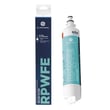
| Water filtration | GE refrigerator water filter RPWFE | Filtered dispenser water and ice |
| Cooling airflow | Refrigerator evaporator fan motor WR60X26866 | Circulates cold air for even temps |
| Temperature feedback | Refrigerator temperature sensor WR55X10025 | Helps regulate compartment temps |
| Lighting | Refrigerator led light assembly WR55X11132 | Interior illumination |
Why it matters
If you are deciding whether it is “high end,” the practical takeaway is this: higher-tier refrigerators like the GE GFE28HSHGSS usually deliver better feature sets and tighter temperature control, but they also tend to use more electronics (control boards, sensors), which can increase repair complexity and part cost.
Helpful next step
For a quick way to map features to your exact configuration (controls, filter type, alarm behavior), use the feature and operation sections in the owner's manual.
Last updated: February 2026