 Installation guide
 Owner’s manual
 Error Codes


Is GE profile considered high-end?
Yes. GE Profile is generally considered GE’s higher-end mainstream line, positioned above standard GE models with more premium features and finishes. It is not GE’s top luxury tier; it typically sits below lines like Café in overall design and feature exclusivity.
How GE Profile typically fits in the GE lineup
We see GE’s product families commonly grouped like this:
- GE (standard line): core features, value-focused
- GE Profile: upgraded features, styling, and performance options
- Café: more design-forward, higher-end finishes and feature sets
What “high-end” usually means in real use
“High-end” can mean different things depending on what you care about most. Here are the areas where GE Profile usually stands out:
- More advanced wash, cook, or cooling features (model-dependent)
- More premium exterior finishes and control designs
- More convenience features (for example, upgraded cycles or smart features on some models)
- Better fit-and-finish compared to entry-level lines
- Higher price point than standard GE models
Quick comparison
| Line | Typical positioning | Best for |
|---|---|---|
| GE | Entry to mid-range | Reliable basics and value |
| GE Profile | Upper mainstream | Premium features without luxury pricing |
| Café | Premium to near-luxury | Design-focused kitchens and higher feature sets |
Why it matters when you’re shopping parts
For your GE dishwasher model GDF510PSD1SS, the most important thing for parts compatibility is the exact model number, not the product line name. Use the parts list for GDF510PSD1SS and confirm details in the owner's manual.
Last updated: February 2026
Is it worth repairing a GE dishwasher?
Yes, repairing a GE GDF510PSD1SS dishwasher is usually worth it when the unit is under 10 years old and the problem is limited to a common, replaceable part (like a latch, heater, or spray arm). If repairs are frequent or the cost approaches half the price of a comparable new dishwasher, replacement is the better value.
Quick decision checklist
- The dishwasher is under 10 years old and has been reliable overall.
- The issue is one clear failure, not multiple symptoms at once.
- The repair is a common wear item (latch, drain hose, inlet valve, spray arm, rack rollers).
- You can confirm the symptom with basic checks in the owner's manual.
- You are not seeing repeated leaks, repeated no-drain events, or repeated control problems.
Typical repair scenarios for this model
Many “worth it” repairs on the GDF510PSD1SS involve parts that are straightforward to replace and restore normal washing.
| Symptom | Common fix | Example part on this page |
|---|---|---|
| Door won’t latch or won’t start | Replace latch or strike | GE dishwasher door latch lock WD21X10490, dishwasher door latch strike WD13X10071 |
| Not drying or water not heating | Replace heater element | Dishwasher heater element WD05X30818 |
| Poor cleaning, weak spray | Clean filters; replace spray arm if damaged | Dishwasher spray arm, lower WD22X33499 |
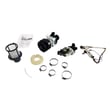
| Not draining | Check hose routing; replace drain pump if failed | Dishwasher drain hose WD24X10062, dishwasher drain pump kit WD49X23779 |
Why it matters
A dishwasher repair is most cost-effective when it restores core functions (fill, wash, heat, drain) without chasing multiple intermittent issues. Keeping filters clean and addressing a single failed component early also helps prevent secondary problems like poor wash performance or standing water.
Before you decide: 5 fast checks
- Confirm power (including any wall switch controlling the dishwasher circuit).
- Check and clean filters if dishes feel gritty or cleaning has declined.
- Look for obvious leaks around the door and tub seal area.
- Verify draining (no standing water after the cycle).
- Review installation basics (drain hose routing, service access) in the installation guide.
Last updated: February 2026
What is the most common problem with a GE dishwasher?
The most common issues we see with a GE dishwasher like model GDF510PSD1SS are not draining (clogged filters or drain path) and not starting (door not fully latched or a safety switch condition). Start with filter cleaning and confirming the door latches securely per the owner's manual.
Most common symptoms and what usually causes them
- Water left in the bottom: clogged filters, blocked drain hose, or a drain pump problem
- Won’t start or stops mid-cycle: door not fully closed, latch not engaging, or cycle interruption
- Poor cleaning or gritty dishes: filters need cleaning; spray arms clogged
- Not drying well: heater issue, rinse aid empty, or cycle selection
- Beeping or flashing Start light: door opened or cycle interrupted (common and usually simple)
Quick checks we recommend first (fast, no parts)
- Open the door and re-close firmly, then press Start and close the door to resume.
- Clean the filters (GE recommends inspecting periodically, about every other month depending on use).
- Check the spray arms for clogs and clear food debris from the holes.
- Confirm the drain path is clear (sink/disposal connection and hose routing).
- Use proper detergent and rinse aid; low-performing detergent and an empty rinse aid dispenser can cause poor results.
Parts that commonly solve these problems on GDF510PSD1SS
| Symptom | Common part to inspect/replace | What it affects |
|---|---|---|
| Won’t start, door won’t “click” shut | GE dishwasher door latch lock WD21X10490 | Confirms the door is locked so the dishwasher can run |
| Poor cleaning, lower rack not getting clean | Dishwasher spray arm, lower WD22X33499 | Water spray coverage on the bottom level |
| Not drying, water stays cool | Dishwasher heater element WD05X30818 | Heats water and supports drying performance |
| Not draining | Dishwasher drain hose WD24X10062 | Moves water out to the sink/disposal |
Why it matters
Drain and start problems are common because they are tied to safety interlocks (door latch) and routine maintenance (filters). Fixing these early prevents repeat cycle failures, odors, and poor wash performance.
Last updated: February 2026
What is the average life expectancy of a GE dishwasher?
A GE dishwasher like model GDF510PSD1SS typically lasts about 10 to 15 years, with around 12 years being a practical average for normal household use. Regular filter cleaning, correct detergent use, and fixing small issues early are the biggest factors in reaching the high end of that range.
Typical lifespan and what changes it
Most dishwasher failures are tied to heat, water flow, and door sealing. These factors usually decide whether you land closer to 10 years or closer to 15.
- Usage frequency: daily cycles wear pumps, seals, and racks faster than light use
- Water quality: hard water can speed up mineral buildup in spray arms and filters
- Maintenance: cleaning filters every month or two helps prevent wash and drain strain
- Drying heat: heavy heated-dry use adds stress to the heater and wiring
- Small leaks: catching a minor drip early protects the motor, wiring, and flooring
Maintenance that helps you hit the 10 to 15 year range
The manual for this GE dishwasher recommends inspecting and cleaning the filters periodically (often every other month, depending on usage). Use the care steps in the owner's manual to keep wash performance strong.
- Clean the filter(s) when dishes feel gritty or cleaning performance drops
- Scrape heavy food soils off dishes (no need to pre-rinse normal soil)
- Use dishwasher-approved detergent and rinse aid as directed
- Keep spray arm holes clear so water pressure stays strong
- Watch for slow draining and address it before it becomes a pump issue
Quick “repair vs replace” guide
| What you’re seeing | Common cause | Typical fix |
|---|---|---|
| Poor cleaning, gritty dishes | Clogged filter or spray arm | Clean filter; inspect spray arms |
| Not drying well | Heater or rinse aid issue | Check settings; test heater circuit |
| Won’t start or stops mid-cycle | Latch or control issue | Check door latch; look for error codes |
| Leaks at the door | Worn gasket or seal | Replace door/tub sealing parts |
If the door will not reliably latch, a common wear item is the GE dishwasher door latch lock WD21X10490.
Why it matters
Dishwashers often run long cycles with heat and constant water movement. Keeping filters and water flow in good shape reduces strain on high-cost components like the heater, drain pump, and electronic control.
Last updated: February 2026





