Owner’s manual
 Error Codes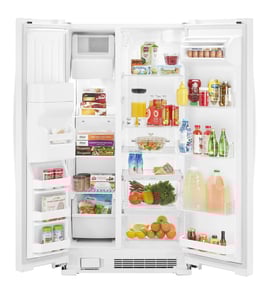


How to reset a GE side by side refrigerator?
To reset your GE PSS26MSWASS side-by-side refrigerator, we recommend a simple power reset first: unplug the refrigerator (or switch off the breaker) for 2 to 5 minutes, then restore power. This clears minor control glitches and restarts normal cooling.
- Power cycle reset: Unplug for 2 to 5 minutes, then plug back in.
- Breaker reset: Turn the refrigerator circuit breaker OFF for 2 to 5 minutes, then ON.
- Cooling system OFF then ON (control reset): Use the controls to turn cooling OFF, wait about 30 seconds, then turn cooling back ON (details below).
- Exit showroom mode (if it looks “on” but won’t cool): Unplug and plug back in; then confirm cooling is enabled.
Your PSS26MSWASS can stop cooling without cutting power to the refrigerator. Use this when the display is acting up or temperatures are not responding to settings.
- Go to Home > Options > Information and Settings > Cooling System Off.
- Activate OFF (often by pressing ENTER).
- After about 30 seconds, touch the screen and press ON.
- Press the WARMER pad for either the refrigerator or freezer until the display shows OFF.
- Press the COLDER pad to turn cooling back on.
- Allow up to 24 hours for temperatures to stabilize after restarting cooling.
| Reset type | What it fixes | What to expect |
|---|---|---|
| Power cycle | Minor electronic glitches | Display reboots; cooling resumes normally |
| Cooling OFF/ON | Control setting issues | Cooling restarts; stabilization can take up to 24 hours |
| Showroom mode exit | No-cool with lights/display working | Cooling should start shortly after reset |
A refrigerator can appear to “work” (lights and display on) even when cooling is turned OFF. Resetting correctly helps restore cooling and prevents food temperature issues.
For model-specific control steps and troubleshooting charts, use the PSS26MSWASS owner’s manual.
Last updated: February 2026
Is GE profile considered high end?
Yes. GE Profile is GE’s premium line, positioned above standard GE appliances with more advanced features and styling; it is typically a step below GE’s luxury-tier offerings. Your GE PSS26MSWASS is a GE Profile side-by-side refrigerator.
GE Profile is generally considered high end because it commonly includes upgrades such as:
- More precise electronic temperature controls and sensors
- Enhanced food-preservation features and airflow management
- Quieter, higher-efficiency compressor operation
- More design-forward finishes and dispenser features
- More feature-rich control panels (often LCD-style)
For example, the PSS26MSWASS temperature controls are factory preset to 37°F for fresh food and 0°F for the freezer, and the control range is typically 34°F to 44°F (fresh food) and -6°F to +6°F (freezer). See the PSS26MSWASS owner’s manual for the exact control layout and settings steps.
| Line | Typical positioning | What you usually get |
|---|---|---|
| GE | Core lineup | Essential features, value-focused configurations |
| GE Profile | Premium | More features, more electronic controls, upgraded design |
Knowing you have a GE Profile model helps because premium models often rely more on electronic controls and sensors. When temperatures drift, ice production slows, or the unit runs longer than expected, the fix is often tied to a specific component rather than a basic mechanical adjustment.
If you are diagnosing temperature stability, defrost performance, or dispenser behavior on PSS26MSWASS, these model-matched parts are often involved:
- GE profile refrigerator temperature sensor WR55X10025 (temperature feedback to controls)
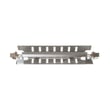
- Refrigerator defrost heater WR51X10055 (clears frost from the evaporator)
- Refrigerator defrost bi-metal thermostat WR50X10069 (defrost safety and cycling)
- Refrigerator water filter MSWF (water quality and flow to dispenser)
Last updated: February 2026
What is the life expectancy of a GE Profile refrigerator?
Most GE Profile refrigerators last 10 to 15 years with normal household use. For the GE PSS26MSWASS, regular maintenance (clean airflow, stable temperatures, and timely part replacement) is what most often determines whether you land closer to 10 years or closer to 15.
Warranty length is not the same as life expectancy, but it helps highlight which systems are built for long service.
| Item | Typical coverage shown in the GE warranty section | Why it matters |
|---|---|---|
| Full refrigerator (most parts) | 1 year | Early failures are usually electrical or installation related |
| Sealed system (compressor, condenser, evaporator, tubing) | 5 years (GE Profile models) | The sealed cooling system is designed for long-term reliability |
| Water filter cartridge (if included) | 30 days | Filters are consumables, not long-life components |
For the exact warranty wording and coverage details for your model family, use the PSS26MSWASS owner's manual.
We see these steps make the biggest difference on side-by-side refrigerators like the PSS26MSWASS:
- Keep condenser airflow clear; vacuum dust from the grille and around the condenser area.
- Confirm door seals close tightly; warm air leaks force longer run times.
- Set stable temps (about 37°F fresh food and 0°F freezer) and avoid frequent adjustments.
- Replace the water filter on schedule to protect the dispenser water path.
- Address frost buildup early; defrost problems can strain the evaporator fan and cooling performance.
- Do not overload shelves so vents stay open and air can circulate.
If performance drops as the unit ages, these are frequent culprits:
- Temperature swings or warm sections: a failing sensor such as the GE profile refrigerator temperature sensor WR55X10025.
- Frost buildup and reduced cooling: defrost system issues (heater, thermostat) or airflow problems.
- Noisy operation or warm freezer: evaporator fan motor wear.
- Slow ice production or no ice: ice maker wear or dispenser door issues.
A refrigerator that is running longer than normal to hold temperature uses more energy and puts extra wear on the compressor and fans. Catching airflow, defrost, and temperature-sensing problems early is the simplest way to extend service life.
Last updated: February 2026
What is the most common problem with GE refrigerators?
The most common problems we see with GE refrigerators like model PSS26MSWASS are cooling complaints (warm fridge or freezer) and ice maker or dispenser issues. Cooling problems are often tied to airflow, dirty condenser coils, or a failed fan; ice issues are commonly caused by water supply or dispenser-door problems. For model-specific operating details, use the PSS26MSWASS owner’s manual.
- Not cooling enough: restricted airflow, dirty condenser coils, or a failed fan motor
- Freezer cold but refrigerator warm: air damper stuck, blocked vents, or evaporator fan problem
- Ice maker not making ice: water supply issue, ice maker failure, or freezer temperature too warm
- Ice clumping or frost near dispenser: ice chute door not sealing
- Running a lot or louder than expected: can be normal with high-efficiency compressors, but also happens with airflow restrictions
- Confirm vents inside both compartments are not blocked by food packages.
- Clean the condenser coil area and make sure the condenser fan area is clear.
- Verify doors close fully and gaskets seal all the way around.
- If ice is the issue, confirm the household water valve is fully open and the line is not kinked.
- Listen for normal operating sounds; many newer-style GE units run longer and can sound different during normal operation (details are in the manual).
| Symptom | Likely system | Example part to check on this model |
|---|---|---|
| Warm temps, erratic temps | Temperature sensing | GE profile refrigerator temperature sensor WR55X10025 |
| Frost buildup, warm fridge | Defrost system | Refrigerator defrost heater WR51X10055 and refrigerator defrost bi-metal thermostat WR50X10069 |
| Fridge warm, freezer OK | Airflow | Refrigerator evaporator fan motor WR60X10185 or refrigerator air damper assembly WR60X10229 |
| Ice dispenser frosting, leaks air | Dispenser door | Refrigerator dispenser ice chute door kit WR17X11653 |
| Bad taste, slow water | Filtration | Refrigerator water filter MSWF |
Cooling and ice maker complaints often share the same root cause: airflow and temperature control. Fixing airflow (fans, damper, coils) protects food, improves ice production, and reduces long run times.
Last updated: February 2026