Installation guide
 Owner’s manual


How do I tell what model my Kenmore dryer is?
Your Kenmore dryer’s model number is printed on the appliance ID label; for model 11078102310, the label is typically found around the door opening (often on the door frame) and is the exact number we use to match the right parts, diagrams, and specifications.
Check these common locations on Kenmore dryers:
- Inside the dryer door opening on the door frame
- On the back panel of the dryer cabinet
- Near the lint screen housing area (depending on design)
- On a metal plate or sticker with both model and serial numbers
Model numbers must match exactly, character for character.
- Write it down exactly as shown (no extra spaces)
- Include all digits (example: 11078102310)
- Record the serial number too; it helps identify production details
- If the label is worn, take a clear photo and zoom in
| What you see on the label | What it means for parts |
|---|---|
| 11078102310 | Exact model used to select compatible Kenmore dryer parts |
| Serial number | Helps confirm production series when ordering or troubleshooting |
Using the exact model number prevents ordering the wrong items, especially for fit-critical parts like a dryer drum belt WP8547157 or heating and safety components such as a dryer thermal fuse WP3390719. It also ensures the instructions and venting requirements you follow match your specific dryer.
Use the 11078102310 owner’s manual to confirm label location, operating details, and care guidance for your specific Kenmore 27-inch gas dryer.
Last updated: February 2026
How much does it cost to replace a heating element in a Kenmore dryer?
For Kenmore model 11078102310 (a 27-inch gas dryer), you typically do not replace an electric heating element; heat is produced by a gas burner system. Most “no-heat” repairs on this model land in the $25 to $250 parts range, and $150 to $400 total if you hire a technician (parts plus labor).
Common no-heat or intermittent-heat fixes for model 11078102310 include:
- Gas valve coils (very common intermittent heat symptom): dryer valve coil kit 279834
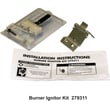
- Igniter (glows weakly or fails to ignite): igniter 279311
- Radiant sensor (flame sensing issues): dryer radiant sensor WP338906
- Thermal safety devices that open from overheating or restricted venting: dryer thermal fuse WP3390719 and dryer thermal cut-off kit WP8573713
- Temperature sensing issues (cycling problems): dryer thermistor WP8577274
Costs vary by symptom and how many parts are replaced at once.
| Repair scenario (gas dryer) | Typical parts cost | Typical total with labor |
|---|---|---|
| Replace gas valve coils | $25 to $60 | $150 to $300 |
| Replace igniter or radiant sensor | $25 to $80 | $175 to $325 |
| Replace thermal fuse or thermal cut-off kit | $20 to $80 | $175 to $350 |
| Multiple parts in one visit (common) | $60 to $250 | $250 to $400 |
We recommend these basics first because they often prevent repeat failures:
- Confirm you are running a heated cycle (not “Air Only”).
- Verify the gas supply is on and connections are leak-free (gas models).
- Check airflow; long or kinked venting increases drying time and can shorten dryer life.
- Clean the lint screen and inspect the vent hood outside for blockage.
- If the dryer will not start, confirm the door is fully closed and the house breaker or fuse is OK.
For vent length and elbow limits that protect drying performance, use the installation guide.
Pricing confusion usually comes from mixing up electric dryer “heating element” repairs with gas dryer burner repairs. On model 11078102310, choosing the correct gas-heat parts (coils, igniter, sensors, fuses) gets you back to safe, consistent heat without paying for the wrong component.
Last updated: February 2026
How to hard reset a Kenmore dryer?
For the Kenmore 11078102310 gas dryer, a “hard reset” is a power reset: unplug the dryer (or switch the breaker off) for 1 minute, then restore power and start a cycle normally. This clears many control glitches and restores standby operation.
- Press Power to turn the dryer off (standby).
- Unplug the dryer for 1 minute (or turn off the circuit breaker).
- Plug back in (or turn breaker on).
- Close the door fully.
- Press and hold START/PAUSE until you hear the drum begin moving.
- If the dryer still will not run, follow the checks in the 11078102310 owner's manual.
These items commonly prevent a Kenmore gas dryer from running even when power is restored:
- Door not fully closed or door catch not latching (inspect the dryer door catch WPW10111905).
- START/PAUSE not pressed and held long enough (the manual notes you should hold it until the drum moves).
- House fuse blown or breaker tripped (reset/replace as needed).
- Dryer installed with poor airflow or incorrect setup (verify clearances and venting in the installation guide).
| What you do | What it helps | What it does not fix |
|---|---|---|
| Unplug 1 minute | Control glitches, stuck interface, standby recovery | Broken parts, blocked venting, failed safety devices |
| Check door latch | No-start due to door switch not made | Heating problems |
| Check breaker/fuse | No power to controls or motor circuit | Mechanical noise, poor drying |
A power reset can restore normal operation, but if the dryer shut down due to an underlying issue (like a door-latch problem or an installation/airflow problem), the symptom returns until the root cause is corrected.
Last updated: February 2026
What are common problems with Kenmore dryers?
Common problems on the Kenmore 11078102310 27-inch gas dryer include no heat, long dry times, won’t start, early cycle shutoff, vibration, and thumping or rattling noises. Most fixes come down to airflow (lint and venting), power and door/controls, leveling, or a failed safety or gas-ignition part; see the 11078102310 owner's manual for model-specific checks.
- No heat (drum turns): gas supply valve closed, ignition system issue, or a safety device opened.
- Takes too long to dry: restricted venting, too many elbows, crushed/kinked duct, or clogged lint screen.
- Won’t start: controls not set to run, Start not pressed firmly, door not fully closed, or a house fuse/breaker issue.
- Thumping for first few minutes: normal after non-use; also check for small items at drum edges.
- Vibration or banging: dryer not level, legs not set, or load is balled up.
- Clean the lint screen before every load.
- Run a heated Timed Dry cycle (not Air Only) to confirm heat.
- Confirm the dryer is level front-to-back and side-to-side.
- Check the vent path for kinks and keep 90° turns to a minimum.
- Verify the gas supply valve is fully open.
The installation instructions warn that vent runs longer than the Vent System Chart reduce performance and can shorten dryer life. Use rigid metal venting when possible and keep turns gradual; see the 11078102310 installation guide.
| 90° elbows | Rigid metal with box/louvered hood | Rigid metal with angled hood |
|---|---|---|
| 0 | 64 ft | 58 ft |
| 1 | 54 ft | 48 ft |
| 2 | 44 ft | 38 ft |
| 3 | 35 ft | 29 ft |
| 4 | 27 ft | 21 ft |
If basic checks do not fix the issue, these are frequent replacements on this model family:
- For no heat or intermittent heat: dryer valve coil kit 279834, igniter 279311, dryer radiant sensor WP338906
- For no run or sudden stop: dryer thermal fuse WP3390719
- For squealing, rumbling, or thumping: dryer drum support roller WPW10314173, dryer idler pulley WPW10547292, dryer drum belt WP8547157
Airflow and vent length control drying time, energy use, and how hard the dryer has to work. Fixing vent restrictions and leveling issues prevents repeat failures of safety parts like thermal fuses and improves overall drying performance.
Last updated: February 2026