Owner’s manual
 Error Codes




How do I know what model Kenmore refrigerator I have?
To identify your Kenmore refrigerator model, we look for the model and serial number label on the cabinet inside the fresh food section (often on a side wall, ceiling, or behind a crisper drawer) or near the bottom front behind the kick plate. For model 59672013017, the owner's manual also lists model identification details.
Where to look for the model number label
Check these common spots first:
- Inside the refrigerator compartment on the left or right side wall
- On the ceiling of the fresh food compartment
- Behind or underneath a crisper drawer (remove the drawer to see the label)
- Behind the lower front kick plate or grille area
- On the cabinet frame near the door opening (not on the removable door)
What the model number looks like (Kenmore format)
Kenmore model numbers are typically a series of digits (sometimes with a dot in some documents). Your parts page is organized by the full model number 59672013017, which is the number we use to match the correct parts list, diagrams, and specifications.
Quick check table
| What you find | What it means | What to do next |
|---|---|---|
| Model number is readable | You can match parts accurately | Use the exact model number when ordering parts |
| Label is hard to read | Some characters may be missing | Take a clear photo and compare each digit to the parts page model |
| Only partial number found | Not enough to guarantee fit | Keep searching other label locations and confirm all digits |
Why it matters
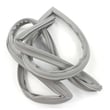
Using the exact model number prevents ordering the wrong items for your refrigerator, such as a water filter, door gasket, control board, or evaporator fan motor. Even small number differences can change the correct replacement part.
Last updated: February 2026
How to tell if a Kenmore refrigerator compressor is bad?
A bad compressor in your Kenmore 59672013017 bottom-mount refrigerator usually shows up as poor cooling even though the unit runs a lot, repeated clicking as it tries to start, or the compressor staying unusually hot. First rule out power, control settings, airflow, and fan issues using the 59672013017 owner's manual.
Quick symptoms that point to a compressor problem
- Refrigerator and freezer both warm, even after 24 hours of running
- Repeated clicking every few minutes (start attempt, then shutoff)
- Compressor runs constantly but temperatures do not improve
- Compressor is very hot to the touch area (after it has been trying to run)
- You hear fans running but cooling is still weak
Checks to do before blaming the compressor
The manual notes that a new installation needs 24 hours to cool completely and that high-efficiency compressors can run longer, especially with warm room temps or frequent door openings.
- Verify the outlet works (plug in a lamp) and check the breaker or fuse
- Confirm the temperature controls are turned on and set correctly
- Make sure doors are closing and sealing; a leak can mimic “no cooling”
- Listen for normal operating sounds (pulsating, hissing, gurgling) versus repeated clicking
- Check for strong airflow inside; a failed evaporator fan can cause warm temps
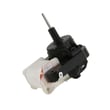
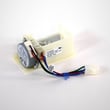
If airflow is weak or noisy, the refrigerator evaporator fan motor WPW10128551 is a common cooling component to inspect.
What a technician tests (the definitive confirmation)
A compressor diagnosis is confirmed with electrical and sealed-system checks.
| Test/observation | What it suggests |
|---|---|
| High start amperage then immediate shutoff | Compressor struggling to start or start device issue |
| Continuity/insulation tests fail | Internal compressor electrical failure |
| Runs but pressures/temps do not change correctly | Sealed-system or compressor pumping issue |
Why it matters
Replacing a compressor is a major repair; doing the quick checks above prevents replacing an expensive sealed-system part when the real cause is a control setting, door seal, or a fan/airflow problem.
Last updated: February 2026
What does "bottom mount refrigerator" mean?
A bottom-mount refrigerator (like Kenmore model 59672013017) has the freezer compartment on the bottom and the fresh-food refrigerator section on top, so the items you use most often sit at a more comfortable, eye-level height. For layout and feature details, check the 59672013017 owner's manual.
How a bottom-mount layout is different
In a bottom-mount design, we typically see these characteristics:
- Fresh-food shelves and crisper drawers are in the upper section for easier daily access
- A pull-out freezer drawer or lower door stores frozen foods below
- The refrigerator door(s) are opened more often than the freezer, so the most-used space is higher
- Door bins and dairy storage are usually in the upper door area
- Ice maker and water filtration features are commonly routed through the fresh-food section
Quick comparison: bottom-mount vs top-freezer
| Feature | Bottom-mount refrigerator | Top-freezer refrigerator |
|---|---|---|
| Fresh-food access | Higher, easier reach | Lower, more bending |
| Freezer access | Lower drawer/door | Upper door |
| Best for | Frequent fresh-food use | Frequent freezer use |
Why it matters for everyday use and repairs
The “bottom mount” label helps set expectations for how you load food and how you troubleshoot common issues. For example, cooling airflow, door alignment, and drawer sealing can affect performance; the manual also calls out clearance needs and safe handling of heavy glass shelves.
Helpful tips for owners
- Leave ventilation space around the cabinet (sides/top and behind) to support proper cooling
- Keep the door seal clean so the refrigerator section holds temperature efficiently
- Use both hands when removing glass shelves; tempered glass can shatter if shocked
- If your unit has a water filter, replace it on schedule to protect water flow and taste
Last updated: February 2026
Why is my Kenmore refrigerator leaking from the bottom?
A bottom leak on Kenmore refrigerator model 59672013017 is usually caused by defrost water missing the drain system (clogged/iced drain) or water supply issues for the dispenser or ice maker. Start by checking for a blocked drain and then inspect the water line connections for seepage.
Quick checks that fix most bottom leaks
- Unplug the refrigerator before removing panels or working near wiring.
- Look for ice or debris in the defrost drain (common cause of water under the crisper or on the floor).
- Check the drain pan underneath for cracks, overflow, or being out of position.
- Inspect the water filter seating; a loose or misinstalled filter can cause dripping.
- Pull the unit out and check the water supply line and valve connection at the lower rear right area.
Water supply leaks (dispenser or ice maker)
Your manual’s water line instructions emphasize tightening fittings without overtightening, creating a service loop to prevent kinks, and turning the water on to check for leaks. Use these steps as your baseline procedure in the owner's manual.
If the leak appears only when dispensing water or making ice, these parts are common suspects for this model:
| Symptom | Most likely area | Part to consider |
|---|---|---|
| Water on floor near front after dispensing | Dispenser drip and tubing | Re-seat filter; inspect lines |
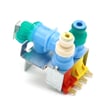
| Water pooling near back/bottom | Supply line or valve connection | Refrigerator water inlet valve assembly WPW10420083 |
| Drips around filter housing | Filter head or filter not fully seated | Refrigerator water filter head W11346623 or refrigerator water filter EDR4RXD1 |
Defrost drain and drain pan issues
When the defrost drain is clogged, meltwater can back up and run down to the bottom of the cabinet, then onto the floor.
- Clear visible debris from the drain opening.
- Melt any ice blockage with warm water (small amounts at a time).
- Confirm the drain pan is not cracked and is positioned to catch water.
- Clean the pan if it is overflowing from sludge buildup.
Why it matters
Bottom leaks can damage flooring and also point to airflow or defrost problems that reduce cooling performance. Fixing the drain path or a small water fitting leak early prevents bigger issues like ice buildup and recurring puddles.
Last updated: February 2026