Installation guide
 Owner’s manual
 Error Codes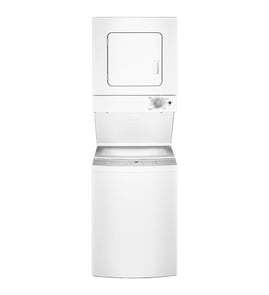


How does the GE washer dryer combo work?
The GE GUD27ESPM1DG laundry center is a stacked washer and dryer that can run at the same time; the washer fills, agitates, rinses, and spins, while the dryer tumbles and dries using a vented exhaust system that must be ducted outdoors. See the GUD27ESPM1DG owner’s manual for cycle and control details.
How the washer side works
The washer uses a cycle selector and Start button to run through wash, rinse, and spin stages.
- Add items loosely; overloading can reduce cleaning and spinning performance.
- Add detergent (HE detergent is recommended for best results).
- Select a washer cycle and temperature; rinses use cold water.
- Close the lid and press Start; the lid locks during spin for safety.
- If the lid is left open with water present, the washer can auto-drain after about 15 minutes.
How the dryer side works
This model’s dryer is not ventless; it is designed to exhaust to the outdoors (proper venting is critical).
- Load items loosely and close the dryer door.
- Choose an automatic cycle (sensor-based) or a timed dry cycle.
- Clean the lint filter before each load.
- Start the cycle; opening the door stops the dryer until restarted.
Washer vs. dryer at a glance
| Feature | Washer (bottom) | Dryer (top) |
|---|---|---|
| Main job | Clean clothes | Remove moisture |
| Key stages | Wash, rinse, spin | Tumble, heat, cool-down |
| Safety interlock | Lid locks during spin | Door must be closed to run |
| Airflow requirement | None | Must vent outdoors |
Why it matters
Understanding that GUD27ESPM1DG is a vented laundry center helps you avoid long dry times and overheating issues; most “dryer problems” on these units trace back to lint buildup or restricted venting, not the controls.
Last updated: January 2026
Where to put laundry detergent in GE washer dryer combo?
For the GE GUD27ESPM1DG laundry center, we add detergent directly into the washer basket (not the bleach funnel or fabric softener dispenser). Add detergent before loading clothes, and use only HE detergent to prevent oversudsing and residue; see the GUD27ESPM1DG owner’s manual.
Where detergent, bleach, and softener go
Use the correct dispenser or location so the cycle can dilute and release products at the right time.
- Detergent: put it in the bottom of the wash basket before adding clothes
- Detergent packets/pods: place in the bottom of the basket first, then add laundry
- Liquid chlorine bleach: pour into the liquid bleach funnel (not into the softener dispenser)
- Fabric softener (agitator models): pour diluted softener into the fabric softener dispenser on the agitator and select Deep Rinse
Quick dosing tips (to avoid suds and long cycles)
Using too much detergent is one of the most common causes of poor rinsing, residue, and longer wash times.
- Use HE (high-efficiency) detergent
- Use less for small loads, lightly soiled loads, or soft water
- If you see lots of suds, reduce the dose next load (even with HE)
- If clothes feel stiff or look dull, run an extra rinse (if available) and reduce detergent
Detergent placement at a glance
| Laundry product | Where it goes in GUD27ESPM1DG | Notes |
|---|---|---|
| HE liquid or powder detergent | Wash basket bottom | Add before clothes for best dissolving |
| Pods/packs | Wash basket bottom | Never place on top of clothes |
| Liquid chlorine bleach | Bleach funnel | Never pour undiluted bleach on clothes |
| Fabric softener | Softener dispenser (or add during rinse on some versions) | Dilute; use Deep Rinse |
Why it matters
Correct placement helps the washer dilute chemicals properly, rinse cleanly, and avoid oversudsing that can cause extended cycle time, poor spinning, and detergent residue.
Last updated: January 2026
Why is my GE washer not spinning clothes dry?
If your GE GUD27ESPM1DG washer finishes with clothes still wet, the most common causes are an out-of-balance load, an incorrect cycle selection, or a drain problem that prevents a full-speed spin. Start by redistributing the load and running Drain & Spin. See the GUD27ESPM1DG owner's manual for cycle and indicator-light details.
Quick checks we recommend first
- Redistribute the load evenly; heavy items can clump to one side.
- Run Drain & Spin to see if the washer can reach a strong spin.
- Reduce load size; overloading can limit spin performance.
- Match the cycle to the fabric; some cycles use lower spin speeds.
- If the tub is still full of water, focus on draining first.
What the indicator lights can mean on this model
Your GUD27ESPM1DG uses a Consumer Help Indicator (CHI). If you see Spin and Rinse lights blinking, the washer detected an out-of-balance condition and may not spin up to full speed. Rebalance the load and then run Drain & Spin.
| What you notice | Likely cause | What to do |
|---|---|---|
| Spin and Rinse lights blinking | Out-of-balance load | Rebalance, then run Drain & Spin |
| Clothes wetter than normal, no lights | Low-spin cycle or overload | Choose a higher-spin cycle, reduce load |
| Water left in tub at end | Drain restriction or weak pump | Check hose for kinks, inspect pump path |
When it points to a part
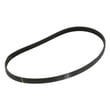
If the washer drains but won’t spin strongly (or you hear the motor but basket speed is low), a worn drive belt can slip.
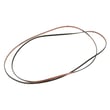
- Inspect the laundry center washer drive belt WE12X27300 for glazing, cracking, or looseness.
- If the washer won’t drain well, check for a kinked drain hose and clogs in the tub-to-pump hose and drain hose.
- If you suspect a drain-pump failure, use the parts list for this model to confirm the correct pump for your exact configuration.
Why it matters
A weak or interrupted spin leaves extra water in fabrics, which increases dryer time and energy use and can make bulky loads feel “never dry.”
Last updated: January 2026