Installation guide
 Owner’s manual
 Error Codes


How do I tell what model Kenmore fridge I have?
Your Kenmore refrigerator model number is printed on a rating label inside the refrigerator. On Kenmore model 25370413412, you will typically find it on an inside wall of the fresh food section or freezer, sometimes behind the crisper drawers or near the toe grille area. Use the exact model number to match the right parts and instructions in the 25370413412 owner's manual.
Where to look for the model number label
Check these common spots first (use a flashlight and look for a sticker or metal plate):
- Inside the fresh food compartment on a side wall
- Inside the freezer compartment on a side wall
- On the frame just inside the door opening
- Behind or near the lower crisper drawers
- Near the front bottom area by the toe grille (kick plate)
What the label looks like and what to write down
The label usually includes several identifiers. We recommend copying them exactly.
| Label item | What it’s used for | Example format |
|---|---|---|
| Model number | Finds the correct parts list and diagrams | 25370413412 |
| Serial number | Helps date the unit and confirm production run | Letters and numbers |
| Electrical ratings | Useful for troubleshooting and safe service | Volts/amps |
Why it matters
Kenmore refrigerators can look similar across multiple series, but parts like a door gasket, temperature sensor, or control board can vary by model. Using the correct model number helps ensure the replacement part fits and the repair steps match your exact refrigerator.
Quick tip for parts matching
Once you have the model number, match parts by both description and identifier when available. For example, if you are addressing odors, this model uses a door-mounted air filter such as the refrigerator door air filter EAFCBF.
Last updated: February 2026
How many cubic feet is a Kenmore washer?
Kenmore washer capacity depends on the exact washer model; most full-size Kenmore top-load washers are 3.5 to 4.8 cu. ft., and most full-size front-load washers are 4.2 to 4.8 cu. ft. Use your washer’s model number to confirm the exact cubic feet in the 25370413412 owner’s manual.
How to find your washer’s exact capacity
- Locate the washer model number on the rating label (commonly under the lid for top-loaders, or around the door opening for front-loaders).
- Search the washer’s Use and Care Guide for “capacity” or “cu. ft.”
- Compare the listed capacity to your laundry needs (comforters, king bedding, large family loads).
- Use the washer model number when ordering parts so the fit and performance match.
Typical Kenmore washer capacity ranges
| Washer type | Typical capacity (cu. ft.) | Common use |
|---|---|---|
| Compact (apartment size) | 2.0 to 3.4 | Small loads, tight spaces |
| Standard top-load | 3.5 to 4.4 | Everyday laundry |
| High-capacity top-load | 4.5 to 4.8 | Bulky items, fewer loads |
| Standard front-load | 4.2 to 4.8 | Large loads, efficiency |
| Extra-large front-load | 4.9 to 5.2 | Biggest loads, premium models |
Why it matters
Capacity affects how well clothes tumble or agitate. Loading beyond the rated tub size reduces cleaning performance and increases out-of-balance spinning, which accelerates wear on suspension, bearings, and drive components.
If you meant Kenmore model 25370413412 (refrigerator)
Model 25370413412 is a Kenmore bottom-mount refrigerator, not a washer. For refrigerator setup details such as leveling and door alignment, use the 25370413412 installation guide.
Last updated: February 2026
How to tell if a Kenmore refrigerator compressor is bad?
A bad compressor in your Kenmore refrigerator model 25370413412 usually shows up as poor cooling with the unit trying to run (humming, repeated clicking, or running nonstop) but temperatures never recover. Before condemning the compressor, we check airflow, condenser cleanliness, and the start and control components that can mimic compressor failure.
Quick symptoms checklist
- Fresh food section warm and freezer warming at the same time
- Compressor is very hot to the touch after running attempts (do not touch bare tubing)
- Repeated clicking every few minutes (often start device overload cycling)
- Compressor hums briefly, then shuts off
- Refrigerator runs constantly but cannot reach set temperatures
- Little to no heat coming off the condenser area when it should be cooling
What to check first (rules out common look-alikes)
- Power and airflow: Make sure the toe grille is not blocked and the refrigerator has good air circulation (restricted airflow can cause overheating and poor cooling). See the installation guide.
- Condenser fan operation: If the condenser fan is not running when the compressor is running, the compressor can overheat and shut down. A failed fan motor is a common cause.
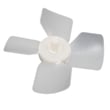
- Evaporator airflow: If the evaporator fan is not moving air, the freezer may cool unevenly and the fresh food section warms. Inspect the refrigerator evaporator fan blade 5308000010 for damage or looseness.
- Temperature sensing and defrost issues: A bad sensor or defrost problem can cause warm temps and long run times that look like a compressor issue.
Compressor vs. other causes (fast comparison)
| What you observe | More likely cause | What we do next |
|---|---|---|
| Clicking, compressor tries then stops | Start device, overload, or control issue | Check wiring, relays, and power control logic |
| Compressor runs, no cooling, fans running | Sealed system or compressor problem | Technician checks pressures and amp draw |
| Freezer cold, fresh food warm | Airflow or damper issue | Check evaporator fan, vents, frost pattern |
| Heavy frost on evaporator cover | Defrost system issue | Check defrost sensor/thermostat and heater circuit |
Why it matters
Replacing a compressor is one of the highest-cost refrigerator repairs and requires sealed-system tools. Confirming airflow, fan operation, and control inputs first prevents replacing the wrong part and helps restore cooling faster.
Last updated: February 2026
What are the most common problems with Kenmore refrigerators?
The most common problems we see on Kenmore refrigerators like model 25370413412 are poor cooling, water leaks, ice maker or dispenser issues, and unusual noises. These usually trace back to airflow restrictions (dirty coils, fan problems), defrost system faults, or worn door seals.
Quick checks that solve many issues
- Make sure the toe grille is not blocked; proper air circulation is essential.
- Confirm doors and the freezer drawer gasket seal fully against the cabinet.
- If you have an ice maker, verify the house water supply connection is tight and not leaking.
- Replace the water filter on schedule (typically every 6 months) to protect water flow and ice production.
- Listen for fan noise changes that point to an evaporator or condenser fan problem.
Common symptoms and the most likely causes
| Symptom | Most common cause | What to do first |
|---|---|---|
| Not cooling well | Dirty condenser coils, weak fan airflow, defrost ice buildup | Clean coils; check for steady fan operation |
| Water on floor | Clogged defrost drain, loose water line connection | Clear drain path; recheck fittings |
| Frost or ice buildup | Defrost sensor/thermostat issue, door not sealing | Inspect gasket seal; check defrost components |
| Bad odors | Old food, saturated air filter | Replace air filter; clean interior |
| Clicking, buzzing, rattling | Fan blade hitting ice, loose parts, compressor start noise | Inspect fan area; tighten loose items |
Parts that commonly fix these problems (when diagnosis points there)
- Refrigerator door gasket 5304537408: helps stop warm air leaks that cause frost and poor cooling.
- Refrigerator evaporator fan blade 5308000010: restores airflow across the evaporator for even cooling.
- Refrigerator condenser fan motor 242018301: improves heat removal at the condenser for better cooling.
- Refrigerator temperature sensor 240597220: helps the control system regulate temperatures accurately.
- Refrigerator door air filter EAFCBF: helps reduce odors in the fresh food compartment.
Why it matters
Cooling, leaks, and ice maker complaints often share the same root cause: airflow and sealing. The installation checklist for this style of refrigerator emphasizes a complete door seal and unobstructed airflow at the toe grille, because small gaps or blocked ventilation can quickly lead to temperature swings, frost, and moisture problems.
Model-specific references
- Use 25370413412 owner’s manual for filter location and replacement timing (water filter is in the top right of the fresh food compartment; replacement is typically every 6 months).
- Use 25370413412 installation guide for door and freezer drawer gasket seal checks and final leveling/airflow setup.
Last updated: February 2026
What does DH mean on Kenmore Elite refrigerator?
On Kenmore refrigerators, dH (often shown as Er dH) indicates a defrost heating problem. On model 25370413412, this typically points to an issue in the defrost circuit such as the defrost sensor/thermostat, wiring, or the control not completing a normal defrost cycle; check the 25370413412 owner's manual for the exact display behavior and reset steps.
What to check first (safe, quick steps)
- Power reset: unplug the refrigerator (or switch off the breaker) for 5 minutes, then restore power.
- Confirm doors fully close and seal; warm air leaks can increase frost and trigger defrost-related errors.
- Listen for the evaporator fan in the freezer; heavy frost can stop airflow and mimic a defrost failure.
- Look for heavy frost on the freezer back panel (a common sign the defrost system is not clearing ice).
- If the display is unresponsive during the error, restore power first, then recheck the code.
Parts commonly involved in a dH / Er dH condition
If the code returns after a reset, these parts are the most common suspects on this Kenmore platform:
| What it affects | Common symptom | Example part for model 25370413412 |
|---|---|---|
| Defrost sensing | Frost buildup, warm fridge section | Refrigerator defrost sensor 808137001 |
| Defrost safety thermostat | Defrost stops early or never heats | Refrigerator defrost bi-metal thermostat 5304521781 |
| Temperature feedback | Temps swing, defrost timing issues | Refrigerator temperature sensor 240597220 |
Why it matters
When the defrost system does not melt frost off the evaporator, airflow drops. That can cause the fresh food section to warm up, the freezer to run longer, and ice buildup to get worse until cooling performance suffers.
When to stop and schedule service
- The freezer back wall is solidly iced over and returns quickly after you clear it.
- The refrigerator is warming above safe food temperatures.
- You see repeated dH / Er dH errors after a power reset.
Last updated: February 2026
What is the bottom part of a refrigerator called?
On a Kenmore refrigerator like model 25370413412, the “bottom part” most people mean is the toe grille (the vented panel at the lower front). Behind and below that area is the machine compartment, where the compressor and condenser components live; keep that grille unblocked for airflow (see the 25370413412 owner's manual).
What you might be referring to
Refrigerator “bottom” can mean a few different things depending on where you’re looking:
- Toe grille: the vented cover at the lower front of the cabinet
- Machine compartment: the area behind the toe grille and lower rear panel
- Compressor area: the sealed system pump, typically low in the cabinet
- Bottom freezer section (on bottom-mount designs): the freezer drawer compartment
Quick ID guide (by location)
| Where you’re looking | Common name | What it does |
|---|---|---|
| Lower front, vented panel | Toe grille | Lets air flow to cool the compressor area |
| Lower back, behind cover | Machine compartment | Houses compressor, condenser fan, condenser coil |
| Bottom drawer area | Freezer compartment | Stores frozen food and supports ice maker components (if equipped) |
Why keeping the “bottom” clear matters
Your 25370413412 needs sufficient air circulation to run efficiently. Blocking the toe grille can trap heat around the compressor area, which can lead to warmer temperatures and longer run times.
If you suspect a problem in the bottom area
Use these quick checks before replacing parts:
- Make sure the toe grille is installed and not blocked by rugs, pet hair, or boxes
- Confirm the refrigerator is level so doors seal properly
- Listen for the condenser fan running when the compressor is on
- Watch for water puddles near the front, which can point to a drain or defrost issue
If you’re troubleshooting cooling or noise, the installation guide also highlights keeping the toe grille clear during setup.
Last updated: February 2026
When did Kenmore Connect come out?
Kenmore Connect came out in 2010. It was introduced as a customer service technology that let select Kenmore and Kenmore Elite washers and dryers communicate diagnostic information to service experts over the phone.
What Kenmore Connect is (and is not)
Kenmore Connect is often confused with refrigerator connectivity, but it was designed for certain laundry products, not for the Kenmore 25370413412 bottom-mount refrigerator.
- It is a diagnostic support feature used during troubleshooting.
- It was launched for select Kenmore and Kenmore Elite washers and dryers.
- It helps share error and operating data with service support.
- It is not the same as Wi-Fi smart home control.
- It is separate from refrigerator topics like water filters, door gaskets, or cooling fans.
How this relates to your Kenmore 25370413412 refrigerator
For this refrigerator model, the most useful references for operation, features, and service procedures are the 25370413412 owner’s manual and the 25370413412 installation guide. Those documents cover items like door removal during installation, leveling, and final checks.
Quick comparison
| Feature/topic | Kenmore Connect | Kenmore 25370413412 refrigerator docs |
|---|---|---|
| Primary purpose | Remote-style diagnostics with service support | Operation, installation, and care steps |
| Product type | Select washers and dryers | Bottom-mount refrigerator |
| Where to look for details | Product feature info for supported laundry models | Owner’s manual and installation guide |
Why it matters
Knowing the 2010 launch date helps set expectations: Kenmore Connect is a legacy diagnostic feature for certain laundry appliances, while refrigerator troubleshooting is typically handled through the model’s manual procedures and standard refrigerator components.
Last updated: February 2026
Why is my Kenmore refrigerator leaking underneath?
Water under a Kenmore 25370413412 bottom-mount refrigerator is usually caused by a clogged or frozen defrost drain, a drain pan that is out of position or overflowing, or a leak at the house water supply connection. We recommend checking the drain path first, then inspecting the pan and water line.
Quick checks (start here)
- Unplug the refrigerator before accessing internal panels or moving it.
- Look for ice or debris at the defrost drain opening inside the fresh food section.
- Check the drain pan underneath for cracks, tipping, or overflow.
- Inspect the water supply line and fittings (especially if you have an ice maker).
- Confirm the cabinet is level; a tilt can cause water to miss the pan.
Most common cause: clogged defrost drain
During normal defrosting, meltwater should flow through a drain tube into the drain pan. If the drain freezes or clogs, water backs up and can leak onto the floor.
What to do
- Remove items near the back wall and locate the drain opening.
- Flush the drain with warm water (a turkey baster works well).
- Use a flexible pipe cleaner to clear sludge.
- If it refreezes quickly, check for heavy frost buildup that points to an airflow or defrost issue.
Water line and connection leaks (ice maker models)
The installation checklist calls out checking for leaks at all connections and rechecking after 24 hours.
| Where it leaks | What you typically see | What to do |
|---|---|---|
| Behind unit at fitting | Drips only when dispensing or making ice | Tighten fitting, inspect tubing for cracks |
| Under front | Random puddles, worse after door use | Verify pan position and level |
| Inside freezer | Ice sheet on floor | Check drain and door seal |
Parts that can help (when inspection shows damage)
- If odors are strong and you are already servicing the unit, replace the refrigerator door air filter EAFCBF.
- If warm air leaks are causing excess frost and meltwater, inspect the door seal; replace the refrigerator door gasket 5304537408 if it is torn or not sealing.
Why it matters
Leaks can damage flooring and also signal airflow, defrost, or door-sealing problems that reduce cooling performance and increase frost.
Helpful references
- Use the 25370413412 installation guide for leveling and the “no water leaks present at all connections” final checks.
- Use the 25370413412 owner’s manual for care, cleaning, and safe moving guidance.
Last updated: February 2026