Owner’s manual
 Error Codes


How many cubic feet is my Kenmore refrigerator model 10659912703?
The exact cubic-foot capacity for Kenmore model 10659912703 is listed on the model’s rating label and in the 10659912703 owner's manual. Most Kenmore 106 side-by-side refrigerators are commonly in the 22 to 26 cu. ft. range, depending on the specific configuration.
How to find the exact capacity (fastest methods)
- Check the rating label inside the fresh food section (often on a side wall or near the crisper area).
- Look for wording like “Capacity”, “Total volume”, or “Cu. Ft.”
- Use the 10659912703 owner's manual and search for “capacity” or “specifications.”
- If the label is worn, write down the full model number (10659912703) and any serial number for reference.
Typical capacity ranges for side-by-side refrigerators
These ranges help you sanity-check what you find on the label.
| Side-by-side type | Typical capacity | What changes it most |
|---|---|---|
| Standard-depth | 22 to 28 cu. ft. | Cabinet width, ice maker, dispenser features |
| Counter-depth | 20 to 23 cu. ft. | Shallower cabinet depth |
Why capacity can vary even within “106” models
Kenmore 106 models were produced in multiple sizes and feature sets. Capacity changes with:
- Cabinet depth (standard-depth vs counter-depth)
- Ice maker and in-door dispenser design
- Shelf and bin layout (spill-safe shelves, door bins, meat pan)
- Insulation thickness and liner design
Related parts that affect usable space (not cubic feet)
If you are trying to restore storage space, these model-matched parts can help:
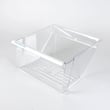
- Refrigerator meat pan WP2188664 (replaces a cracked or missing drawer)
- Refrigerator spill-safe shelf WPW10276348 (restores a broken shelf)
- Refrigerator door shelf rail WP2309941 (helps secure door bins)
Why it matters
Knowing the true cubic-foot capacity helps us match the right shelves, bins, and accessories, and it also helps when comparing replacement refrigerators or planning kitchen fit.
Last updated: January 2026
What are the most common issues with 10659912703?
The most common issues we see with the Kenmore 10659912703 side-by-side refrigerator involve cooling performance, ice and water dispensing, and door sealing or alignment. Many symptoms trace back to airflow problems, defrost system faults, or dispenser and ice maker components that wear over time; use the 10659912703 owner's manual for model-specific checks.
Common symptoms and what they usually point to
- Refrigerator warm but freezer cold: restricted airflow, evaporator fan issue, or frost buildup from a defrost problem
- Frost or ice sheet on the freezer back wall: defrost system trouble (often a defrost thermostat)
- Ice maker not making ice: shut-off arm position, frozen fill tube, or ice maker module failure
- Water dispenser slow or not dispensing: frozen water tube, supply restriction, or dispenser mechanism issue
- Doors not closing well or popping open: door cam wear, gasket sealing issues, or leveling
Parts that commonly relate to these problems
If your symptoms match, these model-compatible parts are often involved:
| Symptom | Part to check | Part ID |
|---|---|---|
| Frost buildup, warm fridge section | Defrost thermostat | WPW10225581 |
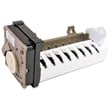
| No ice or intermittent ice | Ice maker assembly | WPW10190965 |
| Slow/no water at dispenser | Water tube | W10823511 |
| Door not closing smoothly | Door cam (black) | WP2182179 |
| Clicking or weak ice dispensing | Auger motor | W11671282 |
Quick checks we recommend before replacing parts
- Set temperatures to typical targets: 37°F fresh food, 0°F freezer
- Confirm vents are not blocked by food packages
- Listen for the evaporator fan running when the freezer door switch is held closed
- Inspect for heavy frost on the evaporator cover (defrost issue indicator)
- For dispenser issues, check for a frozen line in the door and verify household water supply is fully open
Why it matters
On a side-by-side like the Kenmore 10659912703, the freezer supplies most of the cold air to the refrigerator section. When airflow or defrost fails, temperatures drift, ice production drops, and the unit can run longer than normal.
For diagnostic help with display codes and common fault patterns, use Kenmore 106 model refrigerator error codes.
Last updated: March 2026
What is the average lifespan of 10659912703?
A Kenmore side-by-side refrigerator like model 10659912703 typically lasts 13 years with normal household use and basic maintenance. Keeping airflow clear, doors sealing tightly, and the ice and water system maintained helps you reach that lifespan.
Typical lifespan and what affects it
Most side-by-side refrigerators fall into a similar life range; the biggest differences come from usage and upkeep.
- Heavy use (large household, frequent door openings) shortens life
- Poor ventilation around the cabinet raises compressor run time
- Dirty condenser area increases heat load and wear
- Weak door sealing causes longer run times and frost issues
- Ice maker and dispenser use adds moving parts and water-related wear
Maintenance that helps you get the full life
Use the care and cleaning schedule in the owner's manual and focus on these high-impact items:
- Keep the condenser area clean and unobstructed
- Confirm both doors close and seal evenly
- Set temperatures to typical targets: 37°F fresh food, 0°F freezer
- Replace filters on schedule if your unit uses them
- Address unusual noises early (fan rubbing, clicking, buzzing)
Quick reference: symptoms that can shorten lifespan
| Symptom | Common cause | What to check first |
|---|---|---|
| Warm refrigerator section | Airflow or defrost problem | Vents blocked, frost buildup, fan operation |
| Constant running | Dirty condenser or door leak | Airflow around unit, gasket seal |
| No ice or slow ice | Ice maker or water supply issue | Shutoff arm, fill issues, water pressure |
| Clicking then no cooling | Start or compressor circuit issue | Power, relay area, service needed |
Why it matters
Knowing the expected 13-year lifespan helps you decide whether to repair or replace. If your 10659912703 is near that age and cooling performance is slipping, focusing on airflow, sealing, and ice and water maintenance often restores reliability at the lowest cost.
Last updated: March 2026