Owner’s manual


Can I search for Whirlpool parts by model?
Yes. For Whirlpool dryer model WGD5100HW0, searching by the full model number is the most accurate way to get compatible replacement parts because it filters results to the exact diagrams and part listings built for your dryer.
- Find the model number on the dryer’s model tag and match it exactly (letters and numbers).
- Use the full model number WGD5100HW0 when searching; do not shorten it.
- Use the parts diagram to confirm the part’s location and description before ordering.
- Cross-check the part name and part ID to avoid look-alike parts.
- If your dryer is a gas model, confirm you are shopping gas-dryer parts (ignition and burner parts differ from electric).
Your WGD5100HW0 owner’s manual helps you identify what type of installation you have (gas vs. electric), what tools are typically needed, and what safety steps to follow before servicing.
| Task | Typical tools |
|---|---|
| Basic access panels and brackets | #2 Phillips screwdriver, 1/4" nut driver |
| Leveling and setup checks | Level, adjustable wrench |
| Gas connection work (gas models) | Pipe wrench, adjustable wrench, pipe-joint compound |
If you already know the symptom, model-based search gets you to the right part page quickly:
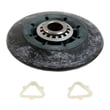
- Squealing or thumping drum: dryer drum support roller WPW10314173
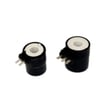
- Dryer will not heat (gas): dryer gas valve coil kit 279834
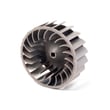
- Noisy airflow or poor airflow: dryer blower wheel WP697772
- Dryer overheats or shuts off: thermal fuse W10909685
Whirlpool often uses similar-looking parts across multiple dryers. Searching by WGD5100HW0 reduces returns and downtime because you’re matching parts to the exact drum, burner, and airflow design used in your dryer.
Last updated: February 2026
What's the average lifespan of a Whirlpool dryer?
Most Whirlpool dryers, including model WGD5100HW0, typically last 10 to 13 years with normal household use. Consistent airflow maintenance (lint screen and venting) and avoiding overheating are the biggest factors that help a gas dryer reach the high end of that range.
- Venting length and bends: Long runs and too many 90° turns reduce performance and can shorten dryer life.
- Lint control: Clean the lint screen every load; remove lint from inside the cabinet and exhaust vent about every 2 years (more often with heavy use).
- Overheating events: Restricted airflow can overheat the dryer and stress safety devices.
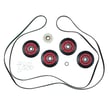
- Wear parts: Rollers, idler pulley, and blower wheel wear over time and can cause noise or poor airflow.
- Usage habits: Overloading and running back-to-back heavy loads increases wear on the drive system.
Use the venting and cleaning guidance in the WGD5100HW0 owner’s manual.
- Clean the lint screen every load; do not wash it with water (wet lint is harder to remove).
- Keep the vent route as straight and short as possible; use as few elbows as you can.
- Use rigid metal venting where possible; avoid kinks and crushed duct.
- Have lint removed from the exhaust vent and inside the cabinet about every 2 years.
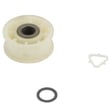
- If you hear squealing or thumping, inspect common wear items like the dryer drum support roller WPW10314173 and dryer idler pulley W10837240.
Long vent runs and extra elbows increase drying time and energy use; they also raise operating temperatures, which can shorten component life.
| 90° turns/elbows | Max rigid metal vent length (approx.) |
|---|---|
| 0 | 64 ft |
| 2 | 44 ft |
| 4 | 27 ft |
A dryer that dries efficiently runs cooler and for fewer minutes per load. That reduces stress on the motor, drum support system, and gas heat components, helping your Whirlpool dryer last closer to its expected lifespan.
Last updated: February 2026
How do I troubleshoot my WGD5100HW0?
For your Whirlpool WGD5100HW0 dryer, start troubleshooting by confirming power, door closure, and control settings; then check airflow and venting. This model can display messages like “Check Vent” for restricted airflow and an L2 code when the heater is not getting proper power.
- Make sure the controls are set to a running/ON state and the Start button is pressed firmly.
- Confirm the dryer door is fully closed.
- Verify the household fuse is intact or the circuit breaker has not tripped.
- Run a Timed Dry heated cycle (do not use an Air Only temperature setting) to confirm heat operation.
- If the display shows “Check Vent”, inspect the vent for crushing, kinks, or blockage.
Restricted airflow is the top cause of long dry times and overheating shutdowns.
- Use a heavy metal vent; do not use plastic or metal foil vent.
- Confirm the vent fits over the dryer exhaust outlet and inside the exhaust hood.
- Secure connections with a 4 in (102 mm) clamp.
- Move the dryer carefully to avoid crushing or kinking the vent.
| Symptom | What to check first | What it affects |
|---|---|---|
| “Check Vent” message | Vent crushed or blocked | Drying time, heat safety |
| Long dry times | Lint screen and vent path | Efficiency, energy use |
| Dryer shuts off early | Airflow and levelness | Moisture sensing accuracy |
Clean the lint screen every load; deep-clean it with a nylon brush about every 6 months (or sooner if residue builds up).
- Roll lint off with your fingers.
- Rinse both sides with hot water.
- Scrub with hot water and liquid detergent using a nylon brush.
- Rinse, dry thoroughly, and reinstall.
This model must be level for the moisture sensing system to operate correctly. Check level side-to-side and front-to-back; adjust leveling legs as needed. Steps and diagrams are in the owner's manual.
If the dryer runs but has no heat, common gas-heat suspects include the igniter, radiant sensor, and gas valve coils. If the dryer overheats or stops heating, a thermal fuse can open.
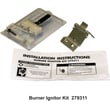
- No heat (gas): consider igniter 279311 and dryer gas valve coil kit 279834
- Heat cuts out: consider thermal fuse W10909685
Good airflow and correct leveling protect the dryer from overheating, reduce dry times, and keep sensor cycles accurate.
Last updated: March 2026