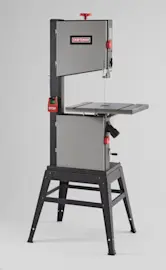
Owner’s manual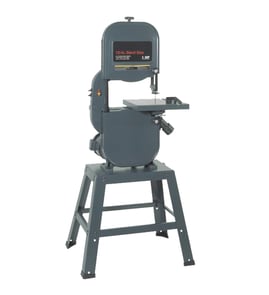


How do I know the size of my bandsaw blade?
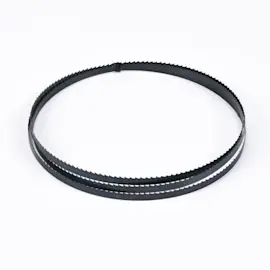
For the Craftsman band saw model 137224320, the correct blade size is 80 inches long, and it accepts blade widths of 1/8 inch, 1/4 inch, 3/8 inch, or 1/2 inch. To confirm what you have installed, measure blade length, width, and TPI (teeth per inch) using safe handling practices.
Blade size specs for Craftsman 137224320
Use these as your target when buying or verifying a replacement blade.
| Spec | What to look for | 137224320 spec |
|---|---|---|
| Blade length | Total loop length | 80 in. |
| Blade width | Tooth tip to back edge | 1/8 in. to 1/2 in. |
| TPI | Teeth per inch | Varies by material and cut |
How to measure your blade (length, width, and TPI)
Turn the saw off and unplug it before handling the blade.
- Length: If the blade is off the saw, keep it coiled, lay it flat, mark a starting point (often the weld), then measure around the full loop until you return to the mark.
- Width: Measure from the tooth tip straight across to the back edge of the blade.
- TPI: Count how many teeth are in 1 inch; for small teeth, count teeth across 2 inches and divide by 2.
- Kerf and set: If cuts are burning or wandering, the tooth set and sharpness matter as much as size.
- Safety: Wear gloves and eye protection; band saw teeth are sharp.
Picking the right width for the cut
Blade width affects how tight a curve you can cut and how straight the blade tracks.
- 1/2 in.: Best for straighter cuts and resawing; hardest to turn tight curves
- 3/8 in.: Good general-purpose choice
- 1/4 in.: Better for moderate curves
- 1/8 in.: Best for tight curves and delicate work
For step-by-step blade removal and installation, follow our guide: how to replace a band saw blade.
Why it matters
Using the correct 80-inch blade length keeps tension and tracking in the safe adjustment range. Matching blade width and TPI to the job helps prevent slow cutting, ragged cuts, blade drift, and premature blade breakage.
If you are shopping for parts or accessories by model number, start with the model parts list, or search by model on Sears PartsDirect. For additional model-specific specs and adjustments (tension gauge and tracking knob settings), use the owner's manual.
Last updated: February 2026
What is the 3-tooth rule for bandsaws?
The 3-tooth rule is a blade-selection guideline: when cutting on your Craftsman 137224320 band saw, choose a blade TPI (teeth per inch) so at least 3 teeth are in the workpiece at all times. This reduces tooth stripping, improves chip clearance, and helps the saw cut smoother.
How to apply the 3-tooth rule (quick method)
- Measure the material thickness (the direction the blade teeth pass through).
- Pick a TPI that keeps 3 or more teeth engaged.
A practical way to think about it:
- Minimum teeth engaged = 3
- Rule of thumb:
TPI x thickness (in.) ≥ 3
Examples (typical starting points)
- 1/4 in. stock: 14 TPI or higher (3.5 teeth engaged)
- 1/2 in. stock: 6 TPI or higher (3 teeth engaged)
- 1 in. stock: 3 TPI or higher (3 teeth engaged)
What happens if you break the rule
- Too few teeth in the cut (TPI too low)
- Teeth can snag and strip
- Cut feels grabby and rough
- Blade can kink when you try to steer a wide blade through a tight radius
- Too many teeth in the cut (TPI too high)
- Gullets pack with sawdust or chips
- The saw cuts slowly and heats the blade
- You may be tempted to push harder, which can overload the motor
Blade choice tips that match this model
Your manual emphasizes using the correct blade for the job and keeping blade tension and guides properly adjusted. It also notes this saw is intended for wood and similar materials, and it provides guidance on blade widths for common cuts. For the model-specific blade width and length guidance, use the owner's manual.
Common blade width guidance (from the manual)
| Operation | Recommended blade width (in.) |
|---|---|
| Cross cutting, mitering, beveling, compound cutting | 1/4, 3/8, 1/2 |
| Curve cutting | 1/8, 1/4 |
Why it matters
Following the 3-tooth rule helps your Craftsman band saw cut efficiently without forcing the feed rate. That supports better accuracy, longer blade life, and fewer issues like slow cutting or premature dulling.
Related troubleshooting help
If your saw is cutting slowly even with the right TPI, use our DIY guide: band saw cutting slowly. For broader repair help, start here: band saw repair guide landing page.
You can also look up replacement parts for your Craftsman 137224320 by model on Sears PartsDirect.
Last updated: February 2026
What is the specs of the Craftsman 12 inch bandsaw 137224320?
The Craftsman 12-inch band saw model 137.224320 is a 1 HP (max developed), 2-speed saw rated at 1410 and 2600 F.P.M. (no load), and it includes a leg stand. For the full list of product specifications and setup details, use the owner's manual.
Key specs (from the manual)
- Brand: Craftsman
- Model: 137224320
- Saw size class: 12-inch band saw
- Motor rating: 1 HP (max developed)
- Speeds: 2 speeds
- Blade speed: 1410 and 2600 F.P.M. (no load)
- Stand: Leg stand included
What these specs mean in real use
These specs tell you how the saw is intended to perform:
- Two speeds let you match blade speed to the material and cut quality.
- F.P.M. (feet per minute) is blade speed; higher speed typically cuts faster but can increase heat.
- 1 HP (max developed) is a peak-style rating; steady cutting performance depends on blade sharpness, tension, and feed rate.
Quick reference table
| Spec | Craftsman 137224320 |
|---|---|
| Motor | 1 HP (max developed) |
| Speeds | 2 |
| Blade speed (no load) | 1410 / 2600 F.P.M. |
| Stand | Leg stand |
Why it matters
Matching blade speed and feed rate to your material helps prevent slow cutting, burning, and blade drift. If the saw bogs down, feeding the workpiece more slowly is a common fix.
Parts and diagrams
For model-specific diagrams and to look up replacement parts by model number, start with the parts list for Craftsman 137224320, or search by model on Sears PartsDirect.
Last updated: February 2026