Installation guide
 Owner’s manual
 Error Codes


How many cubic feet is an admiral washer?
Admiral washer capacity depends on the exact model. For the Admiral ATW4475VQ0 top-load washer, the most reliable way to confirm cubic feet is to check the capacity/specifications section in the ATW4475VQ0 owner's manual, since capacity varies across Admiral top-load designs.
How to find the capacity for ATW4475VQ0
We recommend using the model-specific documentation first, then confirming by comparing to similar top-load platforms.
- Look for “Capacity”, “Washer dimensions”, or “Specifications” in the ATW4475VQ0 owner's manual
- If the manual lists only basket or tub dimensions, use those as a cross-check (capacity is often summarized elsewhere)
- Match the model number exactly: ATW4475VQ0 (small changes in model suffix can change capacity)
- If you are comparing washers, focus on usable capacity (what you can load) rather than just tub volume
Typical capacity range (helpful for comparison)
Most traditional, agitator-style top-load washers like the ATW4475VQ0 commonly fall into a mid-size capacity range.
| Washer type | Typical capacity range | Best for |
|---|---|---|
| Traditional top-load with agitator | 3.0 to 3.8 cu. ft. | Everyday mixed loads |
| High-efficiency top-load (impeller) | 4.0 to 5.5 cu. ft. | Larger loads, bulky items |
| Front-load washer | 4.0 to 5.8 cu. ft. | Large loads, high efficiency |
Why it matters
Capacity affects how much you can wash per load and how well the washer circulates water and detergent. Overloading a smaller-capacity basket can reduce cleaning performance and contribute to vibration during spin.
Last updated: February 2026
What are common admiral washer problems?
Common problems on the Admiral ATW4475VQ0 washer include not draining or spinning, excessive noise or vibration, and water leaks. Many issues come down to load balance, lid-closed safety operation, hose installation, or a worn drive or drain component; our ATW4475VQ0 owner's manual troubleshooting section walks you through the quickest checks.
Most common symptoms and what to check first
- Won’t drain or spin: confirm the lid is fully closed; check for excessive suds; make sure the drain hose is not clogged and is not routed higher than 96 in. (244 cm).
- Noisy or vibrating: balance the load, avoid overloading, and level the washer (front feet set correctly; rear legs reset if needed).
- Leaking: tighten fill hoses, verify hose washers are seated, and check household plumbing.
- Basket looks crooked: center the basket before starting; re-check leveling and load balance.
- Pauses mid-cycle: some cycles pause for about 2 minutes; let the cycle continue.
Parts that commonly fix these problems (when checks don’t)
If the basic checks above don’t resolve the symptom, these model-compatible parts are frequent fixes:
| Symptom | Common culprit | Example model-compatible part |
|---|---|---|
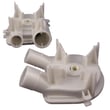
| Won’t drain | Clogged or failing pump | Washer drain pump WP3363394 |
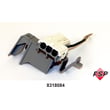
| Won’t spin/agitate (lid-related) | Lid switch not sensing closed lid | Washer lid switch assembly WP8318084 |
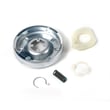
| Agitator “slips” or won’t move clothes well | Worn agitator dogs | Agitator dog 80040 |
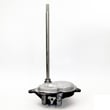
| No spin or weak spin (direct-drive style issues) | Worn motor coupling | Coupling 285753A |
Why it matters
Catching the simple causes first (load balance, leveling, lid closed, correct drain hose height) prevents repeat failures and reduces wear on the drive system, clutch, and pump. It also helps avoid leaks caused by loose fill hoses or poor installation.
Quick safety and prevention tips
- Unplug the washer before inspecting internal parts.
- Turn off the water supply when you’ll be away for an extended period.
- Use the correct amount of detergent to prevent excessive sudsing.
- Re-check leveling after moving the washer or installing new parts.
Last updated: February 2026
What is the average lifespan of ATW4475VQ0?
The average lifespan of the Admiral ATW4475VQ0 top-load washer is about 10 to 14 years with normal household use. Keeping the washer level, avoiding overloads, and replacing wear items (like hoses) on schedule helps it reach that range.
What affects lifespan most
- Load size and balance: Overloading and repeated out-of-balance spins increase wear on the clutch, drive system, and suspension.
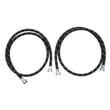
- Water leaks and hose condition: The installation and use instructions call for replacing inlet hoses every 5 years and inspecting for bulges, kinks, cuts, wear, or leaks.
- Leveling and vibration: A washer that is not level can be noisy and stresses components during spin.
- Drain performance: Slow draining makes the washer work harder and can lead to no-spin symptoms.
- Storage in freezing conditions: Freezing can damage the washer if it is not winterized.
Quick maintenance schedule (practical)
| Item | What to do | When |
|---|---|---|
| Water inlet hoses | Inspect for wear and leaks | Every few months |
| Water inlet hoses | Replace | Every 5 years |
| Leveling feet | Recheck level, tighten locknuts | If vibration increases |
| Tub and lid area | Wipe down, leave lid open between loads | Weekly |
Parts that commonly wear on this style of washer
If performance drops (no drain, no spin, weak agitation), these are common suspects on ATW4475VQ0:
- Washer drain pump WP3363394 (draining issues, humming, leaks)
- Washer lid switch assembly WP8318084 (won’t spin or drain if the lid switch circuit is not made)
- Coupling 285753A (motor runs but washer does not agitate or spin)
- Clutch 285785 (poor or slipping spin)
Why it matters
Knowing the typical 10 to 14 year lifespan helps you decide whether to maintain and repair (hoses, pump, lid switch) or plan for replacement if multiple major drive components are wearing out at the same time.
For model-specific care steps like winterizing, leveling, and troubleshooting noise or vibration, follow the ATW4475VQ0 owner’s manual.
Last updated: March 2026