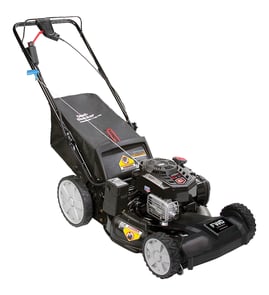



What snapper mower do I have?
Your Snapper mower’s identity is the model number on its ID tag. For the mower shown on this page, the model is Snapper RP21500; on your actual mower, confirm by finding the tag and matching the model number exactly before ordering parts.
Where to find the model number tag
Most Snapper walk-behind mowers use a small white or silver ID tag. Common locations include:
- On the back of the mower deck or frame
- Low on the rear corner of the frame, just below the floor pan
- Near the rear discharge area (if equipped)
- Under the handle mounting area on the deck
- Near the engine mounting plate (less common)
What to write down (and why)
Record these items from the tag so you get the right diagrams and parts list:
- Model number (example: RP21500)
- Series or revision (often shown as series 0 or 1 for this product type)
- Serial number (helps distinguish production runs)
- Engine model (useful for engine-specific parts like carburetor or air filter)
Quick match guide
Use this checklist to confirm you are on the correct model page.
| Item to compare | What should match | Why it matters |
|---|---|---|
| Model number | RP21500 (exact) | Ensures correct deck, drive, and control parts |
| Product type | Gas walk-behind mower | Avoids mixing with rider or electric parts |
| Brand | Snapper | Keeps parts and diagrams aligned |
Why it matters
Snapper mowers can look similar across multiple series, but small changes (deck hardware, self-propelled drive parts, control cables) can vary by model and series. Matching the model number first prevents wrong-part returns and repeat repairs.
For help confirming the tag details before you order, use how to find your appliance model number (and what it means for parts).
Last updated: February 2026
What type of gas do I put in my lawn mower?
For the Snapper RP21500 gas walk-behind mower, use clean, fresh, unleaded gasoline with a minimum 87 octane (87 AKI). Gasoline blended with up to 10% ethanol (E10) is the safest common choice for most small engines.
What to use (and what to avoid)
Use fuel that helps prevent hard starting, surging, and carburetor varnish.
- Use: Unleaded gasoline, 87 AKI or higher
- OK: Up to 10% ethanol (E10)
- Avoid: Old or stale gas (more than about 30 days without stabilizer)
- Avoid: Higher ethanol blends like E15 or E85 (common cause of fuel-system issues)
- Avoid: Mixing oil into the gas unless your mower is a 2-cycle engine (most walk-behind mowers are 4-cycle)
Quick fuel decision table
| Fuel option | Use it in RP21500? | Why |
|---|---|---|
| Regular unleaded 87 AKI (E0 or E10) | Yes | Best balance of availability and engine compatibility |
| Premium 91 to 93 AKI | Yes (optional) | Can help with storage stability; not required for power |
| E15 | No | Can run lean and damage fuel system components |
| E85 | No | Too much ethanol for small-engine fuel systems |
| Gas older than 30 days (no stabilizer) | No | Causes varnish, clogged jets, and hard starting |
Why it matters
Small mower carburetors have tiny passages; the wrong fuel (or old fuel) is the most common reason a walk-behind mower will not start, runs rough, or stalls under load.
Tips for best results
- Buy fuel in small quantities so it stays fresh.
- If you store the mower, add fuel stabilizer and run the engine a few minutes to circulate it.
- If the mower has been sitting, drain the tank and refill with fresh gas before troubleshooting anything else.
For more help with maintenance and repair basics, see easy diy appliance repairs that anyone can do.
Last updated: February 2026
What is the average lifespan of RP21500?
A Snapper RP21500 gas walk-behind mower typically lasts 8 to 12 years with normal residential use and routine maintenance (oil changes, clean air filter, sharp blade). Heavy use, dusty conditions, and skipped maintenance shorten life; good storage and tune-ups extend it.
What most affects lifespan on the Snapper RP21500
- Engine maintenance: regular oil changes and correct oil level prevent premature wear.
- Air filtration: a clogged air filter causes rich running and faster engine wear.
- Blade and deck care: a bent/dull blade stresses the crankshaft; packed grass holds moisture and rusts the deck.
- Fuel habits: old fuel and varnish plug the carburetor and hard-start the mower.
- Storage: dry, covered storage reduces corrosion on cables, wheels, and fasteners.
Typical lifespan by major system
| System | Typical service life | What usually ends it first |
|---|---|---|
| Engine (residential use) | 8 to 12 years | Poor lubrication, dirty air filter, stale fuel issues |
| Deck and handle assembly | 7 to 12 years | Rust-through, impact damage |
| Drive system (self-propel) | 5 to 10 years | Worn belt, cable stretch, worn wheels |
Signs it is near end-of-life (or needs a rebuild)
- Compression feels weak (easy pull, low power under load)
- Persistent smoking after correcting oil level
- Repeated carburetor clogging despite fresh fuel practices
- Excessive vibration (often blade or crankshaft related)
- Deck rust holes or cracking around mounting points
Why it matters
Knowing the expected lifespan helps you decide whether to tune up the RP21500 (blade sharpening, air filter, spark plug, carburetor cleaning) or plan for larger repairs like a drive overhaul or engine replacement.
For help confirming the correct model identification before ordering parts, use [how to find your appliance model number (and what it means for parts)].
Last updated: March 2026