Owner’s manual
 Error Codes



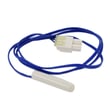
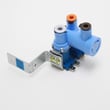
How do I tell what model Kenmore fridge I have?
To identify your Kenmore refrigerator model, look for the model and serial number on the identification label inside the fresh food (refrigerator) compartment. For Kenmore model 79572595711, the manual notes this label is on the interior liner; confirm the full model number exactly as printed. See the 79572595711 owner's manual for the label location and product record details.
Where to look for the model number label
Check these common spots first (starting with the most reliable):
- Inside the refrigerator compartment on the interior liner (side wall area)
- Along the door frame when the refrigerator door is open
- Behind or near the lower crisper drawers (inside the fresh food section)
- Under the front grille or kickplate area (some models)
- On a sticker near the ceiling of the fresh food compartment (some models)
What to write down (and why)
Record the information exactly as shown on the label so we can match parts and diagrams correctly.
- Model number (example format: 79572595711)
- Serial number (used to identify production range)
- Date of purchase (helpful for service history and reference)
Why it matters
Kenmore model numbers can look similar, but small differences change the correct parts list (water filter, ice maker, control board, door components). Using the exact model number prevents ordering the wrong refrigerator parts.
Quick checklist: model number vs. serial number
| Item | What it tells us | Used for |
|---|---|---|
| Model number | The exact refrigerator design | Correct parts and diagrams |
| Serial number | When and where it was built | Version-specific variations |
Tip for faster parts matching
Once you find the label, compare the printed model number to the one on this page: 79572595711. If every digit matches, you are in the right place for Kenmore bottom-mount refrigerator parts.
Last updated: February 2026
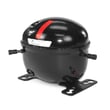
How to tell if a Kenmore refrigerator compressor is bad?
On Kenmore bottom-mount refrigerator model 79572595711, a “bad compressor” usually shows up as poor cooling plus abnormal run behavior (runs almost constantly, overheats, or trips the breaker). Before condemning the compressor, we confirm basics like door sealing, condenser airflow, and recent power or loading changes.
Quick checks before blaming the compressor
These items commonly make the compressor run longer even when the compressor is fine:
- If the refrigerator was just plugged in or power was restored, allow up to 24 hours to cool completely.
- Reduce door openings and avoid loading large amounts of warm food at once.
- Make sure both doors close fully and seal tightly.
- Verify the room temperature is within the typical operating range (about 55°F to 110°F).
- Clean the condenser cover and vents with a vacuum; do not remove the condenser area panel.
For model-specific operating guidance and troubleshooting tables, use the 79572595711 owner's manual.
Signs that point to a compressor problem
If the basics above check out, these symptoms strongly suggest a compressor or sealed-system issue:
- Refrigerator and freezer temperatures stay warm even after 24 hours of steady operation
- Compressor is extremely hot to the touch and cooling performance is still poor
- Repeated clicking as the compressor tries to start, then shuts off (often with dimming lights)
- Breaker trips or the unit repeatedly shuts down shortly after the compressor attempts to run
- You do not hear normal airflow sounds from the fans while the unit is calling for cooling
What’s normal vs. not normal (sound and run time)
Some noises are normal and do not mean the compressor is failing.
| What you notice | Often normal | More concerning |
|---|---|---|
| Clicking | Defrost cycle or controls cycling | Rapid, repeated start-clicks with no cooling |
| Whooshing/gurgling | Refrigerant movement, fans moving air | Loud, harsh buzzing with overheating |
| Long run times | Warm room, frequent door openings, heavy loading | Runs nearly nonstop with rising temps |
Why it matters
A compressor is a major component; replacing it is a high-cost repair and misdiagnosis is common. Confirming airflow, door sealing, and cooling conditions first prevents unnecessary parts replacement.
If you’re ready to move forward
When a compressor is truly failing, replacement typically involves sealed-system work. If you’re diagnosing a no-cool or warm-fridge complaint, we also check airflow components like the refrigerator evaporator fan motor EAU63923603 because a failed fan can mimic compressor trouble.
Last updated: February 2026
What size is Kenmore refrigerator model 79572595711?
Kenmore bottom-mount refrigerator model 79572595711 is a full-size, 33-inch class refrigerator; most units in this model family measure about 33 inches wide, 31 to 34 inches deep (varies with handles), and 67 to 70 inches high. For the exact cabinet and door-clearance dimensions, use the 79572595711 owner's manual.
How to get the exact measurements (the ones that matter for fit)
We recommend measuring your space and the refrigerator in these spots because door swing and handles often change the real-world depth.
- Width: measure the cabinet at the widest point (often the door hinges)
- Depth without handles: cabinet only, back to front edge of doors
- Depth with handles: deepest point including handles
- Height: floor to top of hinge cover
- Door swing clearance: space needed to fully open doors and drawers
- Ventilation clearance: space behind and above for airflow
Typical size ranges for this Kenmore 795 bottom-mount style
These are the common planning dimensions customers use when replacing a 33-inch class bottom-mount refrigerator.
| Measurement | Typical range | Why it varies |
|---|---|---|
| Width | ~33 in. | hinge covers, door alignment |
| Depth | ~31 to 34 in. | handles, door thickness |
| Height | ~67 to 70 in. | leveling legs, hinge cover |
Why it matters
A refrigerator can be “33 inches wide” and still not fit if the doors cannot open fully or if the depth with handles blocks a walkway. Confirming the exact dimensions in the manual helps avoid delivery day surprises.
If you are also planning for water and ice
If your 79572595711 is connected to a water supply, plan for enough slack in the water line so you can pull the refrigerator out for cleaning and service. The manual’s water-line section is the best reference for tubing size and setup details.
Last updated: February 2026
Who makes Kenmore refrigerator model 79572595711?
Kenmore model 79572595711 is a Kenmore-branded refrigerator that is manufactured by LG (the 795 model prefix is commonly associated with LG-built Kenmore refrigerators). For model-specific feature and service details, we recommend confirming identifiers and specifications in the 79572595711 owner's manual.
How to confirm the manufacturer on your exact unit
You can verify LG as the manufacturer by checking the product identification label on the refrigerator.
- Look for the model and serial tag inside the fresh food compartment (often on a side wall) or near the door frame
- Check for an LG-style serial format or an additional manufacturer code on the label
- Compare the model number on the tag to 79572595711 (it must match exactly)
- Use the manual’s identification section to match label locations and terminology
Why the manufacturer matters for parts and troubleshooting
Knowing LG built this Kenmore 795-series refrigerator helps you match the correct component design when ordering parts and diagnosing issues.
Common LG-built component categories you may see on this model include:
- Water filtration and water supply components
- Ice maker and dispenser components
- Evaporator and condenser fan motors
- Electronic control boards and sensors
Examples of LG-built parts used on this model
These are examples of parts listed for Kenmore 79572595711 that align with LG manufacturing.
| System | Example part on this model | Part ID |
|---|---|---|
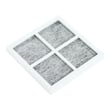
| Air filtration | Lg refrigerator air filter | ADQ73214408 |
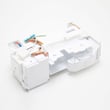
| Ice maker | Lg refrigerator ice maker | AEQ73110210 |
| Water supply | Lg refrigerator water inlet valve | AJU72992601 |
| Cooling airflow | Refrigerator evaporator fan motor | EAU63923603 |
Why it matters
Kenmore is a brand name, and different Kenmore model prefixes are built by different manufacturers. Identifying LG as the builder for 79572595711 helps ensure you get the right Kenmore-compatible parts, service procedures, and diagnostic approach.
Last updated: February 2026
Why is there water leaking from the bottom in my Kenmore refrigerator?
On Kenmore bottom-mount refrigerator model 79572595711, water leaking from the bottom is usually caused by a clogged or frozen defrost drain that overflows into the drain pan, or by a leak in the water supply connections for the dispenser or icemaker. Use the 79572595711 owner's manual to locate access points and follow safe shutoff steps.
Quick checks that fix most bottom leaks
- Unplug the refrigerator before working near wiring or fans.
- Look for ice buildup on the freezer floor; that points to a frozen defrost drain.
- Check the drain pan underneath for cracks, overflow, or being out of position.
- Inspect the water line connections at the back; tighten any fitting that drips.
- Make sure the tubing is routed so it does not vibrate against the cabinet or wall.
- If the leak happens only when making ice or dispensing water, focus on the water system.
Most common causes and what to do
| What you notice | Most likely cause | What we recommend |
|---|---|---|
| Water appears after defrost cycles, freezer floor icy | Defrost drain clogged or frozen | Melt ice with warm water; clear the drain opening and tube |
| Water appears only during ice/water use | Loose connection or leaking valve/tubing | Check fittings and tubing; if leaking persists, test the lg refrigerator water inlet valve AJU72992601 |
| Puddle is intermittent, near front | Drain pan sloshing or shifted | Re-seat the pan and verify the refrigerator is level |
Water line connection points to inspect (high value)
The manual’s water line section emphasizes turning water on, then tightening any connections that leak. Focus on these areas:
- Shutoff valve connection (house plumbing)
- Compression nut and ferrule at the refrigerator connection
- Tubing routing behind the unit (avoid rubbing and vibration)
- Valve area where the supply line enters the refrigerator
Why it matters
A small drip can turn into floor damage and can also cause ice buildup that restricts airflow, leading to warm temperatures in the fresh food section. Fixing the drain path or water connection early prevents repeat leaks.
Last updated: February 2026