Installation guide
 Owner’s manual
 Error Codes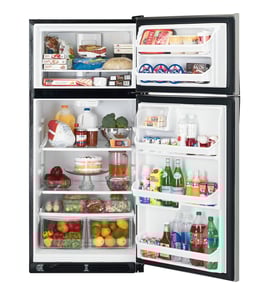

What is a fridge with freezer on top called?
A fridge with the freezer on top is called a top-freezer refrigerator, also commonly called a top-mount refrigerator. Your Whirlpool ER8MHMXML00 is this style, with the freezer compartment above the fresh food section.
In a top-mount design, cold air is produced in the freezer area and then circulates to the refrigerator section through vents. Keeping those vents clear helps both sections hold steady temperatures (details and diagrams are in the owner's manual).
- Freezer compartment located above the refrigerator compartment
- Shared airflow between freezer and fresh food sections
- Temperature controls typically set to mid-settings at installation
- Door swing can often be reversed (left or right opening)
- Vents that must stay unblocked to prevent warm spots and moisture issues
| Style name | Freezer location | Typical benefit | Typical tradeoff |
|---|---|---|---|
| Top-freezer (top-mount) | Top | Simple layout, efficient cooling | Bending more for fresh food |
| Bottom-freezer | Bottom | Fresh food at eye level | Often higher cost |
| Side-by-side | Left side | Narrow door swing, easy freezer access | Narrower shelves |
| French door | Bottom drawer | Wide fresh food space | More parts and complexity |
Knowing the style helps you pick the right troubleshooting steps and parts. For example, airflow between compartments is a key factor on top-freezer models; blocked vents can cause temperature swings and interior moisture buildup.
If temperatures seem off, start with these checks before replacing parts:
- Make sure food packages are not blocking freezer or refrigerator vents
- Limit frequent door openings (humidity and warm air enter each time)
- Allow several hours for temperatures to stabilize after adding a lot of food
- Confirm controls are set to the recommended mid-settings
Last updated: February 2026
Why is my Whirlpool measured fill not accurate?
Measured Fill accuracy issues are almost always caused by calibration being off or household water pressure changing while you dispense. On Whirlpool refrigerators, we calibrate Measured Fill when no other water is being used in the home, then re-test with a steady, consistent fill.
- Calibrate Measured Fill using the steps in your ER8MHMXML00 owner's manual.
- Avoid running a dishwasher, washing machine, shower, or sprinkler during calibration and testing.
- Dispense into the same container each time; wide containers can splash and skew your “measured” result.
- Purge air from the water line by dispensing several cups of water, then re-check accuracy.
- If the dispenser flow is weak or surging, inspect the supply line for kinks and confirm the shutoff valve is fully open.
Measured Fill relies on consistent flow. If pressure drops mid-dispense, the refrigerator can underfill; if pressure spikes, it can overfill.
| What you notice | Most likely cause | Best next step |
|---|---|---|
| Underfills sometimes | Pressure drop during dispense | Calibrate when house water is idle |
| Overfills sometimes | Pressure surge or air in line | Purge air, then recalibrate |
| Always inconsistent flow | Supply restriction or valve issue | Check line, then test inlet valve |
If calibration does not help and the water flow is inconsistent, the water inlet valve can be sticking or not opening evenly.
- Look for slow fill, pulsing flow, or intermittent dispensing.
- If symptoms match, replacing the refrigerator inlet valve WP2315576 is a common fix on water-supply problems.
- If you recently moved the refrigerator, re-check the water tube routing behind the unit.
Accurate Measured Fill helps prevent spills, improves ice maker and dispenser performance, and reduces strain on the water system by keeping flow steady and predictable.
Last updated: February 2026
How do I reset the feeler arm on my Whirlpool ice maker?
On your Whirlpool ER8MHMXML00, the ice maker “feeler arm” is the wire shutoff arm; resetting it usually means lowering it fully to the ON (arm down) position and clearing any ice jam so the arm can move freely. After restoring power, allow time for the next harvest cycle and new ice.
- Lift the wire shutoff arm to the OFF (arm up) position; you should hear/feel a click.
- Lower the wire shutoff arm all the way down to the ON (arm down) position (do not force it).
- Pull out the ice bin and make sure cubes are not piled high enough to hold the arm up.
- Check for a cube jammed in the ejector area; remove ice with a plastic utensil.
- If the refrigerator was just connected to water or recently powered on, wait for production to restart.
If the arm is down but the ice maker still will not cycle, a simple power reset often helps.
- Turn the temperature control to OFF.
- Unplug the refrigerator (or disconnect power at the breaker).
- Wait about 5 minutes.
- Restore power, then reset the control to your normal setting.
For the exact control location and OFF position for your model, follow the steps in the owner's manual.
These are the most common causes after the arm is reset:
| What to check | What “good” looks like | What to do if not |
|---|---|---|
| Freezer temperature | Cold enough to freeze and harvest ice | Set the freezer control colder; wait 24 hours between adjustments |
| Water supply valve | Fully open | Open the household shutoff valve; check for kinks in the water line |
| Ice maker jam | No ice stuck in ejector area | Clear jam with a plastic utensil |
| Arm movement | Arm moves freely up and down | Re-seat the bin, remove obstructions, do not force the arm |
The wire shutoff arm is the ice maker’s built-in on/off control. If it is stuck up by a full bin, a jam, or an obstruction, the ice maker stays off even when the freezer is cold and the water supply is on.
Last updated: February 2026
What are the disadvantages of a top mount fridge?
Top-mount refrigerators like the Whirlpool ER8MHMXML00 are reliable and efficient, but the main disadvantages are convenience and layout: you bend more to reach fresh food, storage is usually less flexible than newer designs, and dispenser features are less common. See the owner's manual for your model’s specific features and airflow guidance.
- Fresh-food access is lower: the refrigerator section sits below the freezer, so you reach down more often.
- Less “eye-level” organization: shelves and bins are typically simpler than many bottom-freezer or French-door layouts.
- Fewer built-in dispenser options: many top-mounts do not include exterior water or ice dispensing.
- Odors can transfer between sections: because air circulates between freezer and refrigerator, smells can move if food is not wrapped.
- Air vents are easier to block: overpacked shelves can restrict airflow and cause temperature swings.
- Keep air vents clear in both compartments.
- Avoid packing food tightly against the back wall or vents.
- Wrap foods tightly to reduce odor migration.
- Clean spills promptly in both sections.
- Put everyday items on the most reachable shelf.
- Use clear bins to group snacks, deli items, or breakfast foods.
- Keep heavier items (milk, juice) on a stable shelf, not in the door.
| Feature | Top-mount (ER8MHMXML00 style) | Bottom-freezer / French-door (typical) |
|---|---|---|
| Fresh-food access | Lower, more bending | Higher, easier reach |
| Storage flexibility | Basic, straightforward | Often more adjustable |
| Dispenser features | Less common | More common |
| Airflow sensitivity | Higher if vents get blocked | Varies by design |
Most “problems” people blame on a refrigerator are really airflow and loading issues. This model relies on clear venting between sections; blocking vents can lead to warm spots, moisture issues, and faster odor transfer.
Last updated: February 2026
What is the most common problem with a Whirlpool refrigerator?
The most common Whirlpool refrigerator problem is a cooling complaint (warm fridge, warm freezer, or temperature swings). On the Whirlpool ER8MHMXML00 top-mount refrigerator, the most frequent root causes are restricted airflow from frost buildup, a dirty condenser area, or a failed evaporator fan system.
Start with the quick checks below; they solve a large share of “not cold enough” calls without replacing major components.
- Set temperatures to normal targets: 37°F fresh food, 0°F freezer
- Make sure vents inside the refrigerator and freezer are not blocked by food packages
- Clean dust from the condenser area (unplug first)
- Listen for the evaporator fan in the freezer; it should run when the compressor is running
- Check door sealing; a leaking gasket causes frost and poor cooling
- Look for ice or water under the crisper; a clogged defrost drain can refreeze and restrict airflow
| Symptom | Most likely cause | What you can do next |
|---|---|---|
| Fridge warm, freezer cold | Airflow problem (frosted evaporator, diffuser issue, fan not moving air) | Check for fan noise and frost pattern; inspect fan blade and motor |
| Both sections warm | Dirty condenser, compressor start issue, or sealed system problem | Clean condenser area; check for clicking/humming patterns |
| Frost on back freezer panel | Defrost system issue or door not sealing | Inspect gasket fit; plan a defrost system diagnosis |
| No ice or slow ice | Water supply or ice maker issue | Confirm water supply; inspect valve and ice maker components |
If troubleshooting points to a failed component, these are common repair parts for this model:
- Evaporator motor WPW10188389 (fan not running or weak airflow)
- Refrigerator evaporator fan blade WP2169142 (fan runs but moves little air, blade cracked/loose)
- Refrigerator defrost timer 4388931 (frost buildup from defrost not advancing)
- Refrigerator inlet valve WP2315576 (ice maker not filling, slow fill)
- Ice maker assembly 4317943 (no ice with good water supply and correct freezer temp)
Cooling and ice maker problems often start as airflow or maintenance issues. Catching them early helps prevent heavy frost buildup, long compressor run times, and food temperature problems.
For model-specific operating settings, door swing guidance, and installation clearances, follow the owner's manual and installation guide.
Last updated: February 2026