Owner’s manual
 Error Codes


What is the warranty on LFXS28566M?
For the LG LFXS28566M refrigerator, the compressor warranty is typically 10 years for parts and 5 years for labor (for the Linear/Inverter compressor). For the full limited-warranty terms, coverage periods, and exclusions, use the LFXS28566M owner's manual.
What’s covered (at a glance)
Warranty coverage can vary by component and by how the refrigerator was installed and used. These are the most common warranty takeaways customers look for:
- Compressor coverage is usually the longest term on this model family
- Warranty applies to defects in materials or workmanship under normal household use
- Installation and maintenance must follow the manual’s requirements
- Issues caused by water supply problems (low pressure, frozen lines, restricted drains) are commonly excluded
- Misuse, improper repair, or non-authorized parts can affect coverage
Where to confirm the exact terms for your unit
Your refrigerator’s warranty is tied to the specific product and serial number. We recommend checking these items:
| What to check | Where to find it | Why it matters |
|---|---|---|
| Serial number | Rating label inside the refrigerator compartment | Confirms eligibility and coverage start details |
| Warranty section | LFXS28566M owner's manual | Lists coverage periods and exclusions |
| Proof of purchase | Receipt or order confirmation | Supports the in-service date used for coverage |
Why it matters
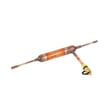
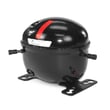
Compressor repairs are among the highest-cost refrigerator repairs. Knowing the compressor parts and labor coverage helps you decide whether to schedule service, troubleshoot first, or price out replacement parts such as the refrigerator compressor TCA38091801.
Last updated: February 2026
What is the average lifespan of an LG fridge?
Most LG refrigerators average 10 to 15 years of service life. For your LG LFXS28566M, lifespan depends heavily on airflow (clean condenser area), stable temperatures, and keeping the sealed system healthy; routine care often pushes real-world life toward the upper end of that range.
Typical lifespan ranges (what we see most often)
- Average: 10 to 15 years
- Well-maintained units: 15 years or more
- Higher repair risk window: after year 8 to 12 (fans, sensors, ice and water components)
What affects lifespan the most
- Keeping the condenser area clean so the compressor runs cooler
- Avoiding overpacking so air can circulate in fresh food and freezer sections
- Maintaining good door sealing and alignment to prevent warm air leaks
- Replacing filters on schedule (helps water flow and reduces strain on valves)
- Fixing small issues early (odd noises, temperature swings, frost buildup)
Maintenance schedule (simple and effective)
| Task | How often | Why it matters |
|---|---|---|
| Replace water filter | About every 6 months | Protects water flow and ice maker performance |
| Clean condenser area | Every 6 to 12 months | Reduces compressor run time and heat stress |
| Check door gaskets for gaps | Every 3 to 6 months | Prevents moisture, frost, and long run times |
| Verify temps (37°F / 0°F targets) | Monthly | Catches cooling problems early |
For model-specific features and indicator lights (including the filter reset steps), use the LFXS28566M owner's manual.
Parts that commonly drive “end-of-life” repairs
These parts do not always fail, but they are frequent decision points when a refrigerator is older:
- Compressor and start components (cooling stops, clicking, warm cabinet)
- Evaporator fan motor (warm fridge, noisy fan, weak airflow)
- Temperature sensor (erratic temps, short cycling)
- Ice maker assembly and water inlet valve (no ice, slow fill, leaking)
If you are troubleshooting cooling performance specifically, the refrigerator compressor TCA38091801 is the sealed-system component most tied to long-term cooling reliability.
Why it matters
A refrigerator that runs hot, runs constantly, or leaks air at the doors can shorten compressor life and increase energy use. Staying on top of airflow, seals, and water filtration is the most reliable way to extend the life of an LG bottom-mount refrigerator.
Last updated: February 2026
What is the most common problem with an LG refrigerator?
The most common problem we see with LG refrigerators like model LFXS28566M is a cooling issue (refrigerator or freezer too warm). In many cases, the cause is something simple such as blocked air vents or frequent door openings; if cooling still does not recover, sealed-system or compressor-related failures become more likely.
Quick checks that fix many “not cold enough” complaints
- Give a new installation time: allow up to 24 hours for temperatures to stabilize.
- Check for blocked air vents; move packages so air can circulate between compartments.
- Reduce long or frequent door openings; warm, humid air quickly raises temps.
- Avoid loading hot food; let it cool to room temperature first.
- Confirm the unit is not in an overly hot location (operation above 110 °F can cause warm temps).
Common symptoms and what they usually point to
| Symptom | Most common cause | What to do first |
|---|---|---|
| Fresh food section warm, freezer OK | Airflow blocked or door use | Clear vents; limit door openings |
| Both sections warm | Cooling system not keeping up | Check room temp, door sealing, airflow |
| Ice maker or dispenser acts up | Water supply, filter, or dispenser conditions | Purge/flush; check filter and supply |
| Discolored ice or odd taste | Filter or water line contamination | Replace filter; discard initial ice |
Ice maker and dispenser issues are also very common
LG’s own guidance is to discard the first few batches of ice (about 140 to 160 cubes) after installation or long periods of non-use, and to stop using ice/water if it dispenses discolored until the cause is corrected. For model-specific dispenser and cooling troubleshooting steps, use the LFXS28566M owner's manual.
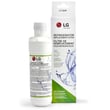
If you are dealing with slow water flow, bad taste, or discolored ice, replacing the filter is a strong first step; this model uses the LG lt1000p refrigerator water filter ADQ74793501.
Why it matters
Cooling problems can spoil food quickly and can also trigger secondary complaints like weak ice production, soft ice, or excess moisture. Starting with airflow, door habits, and filter basics helps you rule out the most common, lowest-cost causes before moving to more complex repairs.
Last updated: February 2026