Installation guide
 Owner’s manual


How to read Kenmore washer model numbers?
Kenmore washer model numbers are structured so the first 3 digits identify the manufacturer, the next set of digits identifies the base model, and the remaining digits indicate feature or production variations. For your Kenmore washer model 11026012011, the 110 prefix is the key manufacturer identifier.
Most Kenmore washer model numbers follow this pattern:
- Prefix (first 3 digits): manufacturer code (for example, 110)
- Middle digits: base design or platform (the core washer family)
- Ending digits: version details (color, feature package, engineering changes)
Here is a simple way to read your model number:
| Model number | What it tells you | Why it matters |
|---|---|---|
| 110 | Manufacturer prefix | Helps match the correct parts system and diagrams |
| 26012 | Base model identifier | Narrows parts to the correct washer design |
| 011 | Variation code | Prevents ordering a similar looking but incompatible part |
We recommend confirming the model number directly from the washer ID tag before ordering parts.
Common locations include:
- Under the lid near the tub opening (top-load washers)
- On the rim of the washer opening
- On the back panel
- Along the side of the cabinet near the top
Even small model-number differences can change which parts fit, especially for items like:
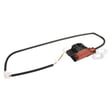
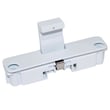
- Lid lock and switch components (example: washer lid lock assembly W10404050)
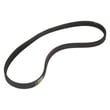
- Drive system parts (example: washer drive belt WPW10006384)
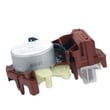
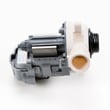
- Drain components (example: washer drain pump assembly WPW10276397)
Using the full model number helps us match the correct diagrams, wiring, and revisions for your exact Kenmore washer.
Use these steps to avoid wrong-part returns:
- Match the full model number exactly: 11026012011
- Compare the part ID and description, not just the part name
- Check installation notes and specifications in the installation guide
- If your washer has a serial number break (common on some models), match that too
Last updated: February 2026
How to force a Kenmore 11026012011 washer to drain?
To force your Kenmore 11026012011 washer to drain, we focus on the drain path: make sure the drain hose is installed correctly, clear any hose or standpipe blockage, then run a drain and spin cycle. If it still will not drain, the drain pump is the most common failed part.
- Unplug the washer before checking hoses or parts.
- Confirm the drain hose is not kinked, crushed, or frozen.
- Verify the hose is not shoved too far into the standpipe; keep about 4.5 inches of hose inside the standpipe.
- Make sure the drain hose form is being used for a standpipe or laundry tub setup.
- Check the standpipe or laundry tub drain for a clog (a slow house drain can mimic a washer failure).
- If the tub is full, bail out water into a bucket first so you can inspect the pump area with less mess.
The installation instructions for this model call out two details that directly affect draining: the drain hose form and the insertion depth into the standpipe. Use the installation guide to match your setup (standpipe, laundry tub, or floor drain).
| Setup | What “correct” looks like | What causes no-drain/slow-drain |
|---|---|---|
| Standpipe | Hose form installed; about 4.5 in. of hose inside standpipe | Hose jammed too deep; no hose form; kinked hose |
| Laundry tub | Hose secured to tub; hose form used | Hose slips under water line; tub drain clogged |
| Floor drain | Hose form removed (floor drain only) | Wrong configuration; restricted drain path |
A humming sound with no water movement, or intermittent draining, often points to a failing pump or a blockage at the pump.
Common fixes for this model include:
- Replacing the washer drain pump assembly WPW10276397
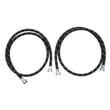
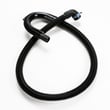
- Checking the washer drain hose W11244231 for internal collapse or a clog
- Inspecting wiring connections if the pump never runs
A restricted drain can stop the spin cycle, leave clothes soaking wet, and strain the drive system. Correct drain hose installation and a clear pump path restore normal drain and spin performance.
Last updated: February 2026
What is the UL code on the Kenmore 11026012011 washer?
On the Kenmore washer model 11026012011, the UL code indicates the washer detected an unbalanced load and stopped or limited the spin to protect the tub and suspension. Correcting load balance and making sure the washer is level typically clears the code; see the installation guide for leveling steps.
- Pause the cycle and open the lid (if it unlocks).
- Redistribute items evenly around the washplate; avoid one heavy item by itself.
- Remove a few items if the basket is tightly packed.
- Run a Drain/Spin cycle after rebalancing.
- Confirm the washer sits solidly on the floor; adjust leveling feet so it does not rock.
- Wash bulky items (blankets, jackets) with a few similar items for balance.
- Mix large and small items so weight spreads evenly.
- Avoid washing a single bath mat or single heavy towel alone.
- Use the correct cycle and spin speed for the load type.
A repeating UL code usually points to a setup issue (leveling, floor flex) or a suspension problem that lets the tub swing too far.
| What you notice | Most likely cause | What we recommend |
|---|---|---|
| Washer bangs or walks during spin | Not level, weak floor, load imbalance | Re-level per the installation guide; reduce spin speed for bulky loads |
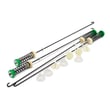
| UL happens with normal mixed loads | Worn suspension components | Inspect suspension; replace if weak (common cause of repeated imbalance) |
| UL appears and lid will not lock/spin won’t start | Lid lock not engaging consistently | Check the washer lid lock assembly W10404050 and wiring connections |
Running repeated high-speed spins while the basket is out of balance increases wear on the suspension, drive system, and tub components. Fixing balance and leveling first prevents unnecessary part replacement.
Last updated: February 2026
How do I fix my OE code?
An OE code on your Kenmore 11026012011 washer means the washer is not draining fast enough. We fix it by checking for a drain path restriction (hose, standpipe, pump) and confirming the drain hose is installed correctly per the installation guide.
- Unplug the washer for 1 minute, then plug it back in and try a Drain/Spin cycle.
- Make sure the drain hose is not kinked, crushed, or pinched behind the washer.
- Confirm the drain hose is not shoved too far into the standpipe; about 4.5 in. (113 mm) should be inside the standpipe.
- Verify the drain hose is not sealed airtight in the standpipe; it needs an air gap to drain properly.
- If you have a laundry tub, make sure the hose is secured and not slipping down into the water.
A bad standpipe setup can trigger OE even when the pump is fine.
| Item to check | What “correct” looks like | What causes OE |
|---|---|---|
| Hose depth in standpipe | About 4.5 in. inside | Too deep can restrict flow or siphon |
| Hose routing | Smooth curve, no sharp bends | Kinks or pinches slow draining |
| Hose position | Not forced tight into pipe | Airtight seal can cause poor draining |
If the hose and standpipe setup are correct and the washer still drains slowly, the drain pump or drain hose is the next place we look.
- Loud humming from the bottom but little or no draining points to a jammed or failing pump.
- Slow draining with no obvious hose issue often points to a partially blocked pump.
- Cracks, soft spots, or internal collapse in the hose can restrict flow.
Helpful model-matched parts to consider:
Running with an OE condition can leave water in the tub, cause repeated cycle interruptions, and increase wear on the drain system. Correct hose placement and a clear drain path restore normal drain speed and help prevent repeat errors.
Last updated: February 2026