Installation guide
 Owner’s manual
 Error Codes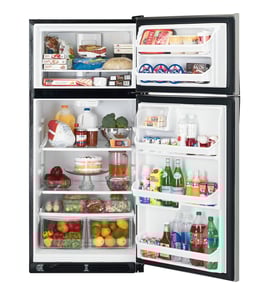



How much top clearance does a fridge need?
For the Crosley CRT182NW0 top-mount refrigerator, we recommend 3/8 inch of clearance at the top (and sides) for proper air circulation and easier installation. This spacing helps the refrigerator cool efficiently and reduces heat buildup around the cabinet; see the CRT182NW0 installation guide for the model-specific clearance callouts.
Use these minimum clearances around the refrigerator cabinet:
- Top: 3/8 inch
- Sides: 3/8 inch
- Back: 1 inch
- Front: enough space for doors to open fully and for drawers to slide out (plan extra if the doors are reversed)
| Location | Minimum clearance | What it helps with |
|---|---|---|
| Top | 3/8 in. | Heat release and airflow |
| Sides | 3/8 in. | Air circulation and fit |
| Back | 1 in. | Airflow plus plumbing and electrical space |
- Measure from the refrigerator case, not the door handles.
- Keep the back gap even; don’t pinch the power cord or water line (if equipped with an ice maker).
- Confirm the unit sits level; a slight tilt back helps doors close consistently.
- After positioning, check that door seals contact the cabinet on all sides.
Clearance is part of the cooling system. When the top, sides, or back are too tight, warm air can get trapped, which can lead to longer run times, warmer temperatures, and moisture issues.
Last updated: February 2026
What is the life expectancy of a top freezer refrigerator?
A top-freezer (top-mount) refrigerator like the Crosley CRT182NW0 typically lasts 10 to 15 years. With steady temperatures, good airflow around the cabinet, and basic upkeep, it’s common to reach the upper end of that range.
Most top-freezer refrigerators have a solid lifespan because the design is simple and efficient. The biggest factors are usage, environment, and maintenance.
- Room temperature and ventilation (hot garages and tight enclosures shorten life)
- Dirty condenser area (forces longer run times)
- Door seal condition (air leaks increase compressor workload)
- Power quality (voltage swings can stress the compressor)
- How often doors are opened and how full the compartments stay
These symptoms often show up as a refrigerator ages; some are repairable, some point to major sealed-system wear.
| Symptom | Common cause | Usually worth fixing? |
|---|---|---|
| Warm fridge or freezer | Airflow issue, frost buildup, fan problem | Often yes |
| Loud humming or repeated clicking | Start components, compressor strain | Sometimes |
| Frost on back freezer wall | Defrost system issue | Often yes |
| Water puddles | Defrost drain issue | Yes |
| Poor door closing or sweating | Worn gasket, cabinet not level | Yes |
We recommend these practical steps for the CRT182NW0.
- Keep food from blocking cold air vents so air can circulate
- Set temperatures gradually and allow 24 hours to stabilize after changes
- Clean spills and odors regularly; cover strong-smelling foods
- Keep the refrigerator level to reduce vibration and improve door sealing
- Follow the safety and care steps in the CRT182NW0 owner’s manual
A refrigerator that runs longer than necessary uses more electricity and puts extra wear on the compressor and evaporator fan system. Small fixes (like improving airflow or correcting a door seal) can prevent expensive cooling problems later.
Last updated: February 2026
Is a top mount or bottom mount fridge better?
A top-mount refrigerator like the Crosley CRT182NW0 is usually the better choice when you want a lower purchase cost, a simpler design, and easy access to the freezer. A bottom-mount is usually better when you use fresh-food items most and want the refrigerator section at eye level.
| Feature | Top-mount (freezer on top) | Bottom-mount (freezer on bottom) |
|---|---|---|
| Fresh-food access | More bending | Less bending, fridge at eye level |
| Freezer access | Easiest access | Drawer-style access, can be heavier |
| Typical cost | Lower | Higher |
| Complexity | Simpler, fewer moving parts | More complex (drawer slides, baskets) |
| Best for | Frequent freezer use | Frequent fresh-food use |
- If you use frozen foods daily, top-mount keeps the freezer at a comfortable height.
- If you cook with fresh ingredients often, bottom-mount reduces bending for the refrigerator section.
- If you want fewer “extras” to maintain, top-mount designs tend to be more straightforward.
- If you have limited space, compare door swing and clearance needs before choosing.
- If you have back or knee pain, bottom-mount usually feels better day to day.
Our installation guidance for this style of refrigerator calls for airflow and service space around the cabinet. Plan for typical clearances of 3/8 inch on the sides and top and 1 inch at the back, then level the cabinet so the doors seal correctly. See the CRT182NW0 installation guide for the leveling and clearance checklist.
The “better” layout is the one that matches how you reach for food. Choosing the right configuration improves everyday comfort, helps the doors seal consistently, and supports stable temperatures in both the fresh-food and freezer compartments.
Last updated: February 2026
What are the disadvantages of a top mount fridge?
A top-mount refrigerator like the Crosley CRT182NW0 puts the freezer at eye level and the fresh-food section below, so everyday items often require more bending and reaching. You also typically get fewer convenience features than higher-end layouts, even though cooling performance is solid.
- Less convenient fresh-food access: the refrigerator compartment is lower, so you bend more for produce, drinks, and leftovers.
- Tighter organization options: top-mount designs often have fewer adjustable storage features than many bottom-freezer models.
- Fewer built-in upgrades: external water and ice dispensers are less common on this style.
- More temperature swing risk from door openings: frequent freezer access can introduce warm air at the top.
- Door-seal sensitivity: if doors are not level or seals do not close fully, you can get frost, moisture, or warm spots.
Use the setup steps in the CRT182NW0 installation guide to make sure the cabinet is level and the doors seal on all sides. Proper leveling and a tight seal help prevent temperature issues and excess frost.
- Confirm the refrigerator is level side-to-side and slightly tilted back (front higher than back).
- Verify both door gaskets contact the cabinet all the way around.
- Leave recommended airflow clearances around the cabinet for proper circulation.
- After changing temperature controls, wait a full 24 hours before adjusting again.
| Feature | Top mount (like CRT182NW0) | Bottom freezer |
|---|---|---|
| Fresh-food access | Lower, more bending | Higher, easier daily access |
| Freezer access | Higher, easier to see | Lower, more bending |
| Storage flexibility | Often simpler | Often more configurable |
| Typical cost | Usually lower | Usually higher |
Most “disadvantages” are really usability tradeoffs. If your household uses the fresh-food section far more than the freezer, the top-mount layout can feel less ergonomic. If you use the freezer most, top-mount can be a practical fit.
Last updated: February 2026