Installation guide
 Owner’s manual
 Error Codes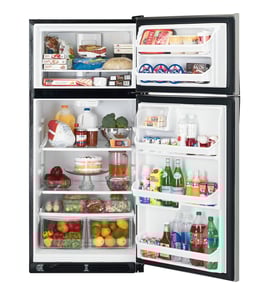



Which is better, top mount or bottom mount refrigerator?
A “better” choice depends on how you use your refrigerator. For most households, a top-mount like the Frigidaire FFTR1713LWE is the best value because it’s typically more energy-efficient and lower-cost; a bottom-mount is better if you want fresh-food items at eye level and easier access.
| Feature | Top mount (freezer on top) | Bottom mount (freezer on bottom) |
|---|---|---|
| Everyday access | Freezer is easiest to reach | Fresh food is easiest to reach |
| Typical cost | Lower | Higher |
| Energy use | Typically lower | Typically higher |
| Organization | Simpler layout | Often more drawers and zones |
| Best for | Budget, reliability, fewer features | Convenience, frequent fresh-food use |
- If you use the refrigerator section most, bottom-mount reduces bending.
- If you use the freezer most (bulk foods, meal prep), top-mount is more convenient.
- If you want fewer parts and simpler service, top-mount designs are usually more straightforward.
- If you have limited space, compare door swing and clearances before choosing.
No matter which style you choose, proper airflow and leveling affect cooling performance and door sealing. For this Frigidaire top-mount platform, the installation guidance calls for typical clearances of 3/8 inch at the sides and top and 1 inch at the back, plus leveling so the cabinet is stable and slightly tilted back for good door closing. See the installation guide for the full checklist.
Choosing the right mount style impacts daily comfort (how often you bend), food organization, and long-term operating cost. Installation details like leveling and clearance also help prevent warm spots, moisture issues, and door seal problems.
Last updated: February 2026
What are the disadvantages of a top mount fridge?
Top-mount refrigerators like the Frigidaire FFTR1713LWE put the freezer on top and the fresh-food section below; the main disadvantages are less convenient access to everyday refrigerated items, fewer premium storage features, and fewer built-in dispenser options compared with many bottom-mount designs.
- You bend more often to reach fresh-food items because the refrigerator compartment is lower.
- Organization can be simpler; many top-mount models have fewer adjustable bins and specialty drawers than higher-end layouts.
- Ice and water dispensers are less common on top-mount units (when present, they are usually simpler than on larger styles).
- Freezer space can feel tighter for bulky items because it is typically narrower and higher.
- Door swing and clearance can be more limiting in tight kitchens; you may need extra space to fully open doors.
Your installation guidance highlights setup items that affect day-to-day usability, especially door sealing and leveling. Use the installation guide to confirm these basics:
- Door seals close completely to the cabinet on all sides.
- The refrigerator is level side-to-side and tilted about 1/4 inch (6 mm) front-to-back.
- The freezer door is level across the top.
- Recommended clearances are maintained (sides and top about 3/8 inch; back about 1 inch).
| Feature | Top-mount (like FFTR1713LWE) | Bottom-mount (typical) |
|---|---|---|
| Fresh-food access | Lower, more bending | Eye-level, easier access |
| Storage features | Often simpler | Often more flexible |
| Dispensers | Less common | More common |
| Cost and complexity | Often lower | Often higher |
Most “disadvantages” come down to ergonomics and convenience. If your household uses the fresh-food section far more than the freezer, the lower refrigerator compartment is the biggest everyday tradeoff.
Last updated: February 2026
What is the lifespan of a Frigidaire FFTR1713LWE refrigerator?
A Frigidaire FFTR1713LWE top-mount refrigerator typically lasts 13 years. Regular upkeep (good airflow, correct leveling, and clean components) helps it reach that lifespan; poor ventilation, dirty condenser areas, and cooling-system strain can shorten it.
Most top-mount refrigerators fall into a predictable range.
- Typical lifespan: 10 to 15 years
- Expected average: about 13 years
- Shortened lifespan drivers: restricted airflow, overheating, heavy frost from door-seal leaks, and long run times
- Extended lifespan drivers: stable temperatures, clean condenser area, tight door seals, and correct leveling
| What you notice | What it usually means | What to do first |
|---|---|---|
| Runs almost constantly | Heat not leaving the cabinet efficiently | Clean condenser area, improve clearance, confirm doors seal |
| Frost buildup in freezer | Moist air leaking in or defrost issue | Check gasket seal and door alignment |
| Warm fridge, freezer OK | Airflow problem between compartments | Check evaporator fan operation |
| Clicking, then no cooling | Start components or compressor strain | Check electrical supply; consider service diagnosis |
We recommend these practical steps for FFTR1713LWE owners:
- Keep installation clearances for airflow (typical guidance is 3/8 inch at sides and top and 1 inch at the back).
- Level the cabinet so it sits solidly on all corners; the install guidance calls for level side-to-side and about a 1/4 inch tilt front-to-back.
- Confirm the doors seal completely to the cabinet on all sides.
- Keep the condenser area clean so the refrigerator can shed heat efficiently.
- If you have an ice maker connected, recheck for water leaks at connections after 24 hours.
For the model-specific setup and leveling procedure, follow the installation guide.
A refrigerator that is out of level or starved for airflow runs hotter and longer. That extra run time increases wear on key cooling components (like the compressor and fans), which is the most common path to a shortened service life.
Last updated: February 2026
What is the most common problem with Frigidaire refrigerators?
Cooling problems are the most common issue we see with Frigidaire refrigerators like model FFTR1713LWE, usually showing up as a warm fresh-food section, weak airflow, or frost buildup. The most frequent causes are restricted airflow from dirty condenser coils, an evaporator fan problem, or a door seal that is not sealing tightly.
- Refrigerator section is warm but freezer seems closer to normal
- Frost or ice buildup on the freezer back wall
- Food freezing in the fresh-food section (airflow or control issue)
- Refrigerator runs a lot or seems louder than usual
- Water puddles inside the refrigerator or under the unit
Use these steps first; they address the most common, most fixable causes.
- Confirm the doors seal completely on all sides (gaps cause warm temps and frost)
- Make sure the refrigerator is level and tilted about 1/4 inch (6 mm) front to back so doors close reliably
- Set controls and wait 24 hours before making additional adjustments
- Keep vents inside the freezer and refrigerator unblocked by food packages
- If you have an ice maker, turn it OFF until the water supply is connected and leak-free
For the model-specific leveling and setup targets (including the 1/4 inch tilt and clearance guidance), follow the installation guide.
If the refrigerator is running but airflow is weak or inconsistent, these parts are often involved.
| Symptom | Common area to inspect | Example part for FFTR1713LWE |
|---|---|---|
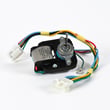
| Warm refrigerator, freezer OK | Evaporator airflow | Refrigerator evaporator fan motor 241854301 |
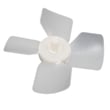
| Noisy airflow or rattling | Fan blade interference or damage | Refrigerator evaporator fan blade 5308000010 |
| Heavy frost, temp swings | Defrost system | Refrigerator defrost bi-metal thermostat 5303918634 |
Cooling issues usually get worse over time: temperatures drift into the food-safety danger zone, frost can block airflow, and the compressor may run longer than it should. Catching a door-seal or fan issue early helps protect food and reduces wear on major sealed-system components.
Last updated: February 2026