Installation guide
 Owner’s manual
 Error Codes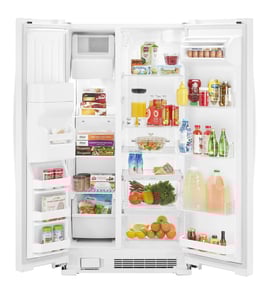



How to read a Kenmore model number?
For Kenmore refrigerator model 10656596500, the model number is read left to right: the first 3 digits (106) identify the manufacturer family, and the remaining digits identify the exact design and feature variations. You can find the full model and serial label on the inside wall of the fresh food compartment (refrigerator section); see the 10656596500 owner's manual.
Where to find the model number on this refrigerator
On Kenmore side-by-side refrigerators like 10656596500, we look in these common spots:
- Inside the refrigerator compartment on an interior side wall (most common)
- Near the crisper area or lower side wall inside the fresh food section
- On a label that also lists the serial number and purchase date fields
- Sometimes behind the base grille area (varies by design)
How to interpret the digits (quick guide)
Kenmore model numbers typically follow a pattern like this:
- Prefix (first 3 digits): manufacturer family identifier (example: 106)
- Middle digits: base platform or series
- Last digits: feature, color, or engineering variation
Example breakdown
| Example model number | What it tells you | Why it helps |
|---|---|---|
| 10656596500 | 106 = manufacturer family; rest = exact build | Ensures parts like a water filter, ice maker, or inlet valve match |
Why it matters when ordering parts
Using the complete model number prevents fit and compatibility issues, especially for parts tied to the water and ice system.
- Water filter style and cap fit
- Ice maker mounting and wiring compatibility
- Water inlet valve configuration
- Door gasket and shelf fit
If you are replacing the water filter on this model, the manual lists replacement filter order part #9020, which corresponds to the genuine Kenmore refrigerator water filter EDR3RXD1.
Last updated: February 2026
How wide is a Kenmore side by side refrigerator?
Most Kenmore side-by-side refrigerators are about 32 to 36 inches wide; your Kenmore 10656596500 is in that typical range. For the exact cabinet width and required clearances for your specific unit, use the dimensions and installation section in the 10656596500 owner's manual.
Typical width ranges (what you can expect)
Side-by-side refrigerator widths vary mainly by capacity and whether the unit is standard-depth or counter-depth.
- Most standard-depth side-by-sides: 33 to 36 in. wide
- Many counter-depth side-by-sides: 32 to 36 in. wide
- Width can change slightly with door style, hinges, and trim
- Always plan for door swing and airflow clearance, not just cabinet width
Clearance guidance that affects “fit”
Even if the cabinet width fits, you still need space for ventilation and the doors to open.
From the installation guidance for this model family:
- Allow about 1/2 in. space on each side and the top for ventilation
- If installed next to a fixed wall, allow about 2 in. minimum on the hinge side (varies by setup) so the door can swing open
- If the refrigerator has an ice maker, allow extra space behind for the water line connection
Quick planning table
| What you are measuring | What to include | Why it matters |
|---|---|---|
| Cabinet width | Case only (no doors) | Confirms the opening size |
| Overall “installed” width | Cabinet plus clearances | Prevents overheating and noise |
| Door swing space | Wall clearance and handle arc | Lets drawers and bins pull out |
Why it matters
Getting the width right prevents installation headaches like doors that cannot open fully, poor airflow that hurts cooling performance, and pinched water lines for the dispenser or ice maker.
Last updated: February 2026
What is the average lifespan of a Kenmore refrigerator?
Most Kenmore refrigerators last 12 to 15 years. For your Kenmore 10656596500 side-by-side refrigerator, routine care like cleaning condenser coils, keeping door gaskets clean, and maintaining proper temperatures helps you reach (and often exceed) that typical lifespan; see the 10656596500 owner's manual for model-specific maintenance guidance.
What affects refrigerator lifespan most
- Condenser coil cleanliness (dust buildup makes the compressor work harder)
- Door gasket condition (air leaks cause longer run times and frost issues)
- Temperature settings (aim for about 37°F in fresh food, 0°F in freezer)
- Ice and water system upkeep (filters, valves, and ice maker performance)
- Ventilation and leveling (poor airflow or an unlevel cabinet stresses components)
Maintenance checklist we recommend
Use this simple schedule to keep a Kenmore side-by-side running efficiently:
| Task | Typical frequency | What to do |
|---|---|---|
| Clean condenser coils | Every 6 to 12 months | Vacuum and brush coils and the area around them |
| Clean door gaskets | Every 1 to 3 months | Wipe with mild soap and water; dry thoroughly |
| Replace water filter | About every 6 months (or when flow drops) | Replace the filter and flush water lines |
| Check temps with a thermometer | Seasonally | Adjust controls if temps drift |
Parts that commonly impact performance over time
If cooling, ice, or water performance declines, these are frequent wear items on many Kenmore 106-style refrigerators:
- Water filtration: genuine Kenmore refrigerator water filter EDR3RXD1
- Water supply control: refrigerator inlet valve W10408179
- Ice production: ice maker assembly - refrigerator ice maker by whirlpool 4317943
Why it matters
A refrigerator that runs longer than necessary (from dirty coils, leaky gaskets, or restricted water flow) puts extra load on the sealed system and compressor. Preventive maintenance reduces run time, improves temperature stability, and helps extend overall service life.
Last updated: February 2026
What is the cubic foot of my Kenmore refrigerator model 10656596500?
Your Kenmore side-by-side refrigerator model 10656596500 has a total capacity of 21.9 cubic feet. This is the combined storage volume of the fresh food compartment and the freezer.
What “21.9 cu. ft.” means in real use
Capacity is a helpful comparison number, but usable space depends on shelves, bins, and airflow clearances.
- A side-by-side layout typically splits space close to 50/50 between refrigerator and freezer
- Overpacking can reduce cooling performance by blocking vents
- Keeping items off the back wall helps prevent freezing in the fresh food section
- Door bins add storage but are warmer than interior shelves
Quick capacity reference
| Capacity range | What it’s typical for | Notes |
|---|---|---|
| 18 to 22 cu. ft. | Many standard side-by-side refrigerators | Common in 33-inch class cabinets |
| 22 to 26 cu. ft. | Larger side-by-side refrigerators | More shelf and bin space |
| 26+ cu. ft. | Oversize / wide units | Often deeper or wider cabinets |
Where to confirm specs for your exact configuration
We recommend checking the specifications section in the 10656596500 owner's manual. It is the best place to confirm capacity and any model-specific notes about shelving, door storage, and airflow.
Why it matters
Knowing the cubic feet helps when you are comparing replacement refrigerators, planning kitchen fit, or deciding whether storage issues are caused by capacity limits versus organization, shelf setup, or cooling airflow.
Last updated: February 2026