Owner’s manual
 Error Codes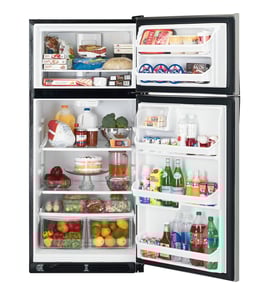


What are the disadvantages of a top mount fridge?
Top-mount refrigerators like the Whirlpool ET1FHTXMQ04 are reliable and space-efficient, but the main disadvantages are less convenient fresh-food access (you bend more), fewer premium organization features, and fewer built-in dispenser options compared with many bottom-freezer designs. See the ET1FHTXMQ04 owner's manual for model-specific features and setup guidance.
- More bending for daily use: the refrigerator section is lower, so produce, deli items, and drinks often require bending.
- Freezer at eye level: convenient for frozen foods, but it can make the fresh-food section feel less accessible.
- Typically fewer organization upgrades: many top-mounts have simpler drawer and bin layouts than higher-end bottom-mount models.
- Fewer dispenser configurations: many top-mount models do not include an external water or ice dispenser.
- Can be tighter for wide platters: shelf width and door bin layouts are often more compact.
| Feature | Top-mount refrigerator | Bottom-freezer refrigerator |
|---|---|---|
| Fresh-food access | Lower; more bending | Higher; less bending |
| Freezer access | Higher; easier reach | Lower; more bending |
| Typical price/complexity | Often lower and simpler | Often higher and more feature-rich |
| Organization features | Often basic | Often more flexible |
Use these practical checks to see if the “disadvantages” will matter in your kitchen:
- Measure how often you access fresh food vs. frozen food each day.
- Confirm you have proper clearances for door swing and ventilation (top, sides, hinge side).
- If you plan to add an ice maker, allow extra space at the back for the water line connection.
- Make sure the refrigerator is level so doors close easily (front leveling/rollers adjustment).
Choosing the right layout affects daily comfort, food visibility, and energy efficiency. If you open the refrigerator section far more than the freezer, a top-mount design can feel less convenient over time because the most-used items sit lower.
Last updated: January 2026
What is the average lifespan of a Whirlpool refrigerator?
Most Whirlpool refrigerators last about 10 to 20 years. For a Whirlpool top-mount refrigerator like model ET1FHTXMQ04, a realistic expectation is 10 to 15 years with normal use, and longer when the doors seal well, airflow stays clear, and the unit is kept clean and level.
- Condenser coil cleanliness (dust buildup makes the compressor work harder)
- Door gasket condition (air leaks cause longer run times and temperature swings)
- Stable temperatures (avoid frequent warm-ups from propped doors or overloading)
- Good airflow (don’t block vents in the fresh food or freezer sections)
- Power quality (surges and repeated outages shorten control and compressor life)
Use the ET1FHTXMQ04 owner's manual for model-specific care and operating guidance.
- Vacuum and brush dust from the condenser area on a regular schedule
- Keep door gaskets clean; wipe with mild soap and water, then dry
- Confirm the refrigerator is level so doors close on their own
- Set temperatures to typical targets: 37°F fresh food, 0°F freezer
- Leave space around the cabinet for ventilation (especially behind and above)
| Symptom | Often fixable? | Common next step |
|---|---|---|
| Warm fridge, freezer still cold | Yes | Check airflow and the evaporator fan system |
| Loud fan noise in freezer | Yes | Inspect fan blade and motor |
| Water leaks/puddles | Yes | Clear drain path, check water line/valve if equipped |
| Not cooling at all | Sometimes | Check start components, compressor, controls |
A refrigerator that runs longer than it should (from dirty coils, air leaks, or blocked vents) puts extra stress on the compressor, control board, and fans, which are some of the most expensive systems to repair.
Last updated: January 2026
Are top mount or bottom mount fridges better?
For a Whirlpool ET1FHTXMQ04 top-mount refrigerator, a top-mount design is typically the better pick if you want strong efficiency and simpler, lower-cost repairs; a bottom-mount is usually better if you want the fresh-food section at eye level and less bending for everyday items. For model-specific use and setup details, use the ET1FHTXMQ04 owner's manual.
| Feature | Top-mount (freezer on top) | Bottom-mount (freezer on bottom) |
|---|---|---|
| Everyday access | More bending for fridge items | Less bending for fridge items |
| Energy use | Often lower | Often slightly higher |
| Repair complexity | Often simpler | Often more complex |
| Freezer access | Easier | More bending for freezer items |
- Choose top-mount if you want lower operating cost, fewer features to maintain, and a straightforward layout.
- Choose bottom-mount if you use the refrigerator section most and want it at a more comfortable height.
- If you have back or knee issues, prioritize the layout that reduces your most frequent bending.
- If you want an ice maker, plan for extra clearance behind the refrigerator for the water line connection.
- Leave proper ventilation space around the cabinet so either style cools efficiently.
Even the best style performs poorly if it is installed too tight. For this Whirlpool top-mount style, we follow these spacing rules:
- Allow about 1/2 inch on each side and at the top for ventilation.
- If installed next to a fixed wall, leave about 2 inches on the hinge side so the door can swing open.
- Avoid installing near heat sources; keep the location above 55°F for proper operation.
The “better” refrigerator is the one that fits your daily habits and your kitchen space. Layout affects comfort, while ventilation and clearance affect cooling performance, energy use, and how hard the compressor has to work.
Last updated: January 2026
What is the most common problem with Whirlpool refrigerators?
The most common Whirlpool refrigerator problems are cooling complaints (warm fridge, warm freezer, or the unit running a lot) and ice maker or water system issues. On your Whirlpool ET1FHTXMQ04, these often trace back to airflow, dirty condenser coils, or water supply components; start with the checks in the ET1FHTXMQ04 owner's manual.
- Not cooling well or temperature swings: restricted airflow, dirty coils, or a fan problem.
- Runs too much: normal during initial cool-down, hot room conditions, frequent door openings, or heavy food loads (the manual notes this behavior for high-efficiency compressors and fans).
- Noisy operation: many sounds are normal (buzzing at water valve fill, fan/compressor pulsing, sizzling during defrost).
- Ice maker not making ice: water supply issue, valve issue, or ice maker component failure.
- Water leaks or puddles: drain or water line/valve issues.
- Confirm temperatures: set the refrigerator to about 37°F and freezer to about 0°F (typical targets).
- Clean condenser coils: dust buildup is a top cause of poor cooling and long run times.
- Check door sealing: look for gaps, torn gasket, or doors not closing fully.
- Listen for fan airflow: weak or no airflow points to an evaporator fan issue.
- For ice maker issues: verify the shutoff arm is down (on mechanical styles) and the household water supply is fully on.
| Symptom | Common suspect | Example part for this model |
|---|---|---|
| Warm fridge, weak airflow | Evaporator fan motor | Evaporator motor WP2315539 |
| Ice maker not filling or slow fill | Water inlet valve or supply restriction | Refrigerator water inlet valve WP2188808 |
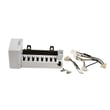
| No ice production (mechanical ice maker) | Ice maker assembly | Ice maker assembly - refrigerator ice maker by Whirlpool 4317943 |
Cooling and ice maker problems often start small (dusty coils, a door not sealing, a weak fan) but can lead to food spoilage, heavy compressor run time, and recurring ice maker failures if they are not corrected early.
Last updated: January 2026