Owner’s manual
 Error Codes


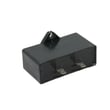

How many cubic feet is a Kenmore Elite refrigerator?
Kenmore Elite refrigerator capacity depends on the exact model; for the Kenmore 59655652500 side-by-side refrigerator, the cubic-foot capacity is listed in the specifications section of the 59655652500 owner's manual.
How to find the exact capacity for your Kenmore Elite
We recommend confirming capacity by model number because “Kenmore Elite” covers many sizes (side-by-side, French door, top freezer).
- Check the model and serial label inside the fresh food section on the left wall.
- Look in the manual for Specifications or Product dimensions and capacity.
- If you have the original sales listing, compare the model number to the listed capacity.
- If you are measuring for a kitchen opening, use the manual’s measuring guidance, not capacity.
Typical Kenmore Elite capacity ranges (for quick comparison)
These ranges help set expectations, but the manual is the final word for 59655652500.
| Refrigerator style | Typical capacity range | Best use case |
|---|---|---|
| Side-by-side | 22 to 28 cu. ft. | Narrow door swing, easy freezer access |
| French door | 25 to 31 cu. ft. | Maximum fresh-food space |
| Top freezer | 14 to 21 cu. ft. | Budget-friendly, simple layout |
Why it matters
Capacity affects food storage, energy use, and fit. Two refrigerators can have similar outside dimensions but different usable cubic feet due to ice maker design, shelving, and door bin layout.
Related parts that can reduce usable space
If ice storage or airflow issues are making the refrigerator feel “smaller,” these parts are commonly involved:
- Refrigerator ice maker D7824706Q (ice production and bin fill)
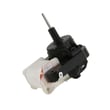
- Evaporator motor WPW10128551 (air circulation that keeps compartments evenly cold)
- Refrigerator damper control assembly WP67003903 (controls cold air flow into fresh food section)
Last updated: January 2026
Where is the water filter on a Kenmore side by side refrigerator?
On Kenmore side-by-side refrigerator model 59655652500, the water filter is located inside the fresh food (refrigerator) compartment, in the upper right-hand corner. You access it by opening the filter cover, then turning the cartridge to remove it (see the 59655652500 owner's manual).
How to find and remove the filter
- Open the refrigerator (fresh food) door.
- Look in the upper right corner for the filter housing and cover.
- Open the cover.
- Turn the filter counterclockwise until it releases.
- Pull the cartridge straight out.
- Install the new filter and turn it clockwise until it stops, then close the cover.
After you install a new filter (important)
Air in the system can cause spurting at the dispenser right after a filter change. We recommend:
- Dispense water continuously for about 2 minutes until the flow is steady.
- Expect a 1 to 2 minute delay the first time you dispense water while the internal tank refills.
- Discard the first glass or two if water looks cloudy (this is typically harmless carbon dust).
| What you notice | What it usually means | What to do |
|---|---|---|
| Water spurts after filter change | Air trapped in the line | Flush water for about 2 minutes |
| Water looks cloudy | Carbon dust from new filter | Keep dispensing; it clears with use |
| Slow water flow | Filter is clogged or needs replacement | Replace the cartridge and flush |
Why it matters
Knowing the exact filter location on model 59655652500 helps you change the cartridge on schedule, maintain good water flow to the dispenser and ice maker, and reduce issues like slow dispensing or small ice cubes.
For step-by-step filter tips and common filter styles, use how to replace the water filter in a Kenmore refrigerator.
Last updated: January 2026
How wide is a Kenmore side by side refrigerator?
Most Kenmore side-by-side refrigerators are about 32 to 36 inches wide, and the Kenmore 59655652500 falls in that typical range. For the exact cabinet width and the opening clearance you need, use the measurements and installation clearances in the 59655652500 owner's manual.
Typical width ranges (what you can expect)
Side-by-side refrigerator widths vary mainly by capacity and whether the unit is standard-depth or counter-depth.
- Most standard-depth side-by-sides: 33 to 36 inches wide
- Most counter-depth side-by-sides: 32 to 36 inches wide
- Door style, handle style, and hinge design can add a little to the overall space needed
Quick reference table
| Refrigerator type | Typical width | Notes |
|---|---|---|
| Standard-depth side-by-side | 33 to 36 in. | Most common size range |
| Counter-depth side-by-side | 32 to 36 in. | Often slightly narrower, depends on design |
| “Overall space needed” | Width plus clearance | Includes door swing and airflow space |
How to measure correctly (so it fits the first time)
We recommend measuring both the refrigerator and the cabinet opening.
- Measure the opening width at the top, middle, and bottom
- Measure the refrigerator cabinet width (not just door fronts)
- Plan for door swing clearance, especially on the hinge side near a wall
- Allow airflow space; the manual calls for 1/2 inch at the top and 1/2 inch behind the machine compartment cover for proper air circulation
- If flooring is thick (tile, carpet, rugs), re-check the opening because it can change the usable space
Why it matters
A refrigerator that is even 1/4 inch too wide can bind in the opening, restrict airflow (leading to poor cooling), or prevent the doors from opening fully. Using the manual’s “measuring the opening” guidance helps avoid delivery-day surprises.
Last updated: January 2026
How many watts does a Kenmore side by side refrigerator use?
A Kenmore side-by-side refrigerator like model 59655652500 typically uses about 150 to 250 watts while running, but it can draw more power during defrost and when the compressor first starts. For the most accurate electrical requirements, use the specs and electrical section in the 59655652500 owner's manual.
Typical wattage you can expect
Most side-by-side refrigerators cycle on and off, so the wattage changes throughout the day.
- Compressor running: commonly 150 to 250 watts
- Start-up surge: commonly 600 to 1,200 watts for a brief moment
- Defrost cycle: commonly 350 to 600 watts while the heater is on
- Lights and fans: usually 10 to 60 watts combined, depending on design
What the manual tells you about the electrical circuit
For Kenmore model 59655652500, the Use and Care Guide calls for a separate 115-volt, 15-amp, 60 Hz circuit and advises against using adapters, extension cords, or power strips. This is about safe power delivery and avoiding nuisance trips, not a promise of constant wattage. Use the 59655652500 owner's manual for the exact wording and safety guidance.
Quick conversion table (watts to amps at 115V)
These are practical estimates for a 115V supply.
| Load condition | Approx. watts | Approx. amps |
|---|---|---|
| Typical running | 150 to 250 | 1.3 to 2.2 |
| Defrost heater on | 350 to 600 | 3.0 to 5.2 |
| Brief start-up surge | 600 to 1,200 | 5.2 to 10.4 |
Why it matters
Knowing the typical running watts versus the higher defrost and start-up loads helps you choose a properly sized outlet circuit and avoid problems like tripped breakers, warm temperatures, or compressor stress.
If you are measuring power at the outlet
- Measure over 24 hours to capture cycling, not just a 1-minute snapshot.
- Expect higher readings right after door openings and during ice making.
- If wattage stays unusually high continuously, check for dirty condenser coils, poor door sealing, or airflow issues.
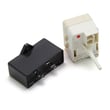
- If the refrigerator is not cooling and the compressor is struggling to start, a failed start device can be involved; see refrigerator overload release W10613606.
Last updated: January 2026