Owner’s manual
 Error Codes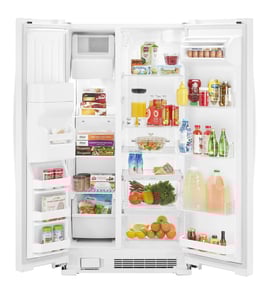



How to restart a GE side by side refrigerator?
To restart your GE GSS25GSHHCSS side-by-side refrigerator, restore power to the unit (unplug it or turn the breaker off, then back on). If you used the control panel to turn cooling off, set the temperature controls back to a colder setting to resume cooling; the touch panel does not remove electrical power.
Quick restart options (safest first)
- Power reset: unplug the refrigerator for about 5 minutes, then plug it back in.
- Breaker reset: switch the refrigerator circuit breaker OFF, wait about 5 minutes, then switch it ON.
- Control panel restart (cooling was turned off): adjust the temperature controls from OFF to a colder setting.
- After restart: allow 24 hours for temperatures to stabilize (factory presets are 37°F fresh food and 0°F freezer).
What to expect after you restart
Some sounds and delays are normal right after power is restored.
| What you notice | What it usually means | What to do |
|---|---|---|
| Clicking or chirping | Compressor attempting to restart | Wait up to 5 minutes |
| Fans running with door open | Fans may run to cool light bulbs | Close doors fully |
| No cooling right away | Unit may be in defrost cycle | Wait about 30 minutes |
If it still will not run or cool
Work through these checks in order:
- Confirm the outlet has power (try a small lamp) and the plug is fully seated.
- Make sure both temperature controls are not set to OFF.
- Check for a tripped breaker or blown fuse and reset/replace as needed.
- If the refrigerator was recently moved, verify doors close completely and nothing is holding them open.
- Review the troubleshooting section in the owner's manual for model-specific steps.
Why it matters
A restart clears minor control glitches and restores normal compressor and fan operation. Setting controls to OFF stops cooling, but it does not disconnect electrical power, so using a power reset is the most complete “restart.”
Last updated: February 2026
Is GE Café considered high end?
Yes. GE Café is considered a premium, high-end line within the GE family, positioned above standard GE models and typically below GE Monogram. You get upscale styling and features, plus stronger warranty coverage on certain components (varies by model); see your owner's manual for details.
How GE Café compares to other GE lines
In practical terms, GE Café is a step up in design and feature set, while Monogram is GE’s luxury tier with more built-in, designer-focused options.
| GE line | Typical positioning | What you usually get |
|---|---|---|
| GE (standard) | Mainstream | Core features, value-focused |
| GE Profile | Premium | More advanced features and controls |
| GE Café | Premium-high end | Pro-style design, upgraded finishes, feature-rich |
| GE Monogram | Luxury | Built-in designs, luxury materials, designer integration |
What “high end” means for a refrigerator purchase
When customers call a refrigerator “high end,” they usually mean a mix of performance, design, and ownership experience. For GE Café models, that often includes:
- Premium exterior styling and coordinated hardware
- Feature-forward controls and convenience options
- Higher-end interior layout and storage flexibility
- Stronger component coverage on some models (for example, sealed system coverage is commonly longer on premium lines)
- Higher typical price point than standard GE models
Why it matters
If you are deciding between GE Profile, GE Café, and Monogram, the “high end” label helps set expectations for price, finish quality, and long-term service approach. It also helps when you are choosing replacement parts for a specific model like GE GSS25GSHHCSS, since parts and features can vary by series.
Last updated: February 2026
What is the most common problem with a GE refrigerator?
The most common issue we see with GE refrigerators like model GSS25GSHHCSS is a cooling problem (fresh food or freezer not staying cold). Many “no cool” complaints trace back to airflow, frost buildup from a defrost issue, or a fan not moving cold air properly; use the owner's manual troubleshooting charts to narrow it down fast.
Quick checks before replacing parts
- Confirm the temperature controls are not set to OFF and the unit has power.
- Make sure doors fully close and nothing is holding them open.
- Allow 24 hours after first plug-in or after loading a lot of warm food.
- Listen for normal defrost-cycle sounds (sizzling, dripping, gurgling) so you do not chase a non-issue.
- Check for heavy frost on the freezer back wall (often points to a defrost problem).
Common symptoms and what they usually mean
| Symptom | Most common cause | What to do next |
|---|---|---|
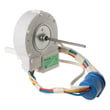
| Refrigerator not cooling well | Airflow restriction or evaporator fan issue | Check vents, then test the fan; consider refrigerator evaporator fan motor WR60X10307 if the fan is not running. |
| Frost buildup, warming temps | Defrost system problem | Inspect for frost pattern; defrost heater/thermostat are common suspects. |
| Strange noises | Often normal operation | Compare to the normal sound descriptions in the manual. |
| No water or slow water | Clogged filter or air in line | Replace the filter and purge air at the dispenser. |
Parts that commonly relate to “no cool” or poor cooling
If your checks point to a component failure, these are frequent fixes on side-by-side refrigerators:
- Refrigerator evaporator fan motor WR60X10307 (moves cold air through the compartments)
- Refrigerator defrost heater WR51X10055 (melts frost off the evaporator)
- Refrigerator defrost bi-metal thermostat WR50X10065 (helps control defrost heating)
- GE profile refrigerator temperature sensor WR55X10025 (feeds temperature info to the control)
Why it matters
Cooling problems can quickly lead to food spoilage and can also cause secondary issues like long run times, excess frost, and water leaks from a clogged or frozen drain. Catching the root cause early prevents repeat failures.
Last updated: February 2026