Installation guide
 Owner’s manual



What does DCVH515GF0WW stand for?
DCVH515GF0WW is the GE model number that identifies your specific gas dryer and its exact configuration. We use this model number to match the correct parts, wiring, and service information for your dryer; it is not a “code” you need to decode to operate it.
What the model number tells us (and what it does not)
The most important thing is that DCVH515GF0WW uniquely identifies your dryer for parts lookup and troubleshooting. GE model numbers can include internal identifiers for series and finish, but you do not need to interpret each character to order parts.
- Confirms the exact GE dryer platform and feature set
- Helps match the correct control panel layout and cycle options
- Ensures parts compatibility (belt, igniter, door switch, etc.)
- Helps locate the right safety and venting instructions
- Prevents ordering “close but not correct” parts
Where to find the model number on the dryer
On GE DCVH515-series dryers, the model and serial label is located on the front of the dryer behind the door (inside the door opening). See the DCVH515GF0WW owner’s manual for the exact label location and illustrations.
Common examples of parts that depend on the exact model
If you are ordering parts, the full model number matters because similar-looking GE dryers can use different components.
| What you are fixing | Example part for DCVH515GF0WW | What it affects |
|---|---|---|
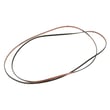
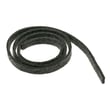
| Drum not turning | Drive belt WE03X29897 | Drum rotation, tumbling |
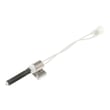
| No heat or ignition issues | Igniter WE04X25996 | Burner ignition on a gas dryer |
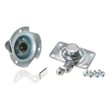
| Dryer will not start when door closes | Door switch WE4M415 | Start enable, door safety |
Why it matters
Using DCVH515GF0WW (not a partial number) is the fastest way to get the right GE gas dryer parts and the correct installation and venting guidance, which directly impacts drying performance and safety.
Last updated: January 2026
What is the most common problem with a GE dryer?
For the GE DCVH515GF0WW gas dryer, the most common issues we see are no heat or long dry times caused by restricted venting or airflow, and a drum that will not turn due to a worn belt or pulley. Many “won’t start” complaints also trace back to power, control lock, or a door switch.
Most common symptoms and what they usually mean
- Dryer runs but no heat: airflow restriction, ignition/heating circuit issue, or gas ignition components.
- Dryer takes too long to dry: lint filter full, crushed/kinked duct, or clogged venting.
- Drum won’t turn (motor runs or hums): worn belt, idler pulley, or drum support wear.
- Dryer won’t start: control panel asleep, control lock on, tripped breaker, or door switch problem.
- Overheating or shutting off: blocked venting or lint buildup inside the dryer and duct.
Quick checks we recommend first (fast, high-impact)
- Clean the lint filter before every load.
- Confirm power: the dryer should wake when you press POWER; reset the house breaker if needed.
- Check control lock/service mode: unlock controls if they are not responding.
- Inspect venting: use the shortest run possible, avoid kinks/crushing, and keep the vent protector positioned correctly.
- If the drum does not turn, inspect common wear parts like the Drive belt WE03X29897 and Idler pulley WE12X83.
Common problems vs likely parts (at-a-glance)
| Symptom | Most likely cause | Example part for DCVH515GF0WW |
|---|---|---|
| Drum not turning | Belt or idler pulley worn | Drive belt WE03X29897, idler pulley WE12X83 |
| Won’t start | Door not sensed closed | Door switch WE4M415 |
| No heat (gas) | Ignition system issue | Igniter WE04X25996 |
| Long dry times | Vent restriction or lint buildup | Venting and duct cleaning (maintenance) |
Why it matters
Airflow problems are a leading root cause because they can create long dry times, poor heating performance, and overheating. The manual also recommends having the interior and exhaust duct connection cleaned at least once a year by a qualified technician.
Where to confirm model-specific steps
Use the DCVH515GF0WW owner’s manual for control lock instructions, troubleshooting charts, and venting guidance specific to your dryer.
Last updated: January 2026
Is a 7.4 cu ft dryer big?
Yes. A 7.4 cu. ft. dryer is a large-capacity size, so it handles bigger mixed loads and bulky items (comforters, blankets) with fewer cycles. For the GE gas dryer model DCVH515GF0WW, the rated capacity is 7.0 cu. ft., which is also considered large; confirm specs in the DCVH515GF0WW owner’s manual.
Capacity quick guide
Most full-size dryers fit into these common ranges.
- 5.0 to 6.9 cu. ft.: standard capacity
- 7.0 to 7.4 cu. ft.: large capacity
- 7.5 to 9.0+ cu. ft.: extra-large capacity
| Capacity range | Common label | Best for |
|---|---|---|
| 5.0 to 6.9 cu. ft. | Standard | Everyday loads, smaller households |
| 7.0 to 7.4 cu. ft. | Large | Towels, mixed loads, bulky items |
| 7.5 to 9.0+ cu. ft. | Extra-large | King bedding, fewer loads overall |
What “big” means in real use
A larger drum gives laundry more room to tumble, which improves drying and helps reduce wrinkles when you avoid packing the drum tight.
- Fewer loads per week for families
- More room for bulky items without compressing them
- Better tumbling action for more even drying
- More consistent sensor-dry performance when airflow is strong
Airflow still matters with large loads
Large capacity only performs like large capacity when the dryer can move air. Use 4-inch metal ducting, keep the run short, and avoid kinks or crushed sections; follow the venting requirements in the DCVH515GF0WW installation guide.
Why it matters
Capacity is about space, but drying performance depends on tumbling room plus strong exhaust airflow; overfilling or poor venting causes longer cycles and higher energy use.
Last updated: January 2026