 Owner’s manual
 Error Codes


How do I tell if my dryer heating element is bad?
If your Kenmore electric dryer model 11068942892 runs but you do not feel heat inside the drum on a heated cycle, the heating element is a top suspect. The most reliable confirmation is a continuity (ohms) test with a multimeter after safely disconnecting power.
Quick symptoms to look for
- Dryer tumbles normally but clothes stay damp or take much longer to dry
- No heat on any heated cycle (not just one setting)
- You do not feel warm air at the exhaust during a heat cycle
- You see a broken coil or burn mark on the element (if accessible)
- A heat cycle starts, then quickly turns cool (can also point to a fuse or thermostat)
Simple heat check (matches the manual)
Our manual’s installation review suggests running a full heat cycle (not Air Dry) and checking for heat after about 5 minutes. If you do not feel heat when you open the door, move on to electrical checks. See the 11068942892 owner's manual.
Multimeter test (best confirmation)
- Unplug the dryer (or switch off the breaker) before opening any panels.
- Access the heater housing and disconnect the element wires.
- Set the meter to ohms (Ω) and test across the element terminals.
- A good element typically shows continuity (often in the rough range of 10 to 50 Ω).
- If the meter reads open/infinite resistance, the element is bad.
What else can mimic a bad element?
A no-heat complaint is often caused by airflow or safety devices, not only the element:
| Symptom | Common cause | What to check next |
|---|---|---|
| No heat at all | Thermal fuse blown | Test dryer thermal fuse WP3390719 and clear vent restriction |
| Heat cuts in and out | High-limit thermostat opening | Test dryer high-limit thermostat WP3390291 and inspect airflow |
| Long dry times but some heat | Restricted venting or lint buildup | Check vent for crushing/kinks; clean lint path |
Why it matters
A failed heating element stops proper drying, but a blocked vent can also overheat the dryer and repeatedly blow a thermal fuse or trip the high-limit thermostat. The manual specifically calls out making sure the vent is not crushed or kinked. See the 11068942892 owner's manual.
Last updated: February 2026
Is it worth replacing the heating element in a dryer?
Yes, it’s usually worth replacing the heating element in your Kenmore 11068942892 electric dryer when the dryer runs but won’t heat; the repair cost is typically far less than replacing the dryer, and a new element often restores normal drying performance.
When replacing the heating element makes sense
We recommend replacing the heating element when these conditions fit your situation:
- The drum tumbles normally but clothes stay cold or take a very long time to dry
- You have proper airflow (strong exhaust at the outside hood) and a clean lint screen
- Power is correct (an electric dryer can run with one leg of power but not heat if a breaker trips)
- The dryer is otherwise in good shape (no major drum, motor, or control problems)
- You want a cost-effective fix instead of replacing the appliance
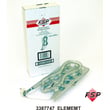
A common replacement for this model is the dryer heating element WP3387747.
Check these first (they can mimic a bad element)
Before you buy parts, we use these quick checks because they are frequent causes of “no heat”:
- Cycle setting: Make sure you are not on AIR DRY/AIR FLUFF
- Airflow: Run the dryer 5 to 10 minutes and check for strong air at the outside vent hood
- Vent material: Use heavy metal or flexible metal venting (crushed or kinked venting kills heat)
- Power supply: Reset both sides of the breaker (electric dryers need full 240V to heat)
- Overheat protection: A blown thermal fuse or cut-off can stop heat and must be addressed with the venting issue
For model-specific operating and troubleshooting guidance, use the owner's manual.
Parts that are commonly replaced with (or instead of) the element
If the element failed due to overheating or restricted airflow, we often see these parts involved:
| Symptom | Common related part | Example part for this model |
|---|---|---|
| Runs but no heat | Thermal fuse | Dryer thermal fuse WP3390719 |
| Overheats, then stops heating | High-limit thermostat | Dryer high-limit thermostat WP3390291 |
| Heat is weak or cycles oddly | Thermistor | Thermistor WP8577274 |
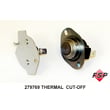
| Repeated no-heat events | Thermal cut-off kit | Cut-off kit 279769 |
Why it matters
Replacing only the heating element without fixing airflow problems can cause repeat failures. The manual’s troubleshooting guidance emphasizes checking the lint screen and exhaust airflow first because restricted venting is a top cause of poor drying and overheating.
Last updated: February 2026
What size belt does a Kenmore dryer take?
For Kenmore electric dryer model 11068942892, the correct drum belt size depends on the exact drive system used on this model. The most reliable way to match the belt is to use the parts breakdown and belt routing shown in the 11068942892 owner's manual so the belt length and rib profile match your drum and motor pulley.
How to identify the right belt for your dryer
We recommend confirming these details before ordering:
- Use the model number 11068942892 (not just “Kenmore 110 series”) when selecting parts.
- Check whether your belt is ribbed (multi-rib) or flat.
- Compare the old belt’s width (most are about 1/4 inch) and rib count.
- Look for belt wear signs: glazing, cracks, missing ribs, or stretched length.
- If the belt broke, inspect the idler pulley and drum rollers for drag or wobble.
Common belt sizes you may see (and why they vary)
Many Kenmore and Whirlpool-built 27-inch electric dryers commonly use a multi-rib belt around the low-90 inch range, but there are multiple lengths used across similar-looking models.
| What you’re measuring | Typical range you’ll see | Why it matters |
|---|---|---|
| Belt length | ~89 to ~94 inches | Wrong length can slip or over-tension the motor/idler |
| Belt width | ~1/4 inch | Must fit the motor pulley and idler correctly |
| Rib profile | 3 to 5 ribs (varies) | Must match pulley grooves to track straight |
Related parts to check while you’re in there
A new belt can fail early if a support part is worn. These are common wear items for this model family:
- Drum support rollers and shafts: support kit WPW10314173
- Idler pulley (keeps belt tension): dryer idler pulley 279640
- Blower wheel (airflow and noise issues): dryer blower wheel WP697772
Why it matters
Using the correct belt size and profile keeps the drum turning at the right speed, prevents squealing and burning-rubber smells, and reduces strain on the drive motor and idler pulley.
Last updated: February 2026
What is the error code SRU?
SRU is not a standard diagnostic error code for the Kenmore 11068942892 electric dryer. When you see “SRU” on or near the controls, it is typically a misread of the cycle/option labeling or a display/console issue rather than a true fault code; use the 11068942892 owner's manual to confirm what your panel indicators mean.
What to check first
- Unplug the dryer for 2 minutes, then restore power to reset the control.
- Confirm the cycle knob is aligned with a labeled cycle, not between positions.
- Check for stuck keys (if your model has push buttons) and wipe the console dry.
- Verify the dryer is on a dedicated 30-amp circuit and the plug is fully seated.
- If the dryer is not heating or stops mid-cycle, inspect airflow and lint buildup.
If “SRU” appears with heating or shutdown symptoms
Restricted airflow and overheating can trigger safety devices that stop heat or shut the dryer down. For this model, common heat-related parts to check include the dryer thermal fuse WP3390719 and the dryer high-limit thermostat WP3390291.
Quick symptom guide
| What you notice | Most likely area | What we recommend |
|---|---|---|
| Runs but no heat | Heating circuit | Check heating element, thermostats, thermal fuse |
| Stops during cycle | Overheating/airflow | Clean venting, check thermal fuse and blower wheel |
| Display/labels seem “wrong” | Console/knob position | Reset power, re-check knob alignment |
Why it matters
Treating “SRU” like a real error code can send you to the wrong repair. Verifying the control labeling and then troubleshooting the actual symptom (no heat, stopping, not starting) saves time and helps prevent repeat overheating issues.
Last updated: February 2026





