Owner’s manual
 View engine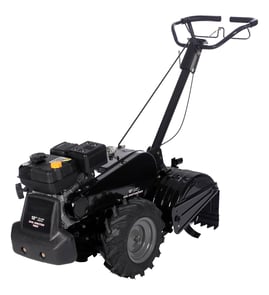



Where is the model number on a Craftsman rear tine tiller?
On the Craftsman rear-tine tiller model 917299063, the model number is printed on the product identification label (a decal-style tag). It’s commonly placed on the tine shield/guard area or near the engine and fuel tank so it’s easy to read during service and parts lookup.
- On the tine shield (the guard over the tines)
- On the main frame near the engine mounting area
- Near the fuel tank (often on or close to the tank decal area)
- On the handle support or control panel area
- On the transmission/gear case area (frame side)
- Park the tiller on a flat surface and let the engine cool.
- Stand on the operator side (behind the handles).
- Look down toward the tine shield and the left and right frame rails.
- Wipe dirt off decals with a damp rag so the numbers are readable.
- Match the model format; for this unit it appears as 917.299063 or 917299063.
Most Craftsman tillers use a printed label or decal with the model number and sometimes a serial number.
| What you see on the label | What it means | What to use for parts |
|---|---|---|
| 917.299063 | Model number with a dot | Use 917299063 (dot or no dot both work) |
| Serial number | Unique ID for your unit | Not usually needed for most parts |
We use the exact model number to match the correct diagrams and parts for your tiller’s handle controls, tine assembly, belts, and drive components. Even small model-number differences can change the drive belt, clutch cable, or tine hardware.
For model-specific label locations and diagrams, use the 917299063 owner's manual.
Last updated: January 2026
How often should I change the oil in my tiller?
For the Craftsman rear-tine tiller model 917299063, we change the engine oil every 25 hours of operation or at least once a year (whichever comes first). We also check the oil level before starting and after each 5 hours of continuous use; see the 917299063 owner's manual.
- Before each use: check engine oil level
- During long jobs: recheck oil after 5 hours of continuous use
- Oil change interval: every 25 hours of operation
- Seasonal minimum: once per year even if you do not reach 25 hours
- Heavy load or high heat: change oil more often
- Dirty or dusty conditions: service maintenance items more often (including air cleaner)
| Item | What to do | When |
|---|---|---|
| Engine oil level | Check and top off as needed | Before starting; after 5 hours continuous use |
| Engine oil | Drain and refill | Every 25 hours or yearly |
| Air cleaner cartridge | Clean or replace | Every 25 hours; more often in dust |
| Spark plug | Replace | At least once a year |
Fresh oil protects the engine under load and heat, and regular level checks help prevent low-oil operation (a common cause of hard starting, rough running, and shortened engine life).
- Warm the engine briefly so oil drains faster (use caution around hot parts).
- Keep the tiller on a level surface when checking and refilling.
- Use a funnel and a catch pan to control spills.
- Tighten the oil fill plug securely after each check.
- If you use multi-viscosity oil (like 10W-30) in warmer weather, check the level more often because oil consumption can increase.
Last updated: January 2026
What tiller is made in the USA?
Most tillers sold today are built with globally sourced parts, and the country of manufacture varies by brand and even by model year. For your Craftsman rear-tine tiller model 917299063, the best way to confirm origin is to check the ID plate and the documentation in the Craftsman 917299063 owner's manual.
Look for these identifiers on the tiller itself (not just the box):
- Product ID plate or decal on the frame, usually near the engine or handle mount
- Country of origin statement (often “Made in …” or “Assembled in …”)
- Engine label (the engine may be made in a different country than the tiller frame)
- Model and serial number; use these to match the correct documentation
- Parts list language; it helps confirm you are looking at the right configuration
This Craftsman rear-tine tiller has model-specific operating and maintenance information in the owner’s manual, including safety rules, assembly guidance, and product specifications such as fuel capacity, oil type/viscosity, and spark plug details. That documentation is the most reliable place to cross-check the exact unit you own.
| Item | Specification |
|---|---|
| Gasoline capacity | 3 quarts (2.8 L) |
| Engine oil type | SAE 30 above 32°F (0°C); SAE 5W-30 below 32°F (0°C) |
| Oil capacity | 20 oz (0.6 L) |
| Spark plug | Champion RC12YC (gap 0.030 in / 0.76 mm) |
Country of manufacture can affect parts sourcing, labeling, and documentation details. When you match your model and serial information to the manual, you also avoid ordering the wrong wear items (like belts, tines, and shear pins) during maintenance.
Last updated: January 2026
What are common tiller problems?
Common problems on the Craftsman 917299063 rear-tine tiller include hard starting or rough running, overheating, excessive bouncing in hard soil, soil clumping when it’s too wet, and drive or tine issues such as “engine runs but tiller won’t move” or “tines skip over ground.” For model-specific operating and maintenance checks, use the Craftsman 917299063 owner’s manual.
- Engine overheats: low or dirty oil, dirty air screen, dirty engine, partially plugged muffler
- Excessive bounce or difficult handling: soil too dry and hard (moisten soil before tilling)
- Soil balls up or clumps: soil too wet (wait until it dries out)
- Engine runs but tiller won’t move: tine control not engaged, V-belt out of adjustment, belt off pulleys
- Engine runs but labors when tilling: tilling too deep, throttle not set correctly, carburetor needs adjustment
- Tines skip over ground: shear pin(s) broken
- Confirm the controls are set correctly
- Release the drive control bar before shifting gears.
- Make sure the shift lever is in the intended position (not between positions).
- Check basic maintenance items
- Verify engine oil level before each use.
- Clean or replace the air cleaner cartridge on schedule.
- Replace the spark plug at least once a year.
- Inspect the drive system
- Look for a loose, worn, or off-track belt.
- Check for broken shear pins if the tines are not biting.
| Symptom | Likely area | Example part for this model |
|---|---|---|
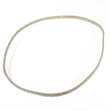
| Engine runs but unit won’t move | Belt drive | Husqvarna rear-tine tiller drive belt 591372401 |
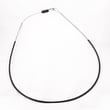
| Tines do not engage consistently | Clutch linkage | Tiller clutch cable 532110675 |
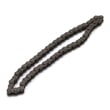
| Jerky drive or noise from drivetrain | Chain drive | Tiller chain, #25-50 532102134 |
Most “tiller problems” come down to three things: engine maintenance (oil, air, spark), soil conditions (too dry or too wet), and drive engagement (belt, cable, shear pins). Fixing the root cause prevents repeated stalling, poor tilling depth (typically 4 to 6 inches), and premature belt or drivetrain wear.
Last updated: January 2026