Installation guide
 Owner’s manual
 Error Codes




How to read Kenmore refrigerator model number?
For Kenmore model 2537034241G, the model number is printed on the serial plate inside the refrigerator compartment. We recommend copying the full model number and serial number exactly as shown before ordering parts or using troubleshooting steps in the 2537034241G use & care guide.
Most Kenmore bottom-mount units like 2537034241G place the serial plate in one of these common spots:
- Inside the fresh food (refrigerator) compartment on a side wall
- On the ceiling or upper side wall inside the refrigerator compartment
- Near the crisper drawer area (often on an interior wall)
- Sometimes behind the toe grille or kick plate area (varies by design)
Write the information exactly as it appears on the plate:
- Model number: includes the full number and any suffix characters
- Serial number: used to identify production range and revisions
- Purchase date (if listed or known): helpful for service records
| What you see | What it means | Why we need it |
|---|---|---|
| 2537034241G | Model number | Matches the correct parts diagrams and parts list |
| Serial number | Unit-specific ID | Helps confirm the correct version of a part |
Kenmore refrigerators often share similar-looking doors, gaskets, controls, and ice maker parts across multiple models. Using the exact model number helps prevent ordering a part that fits a different 253-series variation.
Last updated: January 2026
Why is my Kenmore Elite freezer frosting up?
Freezer frost in a Kenmore bottom-mount refrigerator like model 2537034241G is usually caused by warm, moist air leaking past the door seal or by airflow and drainage issues that let moisture linger and freeze. Start by checking door closing, gasket condition, and freezer loading, then move to defrost and fan checks using the 2537034241G owner's manual.
- Door not sealing tightly: look for gaps, tears, or a gasket that is stiff or warped.
- Door not closing fully: bins or packages can keep the drawer from sealing.
- Frequent openings: heavy traffic and long door-open time adds humidity that turns into frost.
- Overpacked freezer: poor air circulation can create cold spots where moisture freezes.
- Defrost system issue: frost builds quickly and returns soon after you clear it.
- Inspect the gasket for rips, hardened sections, or areas pulling away from the liner.
- Do the paper test: close the door on a sheet of paper; it should drag firmly when pulled.
- Check for obstructions: make sure baskets and food packages are not pushing the door open.
- Confirm airflow: leave space between packages so cold air can circulate.
- Listen for the evaporator fan: a failed fan can contribute to uneven cooling and frost patterns.
| Frost pattern | Most likely issue | What to do next |
|---|---|---|
| Frost mainly near the door edge | Air leak at gasket or door alignment | Clean/reshape gasket; verify door closes square |
| Heavy frost on back wall/evaporator area | Defrost system problem | Follow defrost troubleshooting in the manual |
| Frost plus warm freezer temps | Airflow or fan problem | Check fan operation and vents |
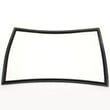
If your inspection shows a sealing problem, replacing the gasket is often the fix. For this model, a common option is the refrigerator freezer door gasket 5304537408.
Frost buildup reduces airflow, forces longer run times, and can lead to temperature swings that affect food quality. Fixing the root cause (seal, airflow, or defrost) restores stable 0°F operation and helps the refrigerator run efficiently.
Last updated: January 2026
What does DH mean on Kenmore Elite refrigerator?
On Kenmore model 2537034241G, DH typically indicates a defrost heater (defrost heat) issue, meaning the refrigerator is not heating the evaporator enough during the defrost cycle. This can lead to frost buildup, warm temperatures, and reduced airflow; use the 2537034241G owner's manual to confirm the display and alarm behavior for your exact control panel.
- Power reset: unplug the refrigerator (or switch off the breaker) for 5 minutes, then restore power.
- Listen for airflow: weak or no airflow from vents often points to frost buildup behind the freezer panel.
- Check door sealing: a leaking gasket can drive excess frost and trigger defrost-related symptoms.
- Confirm temperatures: set refrigerator to about 37°F and freezer to about 0°F, then allow 24 hours to stabilize.
- Look for heavy frost on the freezer back wall: this strongly suggests a defrost system problem.
In this Kenmore bottom-mount refrigerator design, DH-related symptoms usually trace back to one of these:
- Defrost heater not heating
- Defrost thermostat (bi-metal) not closing when cold
- Temperature sensor reporting incorrect readings
- Electronic control not sending power to the heater
If you find heavy frost and poor airflow, the defrost thermostat is a common suspect; the refrigerator defrost bi-metal thermostat 5304521781 is one of the defrost components used on this model.
| What you notice | What it usually means | What to do next |
|---|---|---|
| Freezer cold but fridge warm | Frost blocking airflow | Inspect for frost behind freezer panel; check defrost parts |
| Heavy frost on freezer back wall | Defrost system not working | Test defrost thermostat and heater circuit |
| Intermittent warming, then normal | Defrost not completing consistently | Check sensor connections and control behavior |
| Door edges sweating or frost near gasket | Air leak at door | Inspect/clean gasket sealing surfaces |
When the defrost system cannot melt frost off the evaporator, airflow drops and temperatures drift. That can cause food spoilage risk, longer run times, and extra strain on the compressor.
Last updated: January 2026
What is the cubic foot of my Kenmore refrigerator model 2537034241G?
The exact cubic-foot capacity for Kenmore model 2537034241G is listed on the model and serial tag and in the specifications information for this 253.7034* French door bottom-freezer platform. Use the 2537034241G use & care guide to locate the rating for your specific version.
- Check the model and serial label inside the fresh food compartment (commonly on a side wall); look for “Total capacity” or “cu. ft.”
- Review the specifications section in the 2537034241G use & care guide
- Look for a tech sheet stored behind the toe grille or on the rear access area; it often lists total and compartment volumes
- Use the full model number exactly as printed, including any color code or suffix
Most Kenmore French door bottom-freezer refrigerators in the 253.7034* family land in a narrow range.
| Refrigerator type | Typical total capacity range | Notes |
|---|---|---|
| French door bottom freezer (253.7034* family) | 22 to 24 cu. ft. | Options like an ice maker and bin layout change usable space more than the published total |
- Small design revisions within the 253.7034* platform can change the published capacity slightly
- Ice maker and air channels can reduce usable storage even when total cu. ft. stays similar
- Shelf and bin configurations vary by feature package
Knowing the exact cubic feet helps when you are comparing replacement refrigerators, planning kitchen fit, and choosing storage accessories. It also helps when ordering model-specific parts such as the refrigerator air filter EAFCBF.
Last updated: January 2026