Installation guide
 Owner’s manual
 Error Codes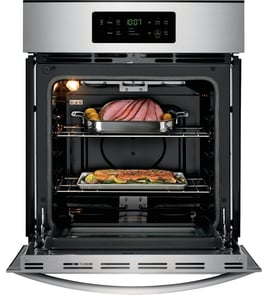



How to find wall oven model number?
For Kenmore wall oven model 79047879403, the model and serial number are printed on the serial plate located along the interior side trim of the lower oven, visible when you open the oven door. Use that exact model number when ordering parts or scheduling service; it prevents mismatches.
- Open the lower oven door and look along the interior side trim for the serial plate.
- Wipe the trim with a damp cloth; grease can hide the print.
- Use a flashlight and look from an angle; the plate can be reflective.
- Write down model number, serial number, and any lot number/letter shown.
These checks help when the label is hard to spot or partially covered:
- Check both the left and right interior side trim areas.
- Look for a metal plate or a durable label, not a paper sticker.
- If the oven was recently installed, confirm the trim pieces are fully seated and not covering the plate.
| Item to record | Example format | Why it matters |
|---|---|---|
| Model number | 79047879403 | Ensures parts fit your exact Kenmore wall oven |
| Serial number | Letters and numbers | Helps identify production run details |
| Lot number/letter | Letter or short code | Often requested when troubleshooting or ordering |
Kenmore wall ovens can look similar across multiple 790-series models, but parts like the control panel, temperature sensor, and bake element can vary by revision. Using the serial plate information helps us match the correct replacement part the first time.
For additional details on the serial plate location and product record, use the 79047879403 owner's manual.
Last updated: January 2026
What is the disadvantage of a wall oven?
For the Kenmore wall oven model 79047879403, the biggest disadvantages are higher total cost (appliance plus cabinet and electrical work), more complicated installation and service access, and less flexibility if you ever remodel. Wall ovens also require safe mounting and ventilation planning.
- Higher overall cost: You often pay for the wall oven plus a separate cooktop, plus cabinetry modifications.
- More complex installation: Proper grounding, correct wiring method, and anti-tip mounting are required for safe operation.
- Harder to move or replace: Built-in appliances are more labor-intensive to remove and reinstall.
- Service access can be tighter: Repairs may require pulling the oven from the cabinet.
- Layout limitations: Some installations are not allowed; for example, these ovens are not approved for stackable or side-by-side installation.
The installation requirements are a real downside for some kitchens because they add labor and planning. For this Kenmore wall oven, key requirements include proper grounding, shutting off power during line connections, and securing the oven with mounting brackets to reduce tip risk.
Use these references when planning or comparing options:
| Feature | Wall oven | Range (oven + cooktop) |
|---|---|---|
| Upfront cost | Typically higher | Typically lower |
| Installation | More complex (built-in) | Usually simpler |
| Remodel flexibility | Lower | Higher |
| Ergonomics | Can be installed higher | Fixed height |
A wall oven can be a great upgrade for cooking comfort and kitchen design, but the built-in installation requirements (cabinet fit, electrical connection, anti-tip mounting, and ventilation clearance) are the main reasons it costs more and is less flexible than a standard range.
Last updated: January 2026
Are all 30 inch wall ovens the same size?
No. “30-inch” is a category, not an exact measurement; 30-inch wall ovens can vary in overall width, height, and depth, and the cabinet cutout requirements can differ by brand and model. For the Kenmore 79047879403, use the cutout and product dimensions in the 79047879403 installation guide to confirm fit before ordering or installing.
Most 30-inch single wall ovens are designed for a cabinet opening around 30 inches wide, but the actual oven chassis and trim can be slightly under or over that nominal size.
Common differences between 30-inch models include:
- Trim width and overlap (how much the front trim covers the cabinet opening)
- Cutout height (varies by single vs. double oven)
- Cutout depth (critical for the trim to sit flush)
- Door swing clearance (space needed in front when the door is open)
- Electrical junction box location and wiring access
The installation instructions for this model family call out key requirements that affect whether a “30-inch” oven will fit your cabinet:
- Allow at least 21 inches of clearance in front for door depth when open
- The cutout depth is critical so the decorative trim sits against the cabinet
- The cabinet base must support up to 375 lb for 30-inch models
| What to measure | Where | Why it matters |
|---|---|---|
| Cutout width | Inside cabinet opening | Prevents side binding and trim gaps |
| Cutout height | Inside cabinet opening | Ensures the oven slides in without forcing |
| Cutout depth | Front of cabinet to back wall | Helps the trim sit flush and reduces vibration/noise |
| Front clearance | Floor space in front of oven | Prevents door interference and improves safety |
If you assume all 30-inch wall ovens are identical, you can end up with trim gaps, a unit that will not slide fully into the cutout, or an installation that stresses the cabinet and wiring. Matching the cutout dimensions to the Kenmore 79047879403 specs prevents rework and protects the oven’s cooling airflow.
Last updated: January 2026
What is the best brand for electric wall ovens?
There is no single “best” brand for every kitchen, but for an electric wall oven like Kenmore model 79047879403, the best choice is the brand that matches your cutout size, electrical supply (120/240 or 120/208V), and the features you will actually use. We recommend comparing reliability, service support, and fit before you buy. See the 79047879403 owner's manual for the feature set and operating basics, and the 79047879403 installation guide for electrical and cabinet requirements.
When customers ask us this, we focus on practical ownership factors more than the logo on the door:
- Fit and compatibility: cabinet cutout dimensions and whether your kitchen is set up for a single or double oven
- Electrical requirements: correct voltage and a dedicated, properly protected circuit
- Serviceability: parts availability (heating elements, temperature sensor, control panel) and technician familiarity
- Cooking performance: even baking, broil power, convection options, and temperature accuracy
- Controls and features: simple keypad vs. advanced modes, timers, self-clean vs. manual clean
| What to compare | Why it matters | What to look for |
|---|---|---|
| Cutout and trim fit | Prevents gaps and rework | Cutout specs that match your cabinet opening |
| Electrical supply | Avoids breaker trips and wiring changes | 120/240 or 120/208V, dedicated circuit |
| Heating system | Impacts preheat and browning | Strong bake and broil elements |
| Temperature control | Impacts baking results | Stable temps, easy calibration |
| Parts and support | Lowers long-term cost | Common parts readily available |
Wall ovens are not “universal fit” appliances. Your installation requirements drive the brand and model you can use without modifying cabinetry or electrical. For example, the installation guidance for this Kenmore wall oven family calls for a properly grounded, dedicated circuit and notes that these ovens are not approved for stackable or side-by-side installation.
Use this short plan to avoid surprises:
- Confirm whether you have a single or double wall oven opening
- Verify your supply is 120/240V or 120/208V, 60 Hz and on a dedicated circuit
- Measure the cabinet cutout and compare to the new oven’s spec sheet
- Decide which features you will use weekly (convection, self-clean, probe, etc.)
- Budget for common wear items over time, such as the frigidaire range oven temperature sensor 316217002 or a bake element
Last updated: January 2026