Owner’s manual
 Error Codes


How to remove bottom plate on whirlpool refrigerator?
To remove the bottom plate (toe grille or toe kick) on your Whirlpool GX5SHDXVQ00 bottom-mount refrigerator, we typically pull the grille straight off the retaining clips after opening the doors. Unplugging the refrigerator first helps keep the job safe while you work near wiring and moving parts.
Before you start
- Unplug the refrigerator or switch off power at the breaker.
- Open both fresh food doors for clearance.
- If your model has a lower water filter cover in the grille area, open that cover first.
- Protect the floor with a towel or thin cardboard to prevent scratches.
- Use a flashlight to see the clip locations along the top edge of the grille.
How to remove the toe kick (bottom plate)
- Grip the toe grille at both ends.
- Pull straight outward with steady pressure to release the spring clips.
- If one side releases first, keep the grille level and work the other side free.
- Once the top clips release, lift or angle the grille slightly (as needed) to clear any bottom tabs.
If it will not pop off
- Check for hidden screws at the ends or underneath (some versions use screws instead of only clips).
- Warm the grille slightly with room-temperature air (cold plastic can feel extra stiff).
- Avoid prying hard with a metal tool; it can crack the grille or scratch the finish.
What you will see after removal (and why it matters)
Removing the bottom plate gives access for cleaning and basic checks. Keeping this area clear helps airflow and can reduce cooling issues.
| What you might access | Why it matters | What to do |
|---|---|---|
| Condenser area | Dust buildup can reduce cooling efficiency | Vacuum and brush gently |
| Drain pan area | Spills or overflow can cause odors | Wipe and dry |
| Leveling feet/rollers | Door alignment and sealing depend on leveling | Adjust if doors do not close well |
Related parts that are commonly involved
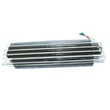
If you are removing the grille to troubleshoot cooling or airflow, these model-compatible parts are often checked during diagnosis:
For diagrams and model-specific component locations, use the owner's manual.
Last updated: February 2026
Can you lay a Whirlpool refrigerator down?
Yes. For your Whirlpool GX5SHDXVQ00 bottom-mount refrigerator, we recommend keeping it upright whenever possible; if you must lay it down for moving, place it on its side (not on the front or back) and let it stand upright for about 8 hours before plugging it back in.
Best practices for laying it down (moving or transport)
- Unplug the refrigerator and remove food, bins, and loose shelves.
- Tape doors shut and secure the power cord so it cannot snag.
- Lay the unit on its side; avoid laying it on the front or back.
- Protect the finish with moving blankets or cardboard.
- Keep it as level as possible during transport to reduce oil migration.
- After moving, set it upright and wait before restarting.
How long should you wait before turning it back on?
Waiting helps compressor oil drain back where it belongs so the sealed system can start and run normally.
| How it was transported | What we recommend before plugging in |
|---|---|
| Stayed upright the whole time | Plug in once it is in place and leveled |
| Laid on its side briefly | Wait about 8 hours upright |
| Laid on its side for an extended time | Wait at least 8 hours upright (longer is fine) |
Why it matters
If oil shifts into the refrigerant lines while the refrigerator is on its side, starting it too soon can cause noisy operation, poor cooling, or compressor stress. Giving it time upright protects the compressor and helps the refrigerator cool properly.
Related guidance
For model-specific moving, leveling, and start-up steps (including door handling and setup), follow the GX5SHDXVQ00 owner's manual.
Last updated: February 2026
Why is there ice on the bottom of my freezer side by side?
Ice on the freezer floor is almost always caused by a clogged or frozen defrost drain; defrost water cannot flow to the drain pan, so it refreezes and builds up as a sheet of ice. On Whirlpool GX5SHDXVQ00, clearing the drain path and confirming the defrost system is working fixes the root cause.
Quick checks and safe first steps
- Unplug the refrigerator before melting ice or accessing panels.
- Remove the freezer bin/basket and look for a solid ice layer on the floor.
- Melt the ice with a hair dryer on low or by placing towels and letting it thaw.
- Flush the drain with hot water (a turkey baster works well) until it flows freely.
- Clean the drain trough and check for food debris blocking the drain hole.
- Re-level the refrigerator so doors close fully and warm air does not add extra frost.
What usually causes the drain to clog
| Cause | What you notice | What to do |
|---|---|---|
| Ice plug in drain tube | Water backs up during defrost | Thaw and flush with hot water until clear |
| Debris in drain trough | Slow draining, recurring ice | Clean trough and drain opening |
| Weak/failed defrost system | Heavy frost on back wall plus ice on floor | Test defrost components and replace as needed |
| Door not sealing | Frost everywhere, moisture inside | Inspect and correct door seal issues |
Parts that can be involved (when it keeps coming back)
If the drain is clear but ice returns, a defrost problem can be driving excess frost and meltwater. Common parts to check on this model include:
- Refrigerator defrost heater WP67002493
- Refrigerator defrost bi-metal thermostat WPW10165425
- Refrigerator electronic control board WPW10503278
Why it matters
A blocked drain can lead to recurring ice sheets, poor airflow, warmer freezer temperatures, and water leaking onto the floor. Fixing the drain and any defrost or door-seal issue helps the refrigerator maintain stable temperatures and prevents repeat icing.
Model-specific help
Use the owner's manual for GX5SHDXVQ00 to locate the drain area and access panels safely for your exact configuration.
Last updated: February 2026
Why is the bottom part of my refrigerator not working?
If the bottom (freezer section) of your Whirlpool GX5SHDXVQ00 bottom-mount refrigerator isn’t working, the most common causes are restricted airflow from frost buildup, a failed evaporator fan, or a defrost system problem. Start with basic airflow and temperature checks, then inspect the fan and defrost components.
Quick checks we recommend first
- Confirm the freezer temperature is set near 0°F and the refrigerator section near 37°F.
- Make sure the freezer vents are not blocked by food packages or bins.
- Listen for the evaporator fan running when the doors are closed (you may hear a steady fan sound).
- Check for heavy frost on the back wall inside the freezer (a strong sign of a defrost issue).
- Verify the doors seal tightly; warm air leaks can cause frost and poor cooling.
Most likely causes (and what to look for)
Airflow problem (frost or blockage)
If the evaporator area is packed with frost, cold air cannot circulate, so the bottom section warms up.
Evaporator fan not running
A failed fan motor can stop cold air movement through the freezer and up to the fresh food section. If you suspect the fan motor, the model-compatible part is the refrigerator evaporator fan motor WPW10128551.
Defrost system failure
If you see a solid frost sheet on the freezer back panel, the defrost heater or defrost thermostat is often involved. For this model, common related parts include the refrigerator defrost heater WP67002493 and the refrigerator defrost bi-metal thermostat WPW10165425.
Symptom-to-cause guide
| What you notice | Most common cause | What to check next |
|---|---|---|
| Freezer warm, little or no fan sound | Evaporator fan issue | Fan blade obstruction, fan motor |
| Heavy frost on freezer back wall | Defrost problem | Defrost heater, defrost thermostat |
| Freezer OK but cooling uneven | Airflow blockage | Vents, overpacked drawers, frost |
| Both sections warming | Sealed system or control issue | Condenser cleanliness, controls |
Why it matters
The freezer (bottom section) is the source of cold air for the entire refrigerator. When airflow stops or frost builds up, temperatures rise quickly and food safety becomes a concern.
Helpful references
- Use the owner's manual for temperature settings, airflow locations, and access guidance.
- For display or diagnostic codes, follow Whirlpool refrigerator error codes.
Last updated: February 2026